

Plastics and POPs
This is an edited version of Sally’s much longer and more detailed piece, which we will be happy to forward to any interested reader.
My mum ran a grocery store – Home Farm Stores – in the 1950s. I used to help out, filling shelves, serving sweets and delivering grocery orders in small boxes on the grocery bicycle. Loose biscuits from reusable tins, sweets from reusable bottles and dried fruit from paper sacs were weighed into paper bags. The “cold” food such as cheese and sausages was stored on glass trays, cut to the required weight then wrapped in greaseproof paper.
In 1941 Pelican Books had published a book called Plastics, written by V E Yarsley and E G Couzens. It cost 9d, and was full of excitement about this new discovery. Plastic, it said, ‘would create a world brighter and clearer than any previously known … a world free from moth and rust and full of colour.’
All this came back to me when I attended a recent seminar held at The Royal Society of Chemistry on Plastic Debris in the Oceans. Despite the undoubted brightness and clarity, the use of plastics had thrown up problems undreamed of in 1941.
Professor Norman Billingham from the University of Sussex, said that in 2011 the EU had used a total of 47 million tonnes of plastics. Of this total, far outstripping its uses for building, electrical goods and car construction, packaging used a massive 39.4%.
‘Pure’ plastics, the original chemical substances, have low toxicity due to their insolubility in water and because they are biochemically inert. Plastic products however contain a variety of additives, some of which can be toxic. For example, plasticisers such as adipates and phthalates are often added to brittle plastics like polyvinyl chloride (PVC) to render them pliable enough for use in food packaging and for such items as children’s toys.
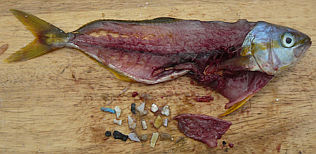 The trouble is, plastics degrade. As component parts, they often become brittle and discoloured, and have to be discarded. Most ‘thermoplastics’ so called because they soften on heating, will decay when exposed to oxygen and light, especially the ultra-violet element of sunshine. As all gardeners know, plastic pots will slowly disintegrate into soft flakes but a plastic wheelbarrow has sufficient mass to keep its shape for years unless physically smashed up. Even then, the fragments of it do not dissolve or go away. It’s these indestructible fragments just getting smaller and smaller that are causing widespread deaths among sea birds. 95% of dead fulmars examined had plastic in their guts.
Natural disasters such as the tsunami in Japan have added huge amounts of plastic litter to our seas. Entire abandoned trawlers, together with their plastic mesh fishing nets, have been found on the coasts of North America; together with vast quantities of smaller plastic goods. 29,000 yellow bath ducks lost from a single container in 1992 are still fetching up on shorelines all over the world. See the website of Marine Research Institute www.algalita.org
And what about POPs? Persistent Organic Pollutants (POPs) are singled out because of their toxicity, carcinogenicity, and hormone-disrupting capacity, present as trace pollutants such as DDT, Dioxins and chemicals used as flame retardants. These migrate to plastics particles due to their affinity for water hating hydrophobic substances and as the plastics break down into smaller and smaller pieces, each piece presents a greater and greater surface area for absorption of POPs. We know now that these tiny POP-bearing pieces are travelling up the food chain, being ingested first by minute filter feeders then in turn by larger creatures. They find their way into the tissue of a fish, shellfish or marine mammals and especially associate with fatty areas of the body, so the liver, gonads and spawn are favoured targets. Clearly, plastics are working as concentrators, building up toxic chemicals in biological systems.
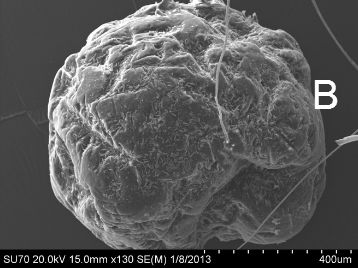
 As you can see on www.cleansea-project.eu, there is a massive push going on to try to deal with the menace of plastic litter in the sea. The trouble is, much of it consists of pieces smaller than a grain of sand, down to 20-micron fragments and even smaller. These ‘microplastics’ can also come from polyethylene microbeads used in shower gels and cosmetics. Hundreds of tonnes of these microbeads are used in the manufacture of facial and body ‘scrubs’. But such items as bottles and plastic cotton buds gradually disintegrate until they, too, become microplastics and in turn carry their own toxic cargo of POPs, known as ‘marine snow’, easily ingested by marine animals.
Sewage treatment plants accumulate microplastics from personal care products and fibres from washing clothes. Because of this, German farmers no longer use treated sewage sludge as a fertiliser.
We on Arran have nothing to be complacent about. Microplastics have been found in prawns in the Clyde. Mussels have been shown to retain microplastics 48 days after ingestion, suffering as a result from inflammation and reduced filtering and clearance rates. Lugworms take up microplastics from the sand they ingest and filter. Meanwhile, in global terms, one million plastic bags are used per minute – day and night.
We have had 60 years of the wrong conditioning directed at throwing things away. It is, of course, an essential part of the ‘chuck out and buy new’ economic model. We have come a long way from my mother’s Home Farm Stores in the 1950s, and have now gone too far. Each one of us needs to change our ways. Saying no to plastic bags would be a start, together with dumping the body scrub. (But please don’t throw it down the loo!).
 The Clyde is arguably Scotland’s most heavily contaminated water body, including cadmium, lead, mercury, pesticides and POPs, according to a recent Scottish Government paper The Clyde Ecosystem Review (2012). Up until the 1990s, only ceasing in 1998 under an EU Urban Waste Water Treatment Directive, more than 1.5million tonnes of sewage waste every year were disposed off Garroch Head, the Isle of Bute. A real worry for the future.
There is a glimmer of hope. The UN Millennium Sustainable Development Goals in the coming year will include targets on checking plastic pollution.
Visit: www.marlisco.eu Stopping Marine Litter Together, and take part in their survey on marine litter.
Have a look at this video showing plankton munching on microplastics:


