

Why some scientists are worried about a cold ‘blob’ in the North Atlantic Ocean …
… and should we be bothered here on Arran?
Sally Campbell writes for the Voice:
The first eight months of 2015 were the hottest such stretch yet recorded for the globe’s surface land and oceans, based on temperature records going back to 1880. It is just the latest evidence that we are, indeed, on course for a record-breaking warm year in 2015.
Yet, if you look closely, there’s one part of the planet that is bucking the trend. In the North Atlantic Ocean south of Greenland and Iceland, the ocean surface has seen very cold temperatures for the past eight months:
They had their coldest Jan-Aug on record, based on more than 80 years of Jan-Aug observations. Those grid boxes encompass the region from “20W to 40W and from 55N to 60N”. Arran is on latitude 55N.
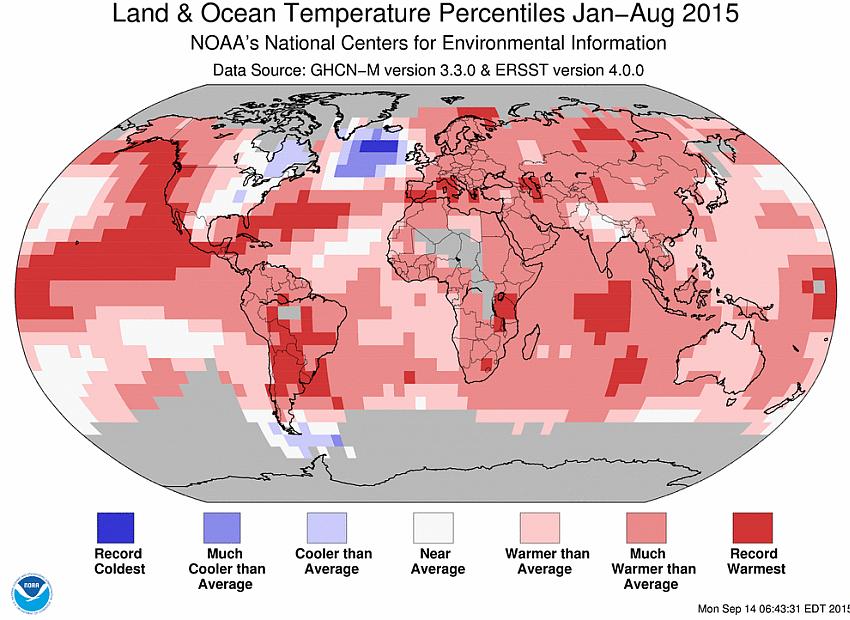
There is a much larger surrounding area that, although not absolutely the coldest it has been on record, is also unusually cold, suggesting that the gigantic ocean current known as the Atlantic Meridional Overturning Circulation, or AMOC, is weakening. This is sometimes confused with the “Gulf Stream,” but, in fact, that is just a southern branch of it. The current is driven by differences in the temperature and salinity of ocean water. This means cold salty water in the North Atlantic sinks because it is denser, and warmer water from farther south moves northward to take its place, carrying tremendous heat energy along the way. But a large injection of cold, fresh water can, theoretically, cause disturbance — preventing the sinking that would otherwise occur and, thus, weakening the circulation. Researchers suggest this source of freshwater is the melting of Greenland, which is now losing more than a hundred billion tons of ice each year.
Researchers Mann and Rahmstorf report “We were formerly somewhat sceptical about the notion that the ocean “conveyor belt” circulation pattern could weaken abruptly in response to global warming. Yet this now appears to be underway, as we showed in a recent article in Nature Climate Change and as we now appear to be witnessing before our very eyes in the form of an anomalous blob of cold water out there in the sub-polar North Atlantic”.
Rahmstorf also commented, “The fact that a record-hot planet Earth coincides with a record-cold northern Atlantic is quite stunning. There is strong evidence — not just from our study — that this is a consequence of the long-term decline of the Gulf Stream System, i.e. the Atlantic ocean’s overturning circulation AMOC (Atlantic Meridional Overturning Circulation), in response to global warming. The short term variations will at some point also go the other way again, so there is no expectation that the sub-polar Atlantic will remain at record cold permanently. But there is an expectation that the AMOC will decline further in the coming decades. The accelerated melting of the Greenland ice sheet will continue to contribute to this decline by diluting the ocean waters.”
The North Atlantic between Newfoundland and Ireland is practically the only region of the world that has defied global warming and even cooled. If the trend continues, there could be many consequences, including rising seas for the US East Coast and, possibly, a difference in temperature overall in the North Atlantic and Europe.
Will it get colder here on Arran? The answer appears to be no for the moment because on balance other global warming trends will compensate.
Sally Campbell
Click here for more information.


