

Arran’s First Geologist finds his proof
Jim Henderson continues his story
James Hutton stood on Newton Shore in Lochranza, staring at rocks that had no logical reason to be there. Did this extraordinary uncomformity exist elsewhere? He went on from Arran to look for further proof. At Glen Tilt in the Grampian Mountains he saw that granite veins had been injected into the surrounding rock, and knew he was right. The world had not been invented by God as a complete and finished thing – for billions of years, it had gone on moving and developing. He shared his new conviction with other brilliant men of his time, and the scientists John Playfair and Sir James Hall went with him to look at the latest unconformity he had discovered, at Siccar Point Cockburnspath, Berwickshire. Their enthusiasm ensured that the Berwick unconformity became Hutton’s most famous discovery.
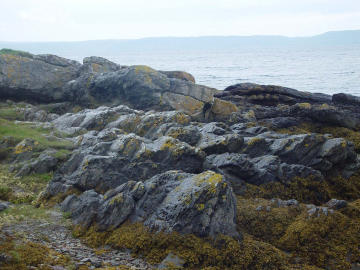 Hutton was sure now that rock formations had been created, deformed, uplifted, eroded and overlain by sediments in the sea, not once but several times over the vast aeons during which our geology had been laid down. He could see how the rock uplifted and deposited, allowing erosion to take place and creating the unconformities that revealed Devonian and Silurian strata. He also realised that the immense heat at the earth’s centre had caused the mineralisation that had given rise to the various rock layers. The evidence uncovered by his explorations provided important facts and added immeasurably to the understanding of the natural history of the earth.
Hutton’s friends Playfair and Hall were convinced by this evidence, but many others were not. They argued against it with all the obstinacy of convinced deniers of new fact, and Hutton, by now tired and in failing health, was unable to respond. However, his books were being published, outlining his theories and illustrating the proof he had accumulated.
By 1795, two volumes of his work titled Theory of the Earth had been published. He was working on a third volume when he died in March 1797. His friend John Playfair completed it from Hutton’s draft, and Illustrations of the Huttonian Theory of the Earth was published in 1802. From then on, other men carried the torch of geological understanding forward. 35 years later, Charles Lyell wrote his Principles of Geology, and Charles Darwin in turn took Hutton’s ideas as the inspiration for his Theory of Evolution.
As late as 1905, Hutton’s work was still being developed by such men as Sir Roderick Murchison (1792-1871), Charles Lapworth (1842-1920) and John Horne (1848-1928). Sir Edward Bailey, who lived until 1965, proved that Glencoe was the result of a Coldera volcano collapsing into itself. In an unimaginably violent process, old rock was hurled on top of younger rock, forming layers through a sideways movement that pushed up the earth’s crust into mountains. It was understood for the first time, too, that the British islands had been connected to neighbouring continents. A massive fault 500 million years ago had torn open the English Channel, and at the same time pushed England and Scotland into a single mass and created the Scottish Highlands. Remains of the Highland Boundary fault extend between Kintyre and Stonehaven, running through the North of Arran and Bute.
Hutton had indeed been right when he stood on the Newton shore. Arran straddles a line of geological activity that gave the British Isles the shape they still have, but until his perceptive eye saw this, nobody knew.
Next month, Jim takes a look at Hutton’s friends, Robert Burns included, who were fellow-members of the Enlightenment movement.


