

The Duellists at Corrie Film Club
On Sunday March 13th at 8.00 in Corrie Hall, the Film Club will be showing The Duellists. Made in 1977, it was Ridley Scott’s first film, and swept to instant success at Cannes. The original story by Joseph Conrad is set during the Napoleonic Wars and is about a deadly feud between two French Hussar officers, Armand d’Hubert (Keith Carradine) and Gabriel Féraud (Harvey Keitel).
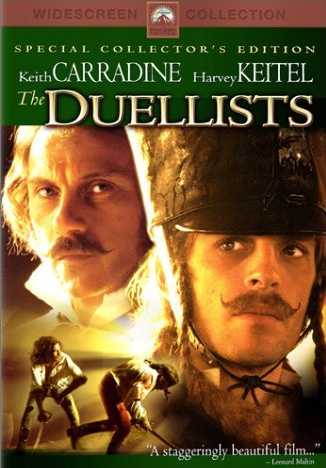 A minor incident leads to a quarrel between the two men that escalates into an affair of honour that can only be settled through a duel. Féraud is initially the aggressive one, but d’Hubert also finds himself caught up in the contest. He is unable to refuse Féraud’s repeated challenges to duel or to walk away because of the rigid code of honour. The feud persists through the different campaigns of the Napoleonic war, and over time both men rise through the ranks to reach the rank of General.
In their repeated, never quite conclusive duels, each comes close to fatally wounding the other, but during the retreat from Moscow, another duel (this time with pistols) is abandoned because the two must act together to survive when they are attacked by Cossacks. Even so, their enmity persists. Féraud, who still supports Napoleon even after the Emperor’s fall, tracks d’Hubert down in the small village where he is living quietly, and the final duel is a pursuit through a ruin with each man armed with a pair of duelling pistols. The outcome is far too interesting, subtle and unexpected to reveal.
The Duellists is studded with actors now well known, including Albert Finney, Edward Fox, Tom Conti and Diana Quick, and it is surprisingly authentic, as Conrad based his story on a real episode that occurred in 1794. The initial, quite trivial insult resulted in 30 duels fought over the next 19 years, with the two officers both mounted and on foot, fighting with swords, rapiers, sabres and finally, pistols. The film has been lauded for its historically authentic portrayal of Napoleonic uniforms and military conduct as well as its accurate early-nineteenth-century fencing techniques. It was shot mainly in the Dordogne region of France, and is marvellous to look at.
The showing is free and non-members of the Film Club are welcome. A small donation to Corrie Village Hall would be appreciated, but is not obligatory.

