

Robert the Bruce – was it an Arran spider?
There is fresh interest in Robert the Bruce at the moment, as a team of archaeologists is investigating the Bannockburn area, trying to identify the exact location of the famous battle of June 1314 in which Robert led the Scots to victory.
By the time of that battle, Robert Bruce was forty years old, and the stormy years of his young manhood that led to the lesson learned from the spider were behind him. He had been born on July 11th 1274 in Turnberry Castle, one of twelve children. His father was the 6th Lord of Annandale and his mother was the Countess of Carrick. Through her, Robert inherited the Gaelic Earldom of Carrick, and through his father he was a strong contender in the Royal lineage to the Scottish throne. At that time, however, the system of ‘tanistry’ still held sway, which meant that any man with a claim could try to prove his superior right to be king.
 On his father’s death in1296, young Robert Bruce, now the Earl of Carrick and 7th Lord of Annandale, was in the running for the Scottish throne – but he was not the only one. John Comyn, Lord of Badenoch and Lord of Lochaber, (known as the Red Comyn to differentiate from his father, the Black Comyn), had been Guardian of Scotland during the Interregnum that had followed the death of Robert Bruce’s father. This gave him an edge over other contenders as for all practical purposes he had for some time already occupied the throne. Descended from King Donald lll of Scotland, Comyn’s mother was Eleanor Balliol, eldest daughter of John de Balliol, and Comyn had married Joan de Valence, daughter of William de Valence, establishing a double line of royal descent, both Celtic and Norman.
Tanistry permitted two contenders for the throne to argue it out. On the 10th of February 1306 the two contenders met in the grounds of Greyfriars Church, Dumfries, to settle the matter. If it began in civilised discussion, it quickly became an attack, and then a murder. Bruce, passionate about his right of succession, struck John Comyn first, but it is alleged that one of Bruce’s supporters dealt the blow that left Comyn dead. Most historians disagree, and list him as having been killed by Robert Bruce. The Pope evidently took the same view, for he excommunicated Bruce for the crime. Bruce acted quickly to claim the vacant throne and was crowned King of Scotland six weeks later, on March 25th at Scone near Perth – a move that caused considerable resentment.
Not surprisingly, the Comyn Clan was vigorously opposed to Robert the Bruce, as was Bruce’s own brother, Edward, who sided with the English king as an early Unionist. Robert, determined to strengthen the throne of Scotland and drive the English out, trained his men as expert guerilla fighters, but after three months of successful campaigns, he and his followers were heavily defeated at Methven near Perth on June 19th.
Robert, with what remained of his supporters, took refuge in the Highlands, but met further opposition. They were defeated less than a month later by the Clan McDougal, cousins of the Comyns at Tyndrum. With his survivors, Robert fled south via the Kintyre peninsula, and took ship to Ulster, where a family friend with connections to his mother’s clan provided shelter in his castle on Rathlin Island. Bruce and his beaten army travelled over to the island in galleys known as ‘Birlinns’ and sheltered there for the winter. Other supporters came to join them, but boredom and inaction set in. Robert, at a nadir of depression and self-doubt, had somehow to find the will and determination to start again.
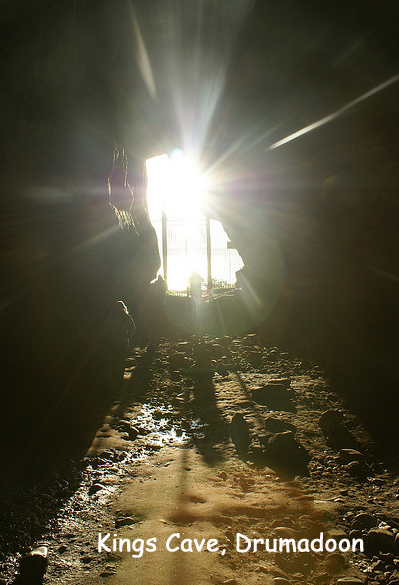
The story of the spider and its patient tenacity in reconstructing its destroyed web is the stuff of legend, and Arran is one of five contenders in the claim to have provided the cave where this happened. Oweynagulman Cave on Rathlin Island has the strongest claim, but the others are; an alternative cave on Rathlin Island, known as Bruce’s Cave, Uanch-an-Righ at Craigruie, Bruce’s Cave, Kirkpatrick, in Dumfriesshire – and of course, Kings Cave, Drumadoon, on Arran.
The story of the passage from Rathlin Island to Arran will appear in next month’s Voice.
A photo of a ‘Birlinn’ can be found at cogandgalleyships.com/blog/774605-birlinn/. One of Scotland’s best-known publishers took its name from this rugged little ship.


