

The wonders of spawning salmon
Sally Campbell
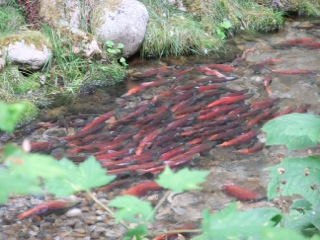 Like many people, I had never seen spawning salmon until last month in British Columbia in Canada. As a young person I had seen anglers and their attendant gillies on rivers in northwest Scotland, but the Canadian salmon of the Kootenay Lake are different. They live only in fresh water. The history of this is interesting.
Many years ago, British Columbia was teeming with sockeye salmon, which migrated hundreds of kilometres down the Columbia River system to the Pacific Ocean, returning three years later. But the river now has 11 major dams between its mouth in Washington State and the Kootenay Lake, so the salmon could no longer migrate. Their access to the Pacific Ocean was cut off. They did not die out, however – they adapted.
Today’s salmon never leave the lake. They live on plankton and aquatic insects in the deep, cold waters of Kootenay Lake and spawn in the many streams and rivers leading to it. Spawning is the last event of their lives, which may be between 4-8 years, for they die afterwards. When living in the main lake, they are bright silver, but as they spawn, they stop eating and begin to absorb their scales. Their bodies turn bright red but their heads are green They are called Kokanee, which means ‘red fish’ in the local native (Ktunaxa) language.
To spawn they fight their way upstream, find a place to nest in gravel and after depositing, fertilizing and protecting their eggs, they die. Their flesh feeds trout and other fish as well as animals, such as bears and cougars. Birds benefit as well, and so do the small organisms in the stream that the young Kokanee will feed from. It’s a rich ecological cycle.
The wild Atlantic salmon rivers on Scotland’s west coast offer opportunities for us to see spawning of wild salmon, but the chances are increasingly rare. Sea lice and chemicals from caged salmon aquaculture are clearly having a major negative impact on Scotland’s iconic species. Those of us interested in the wider ecosystem must work to ensure that this wonderful migrating species, a king of fish, returns in much larger numbers. We need to ensure that what has previously been a large, well-sustained tourist and rod fishing industry is maintained and continued. Gillies with detailed knowledge of their own rivers and burns in the northwest Highlands have a wealth of experience in caring for these magnificent fish. We must not lose this culture for the short-term profit of multinationals interested in aquaculture farming of caged salmon.


