

Too much solar power in Germany?
Andrew Curry, writing on the American site, Truth-out, says solar panels are everywhere in Germany. Rows of them line railway tracks and cover almost every roof. 22% of Germany’s power comes from renewables and solar provides close to a quarter of that. Bavaria, in the south of Germany, has more installed solar capacity than the entire United States.
Why such success? Basically, because German law guarantees a slightly above-market payment rate to small hydroelectric power generators. Residents in Conservative Bavaria soon spotted that this was a good long-term investment with a guaranteed future. Paperwork for renewables was made attractively simple. As a result, German companies lead the world in solar research and technology. On a sunny day last May, Germany produced 22 gigawatts of energy from the sun — half of the world’s total and the equivalent of 20 nuclear power plants.
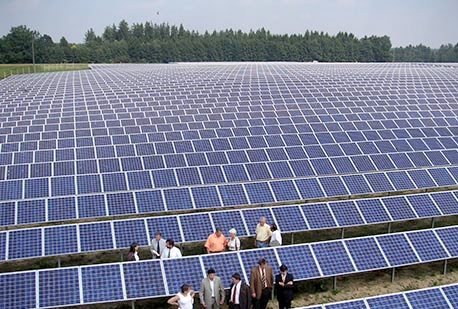 The price of solar panels has fallen 66 percent since 2006, partly because of competition from China, which is threatening to push more expensive German producers out of business. Soon, locally owned renewables may undercut the market for coal and nuclear power. But there’s a problem. Renewable energy sources like wind and solar generate power intermittently, according to how fast the wind is or how bright the sun. And you can’t store electricity like coal or gas. There is always overproduction of power during daylight hours, and this cheap energy surplus has driven prices for traditional coal and nuclear power down. When the power companies try to pass their rising costs on in the form of higher bills, people simply put more solar panels on their roofs.
The renewables boom puts power production into the hands of ordinary people in the same way that the internet gave us an international voice. We may soon be in a position to force power companies to rethink the way they do business. In Scotland, with less sun than Bavaria, that possibility is not quite so close – but something for our Government to think about, all the same.


