

COAST secures funding for Arran marine project officer
Amidst a climate of budget-cutting, COAST has bucked the trend by securing funding for an island marine project officer over the next three years. COAST received the funding on Friday last week, following a significant grant by the Esmee Fairburn Foundation.
The money will enable COAST to undertake its operations more strategically and set in train a range of activities planned by the charity, such as local education events, scientific monitoring of the island’s coast and community conservation work.
‘One of the key responsibilities of the project officer will be to engage with the young people of Arran,’ explained COAST’s chairman Howard Wood. ‘The future of Scotland’s marine resource is in their hands. This money will help COAST to promote a wider appreciation and responsible stewardship of our coastal waters, thereby safeguarding its economic, social and environmental value for generations to come.’
COAST’s vice-chair Sally Campbell: ‘This is a genuinely exciting moment for COAST and the island. By having a project officer dedicated to local education, environmental monitoring and wider advocacy, we are putting Arran on the map as a leader in community-driven coastal management. It is an essential step to making COAST’s activities sustainable for the long-term.’
The money will be granted to COAST over three years and follows previous grant assistance by the Esmee Fairburn Foundation in the formative years of COAST. Since then COAST has successfully advocated for the setting up of Scotland’s first No Take Zone, been awarded Observer Ethical Award for Conservation in 2008, undertaken a range of community marine education events and set up partnerships for the scientific monitoring of Arran’s coastal waters.
For more information contact Sally Campbell:
E: info@arrancoast.com
T: 01770 600822
Lamlash Bay Marine Surveys – 2011
During the summer of 2010, marine biologist Leigh Michael Howarth of the University of York came to Arran to conduct a series of marine surveys in and around the Lamlash Bay No-Take Zone. Now, every summer for the next 3-4 years he will be returning to Arran to continue the dive surveys and much more. Leigh gives insight to our local underwater environment:
Despite its beauty and rich marine heritage, the Firth of Clyde now ranks among the most overfished and degraded areas in Scottish seas, and indeed in the whole of the UK. However, in 2008, Scotland’s first marine No-Take Zone (NTZ) was established in Lamlash Bay, thereby protecting the area from all methods of fishing. The Scottish Marine Act has since set forth a path for the creation of a national network of similar protected areas. How effective the Lamlash Bay NTZ is at promoting the recovery of marine life and fish stocks is therefore of enormous importance and interest both to Scotland, and further afield.
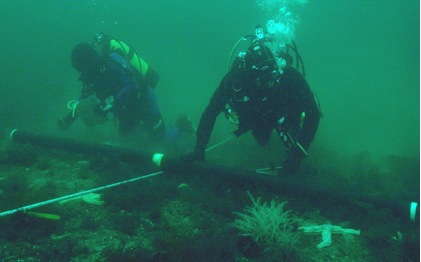 The theory behind protecting areas from fishing pressure suggests that fishing can remove large numbers of individuals from a population whilst greatly damaging the fragile organisms attached to the seafloor. But by stopping fishing, we can allow those overexploited populations to bounce back and for the seafloor to recover. These beneficial effects have been reported to occur in a large number of protected areas both in the UK and abroad. That’s why last summer myself and local charity ‘The Community of Arran Seabed Trust’ (COAST) conducted a series of marine surveys to determine if these benefits are also being received by marine organisms within Lamlash Bay.
After hundreds of hours spent at sea, the surveys were a huge success and the results are now available from www.arrancoast.com/science/arranmarinescience.html, and are also to be published in the journal ‘Marine Biology’. Overall, the study suggested that the NTZ is protecting fragile habitats on the seafloor, allowing for their recovery and promoting the area as rich nursery grounds for juvenile scallops. Now, over the next 3-4 years, I will be repeating the marine surveys in Lamlash Bay and will be extending the surveys into new sites and focusing on new areas of research. Our recent financial backing will also enable us to buy new equipment such as survey vessels and underwater cameras. This is indeed the start of something very exciting.
If anyone would like to know how they can get involved, or if they have a room available to rent to myself or my research assistant Tim Johst-Cross this summer (roughly between late June to early September), please contact me at leigh.howarth@york.ac.uk.
Picture : Leigh Howarth and Howard Wood, recording marine life encountered along a 50m transect in Lamlash Bay:


