

Orkney Arran Saga
Orkney has the power to impress its visitors; a power which comes from the landscape, the remains of an awe-inspiring archaeological past, the glorious abundance of the flora and fauna and the tangible spirit of Orcadians past and present.
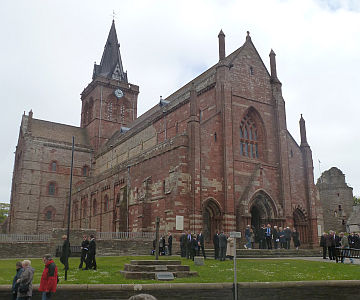 On our first visit to Orkney this year all this was manifest, but one of the most powerful impressions was a visit to St Magnus Cathedral in Kirkwall. It’s a magnificent red sandstone medieval edifice that has withstood the vicissitudes of time, religious turbulence and the Orkney weather and now stands in memorial to the patron saint of Orkney and following generations of its people. It is Britain’s most northerly cathedral, known as “The Light of the North”, and was founded in 1137 by the Viking, Earl Rognvald, in honour of his uncle, St Magnus.
Chapter 45 of The Orkneyinga Saga describes St Magnus, the Earl of Orkney, as ‘a man of extraordinary distinction, tall, with a fine, intelligent look about him. He was a man of strict virtue, successful in war, wise, eloquent, generous and magnanimous, open-handed with money, sound with advice and altogether the most popular of men.’ He was a devout Christian but, sadly, none of his virtues could save him from the jealousy and treachery of his cousin, Hakon, who had Magnus murdered around 1118. Soon after his death, however, tales of miracles began to spread, and as a result Magnus was canonised as a saint and his nephew undertook to build a cathedral in his name.

 Arran visitors to the cathedral are always surprised and delighted by the fourteen paintings on wooden panels depicting the life and martyrdom of St Magnus, for they were painted by young people from the Isle of Arran, as the inscription above them testifies. The paintings were gifted to the people of Orkney in 1980 to celebrate the St Magnus Festival, which takes place every June.
The fourteen pictures are true to the saga of St Magnus, woven through with what George Mackay Brown called, ‘the charm and innocence that belongs to youth; the dew is still on the grass, the first birds are still singing.’ He went on, ‘It’s marvellous that children from another island should have been fired by this Orkney story. It proves that eight and a half centuries on, it is still valid and potent, and not just a weave of medieval miracle and fantasy.’
The project was led by Maureen Farquharson, art teacher in Arran High School at that time, who was inspired by the idea of the St Magnus Festival and the work of the founders of the festival, George Mackay Brown and Peter Maxwell Davies. She wanted her pupils to share in and contribute to the very special event that was being planned – the St Magnus Festival. Before beginning work on the panels, Maureen took her young students through a study of Orkney’s land and seascapes, its dramatic history and the story of St Magnus himself. Among them were Neil Currie and Lesley Craig, who are now in their forties! Maureen introduced them to the work of George Mackay Brown and Peter Maxwell Davies, because in addition to painting the panels, the young people would attend the Festival – which they did. They went to Kirkwall, attended various events and presented their work in person to George Mackay Brown and Peter Maxwell Davies
All this took place thirty-three years ago. Maureen has no idea whether any of the young people of that time have ever returned to Orkney, but she is certain that, as she says, ‘the experience of the panels, the saga of St Magnus and their visit to Orkney will always be with them’. The making and presentation of the panels was not the end of a project, but rather a beginning, for Maureen had become aware that Arran children also needed to become more aware of their own cultural past, so she began the Arran Heritage Project which continues today, a valuable legacy for Arran.
What a pleasure for us to re-discover these moving and delightful panels, giving us a real sense of unity with another island and its people!


