‘Africa in Miniature’ comes to Arran
On Saturday 14th June, COAST supporters set up their stall on the wee Co-op end of Brodick beach to meet a group called CAMASS off the 9.45 ferry. CAMASS stands for Cameroonian Association and Sympathisers in Scotland, and they were on a day’s outing to Arran.
Cameroon is in west Central Africa, bordered by Nigeria to the west, Chad to the north-east and the Republic of the Congo to the south. Its coastline is on the Atlantic Ocean. Oddly, Cameroon is often referred to as “Africa in miniature” because of the mixture of all African features that it contains. There is a large Cameronian community in Glasgow, so the Arran Day Out saw upwards of 100 men, women and children arriving to meet COAST members and learn more about island life and marine conservation.
Jim Henderson of COAST picks up the story:
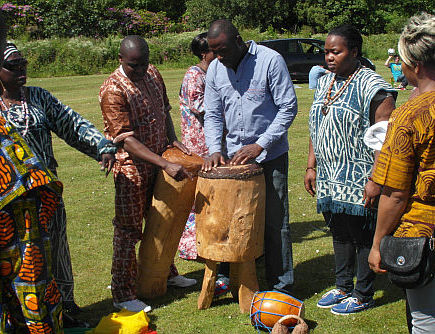
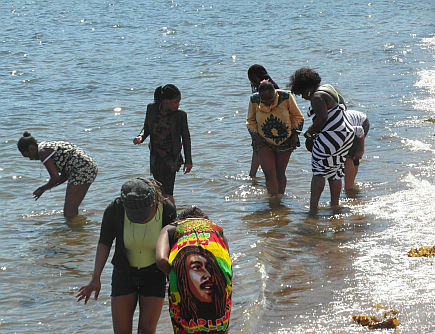
Greetings and introductions led to a rather informal day with the group playing their traditional drums, singing and dancing. Soon we had a lunch break – all prepared in advance by the group and consisting of home made delicious Cameroonian food. Later some of us spent time frolicking in the sea and exploring the fishermen’s walk, and the kids had a rare old time in the play park. All the visitors were extremely gracious and accommodating, happy to talk to the many folks who stopped to take photos, attracted by the colourful Cameroon traditional dress.
The group was formed in Glasgow in 2002 after learning of the death of someone’s father in Cameroon, when they realised that there were so many of their kinfolk residing in the Glasgow area. The first president was Humphrey Sabi. Many Cameroonians had arrived in Scotland as asylum seekers. Separated from their families, language, finance, immigration and culture, it was hard to integrate into a new country, but from the first beginnings the CAMASS organisation created solidarity and enabled people to support each other when difficulties arose. It also assisted members with legal action when threatened with deportation.
Gradually, they began to prove themselves to be useful and responsible citizens. One of their biggest successes to date has been their involvement with a clean-up programme that began in 2008, improving some of Glasgow’s dirtiest areas. They have also helped to organise sporting events and excursions. They are rightly proud of their integration with the Glasgow community, who have made them feel at home and respect their culture.