

Letters to the Voice
Dear Editor
It was good to see the thought provoking piece in last month’s Voice about the problems associated with plastic in our oceans. The Arran Coastal Way team are doing an impressive clean-up.
Last year I was a crew member on eXXpedition, an all-women scientific research voyage across the Atlantic from Lanzarote to Martinique. Amongst other activities we were trawling daily for plastic particles in the top few feet of ocean to add to the data now being collected across the earth. I was privileged to have as one of my watch mates Dr Jenna Jambeck, now the lead author on a major paper published in Science, the leading American journal. Go to http://jambeck.engr.uga.edu/landplasticinput for links to the full article, supplementary data, and the text of an introductory discussion at the American Association for the Advancement of Science.
I believe it would be from this paper that your writer drew the information about the amount of plastic reaching the oceans. Dr Jambeck’s research team did indeed conclude that an estimated 8 million metric tons of plastic reached the oceans in 2010, but not through deliberate dumping. Only a tiny proportion is estimated to be thrown away, whereas the great majority of this shocking tonnage is mismanaged waste that escapes from landfill or other land based sites, as can be seen in the graphic below, which is from Dr Jambeck’s paper. This total does not include rubbish from ships, fishing, or lost through floods, tsunamis or other disasters.
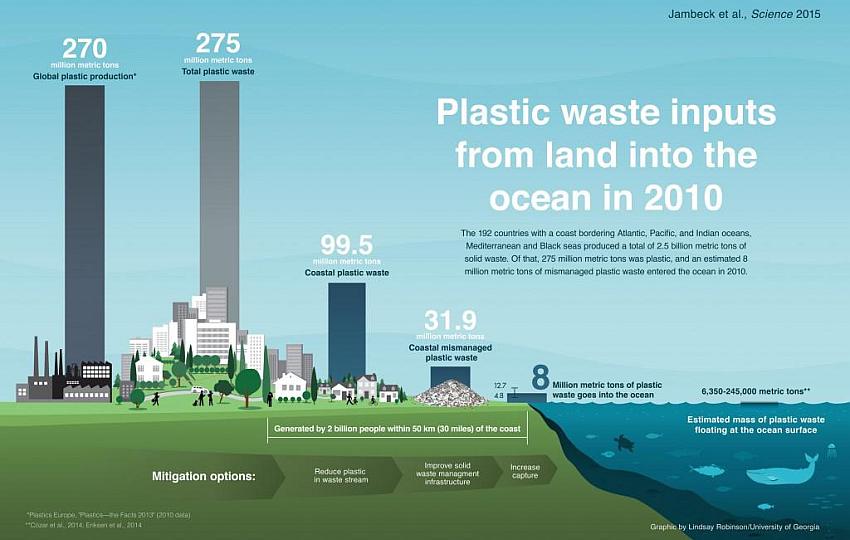
The picture is not quite as bad as your writer described, in that the annual figure is not predicted to increase tenfold by 2020. The paper in Science predicted that the 8 million tonne pa figure would slightly more than double by 2025, (to 17.5 million metric tonnes) and that in the intervening 15 years a total of 150 million metric tonnes would be added to what is already there. This is quite bad enough!
One of the shocking findings drawn from Dr Jambeck’s research is that their robust estimate of tonnage entering the oceans does not fit at all with the previously estimated amount of plastic floating on the oceans’ surfaces. It is at least 20 times larger than the highest estimate and up to 2000 times larger than the lowest estimate. This has raised the urgent question of where all the plastic goes. While some of the lost plastic appears on our shorelines (and is sometimes collected by concerned citizens), much must be suspended in the water column, or accumulating at the bottom of the sea. A great deal will be disintegrating into micro particles with all the attendant dangers your writer noted.
Dr Jambeck’s research is also concerned to point towards mitigation strategies for the whole world. We have to reduce mismanaged waste and we have to reduce waste generation and plastic use, especially single use plastics. This is where we each have the power to make a difference, from not taking plastic bags for veg in the co-op to never again buying a plastic water bottle. Sales of these are now being banned in progressive American states. We can get there too. Lobby the Government anyone?
Yours
Sue Weaver


