

The joys of cruising?
The cruise ship industry is now one of the fastest growing sectors in the mass tourism market, and here on Arran we see more and more cruise ships passing, and sometimes stopping. Many of us also enjoy our own cruising holidays.
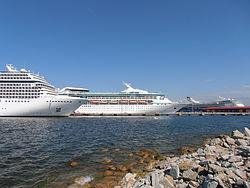 But, as with so many aspects of the modern tourist industry, there is a dark side.
In an article in the Guardian last month, John Vidal described how when the gargantuan Harmony of the Seas slipped out of Southampton docks last month on its first commercial voyage, the 16-deck-high floating city switched off its auxiliary engines, fire up its three giant diesels and headed to the open sea.
But while the 6,780 passengers and 2,100 crew on the largest cruise ship in the world waved goodbye to England, many people left behind in Southampton say they will be glad to see it go. They complain that air pollution from such nautical behemoths is getting worse every year as cruising becomes the fastest growing sector of the mass tourism industry and as ships get bigger and bigger.
For Colin MacQueen, who lives around 400 yards from the docks and is a member of new environment group Southampton Clean Air, the fumes from cruise liners and bulk cargo ships are “definitely” contributing to Southampton’s highly polluted air.
“We can smell, see and taste it. These ships are like blocks of flats. Sometimes there are five or more in the docks at the same time. The wind blows their pollution directly into the city and as far we can tell, there is no monitoring of their pollution. We are pushing for them to use shore power but they have resisted.”
Marine pollution analysts in Germany and Brussels said that these large ships would probably burn at least 150 tonnes of fuel a day, and emit more sulphur than several million cars, more NO2 gas than all the traffic passing through a medium-sized town and more particulate emissions than thousands of London buses. According to leading independent German pollution analyst Axel Friedrich, a single large cruise ship will emit over five tonnes of NOX emissions, and 450kg of ultra fine particles a day.
Bill Hemmings, marine expert at Brussels-based Transport and Environment group said: “These ships burn as much fuel as whole towns. They use a lot more power than container ships and even when they burn low sulphur fuel, it’s 100 times worse than road diesel.” “Air pollution from international shipping accounts for around 50,000 premature deaths per year in Europe alone, at an annual cost to society of more than €58bn [ $65bn],” says the group on its website.
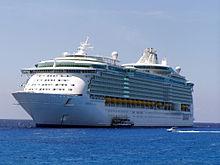 Daniel Rieger, a transport officer at German environment group Nabu, said: “Cruise companies create a picture of being a bright, clean and environmentally friendly tourism sector. But the opposite is true. One cruise ship emits as many air pollutants as five million cars going the same distance because these ships use heavy fuel that on land would have to be disposed of as hazardous waste.”
Nabu has measured pollution in large German ports and found high concentrations of pollutants. “Heavy fuel oil can contain 3,500 times more sulphur than diesel that is used for land traffic vehicles. Ships do not have exhaust abatement technologies like particulate filters that are standard on passenger cars and lorries,” says Rieger.
Perhaps we need to look again at our love affair with cruising?


