Issue 3

WE CAN –

We truly can help promote your business or any event you want to publicise, at a bargain rate that’s too good to ignore.

A mere £35 buys you SIX full-colour adverts if you are a business, and we throw in interviews and pictures free.

If you are a not-for-profit organisation, it’s even better. We give you six adverts for just £20, plus lots of cheerful mentions, pictures etc.

It’s easy. Hit the ADVERTISE button on the toolbar above this to use PayPal, or send a cheque made out to Voice for Arran, to Aorangi, Whiting Bay, Arran. Then talk to us on info@voiceforarran.com about what you’d like us to do for you. With the visitor season about to dawn upon us, this is the time to grab our too-good-to-miss publicity.

Oodles of oomph in Pot Noodle

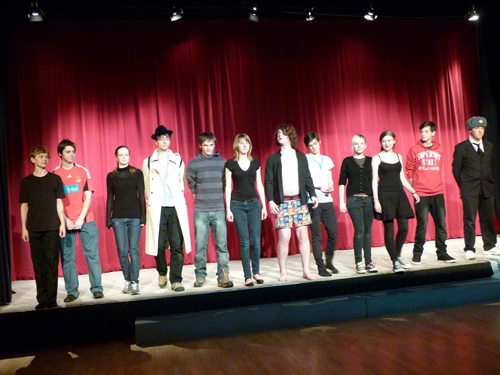
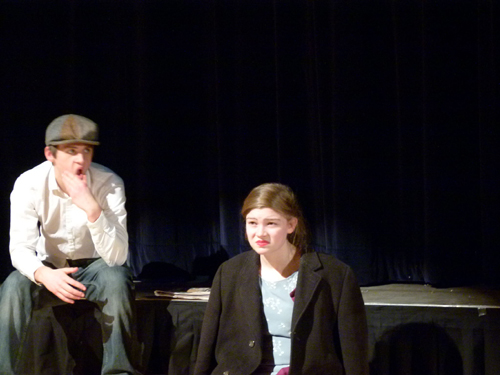
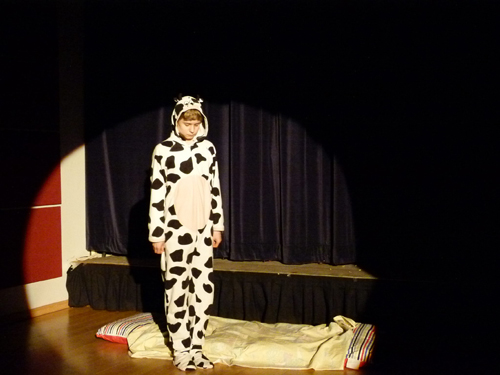
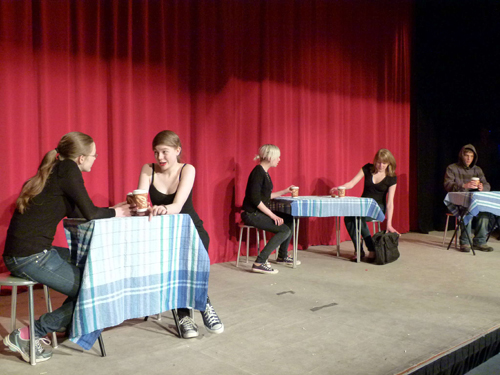
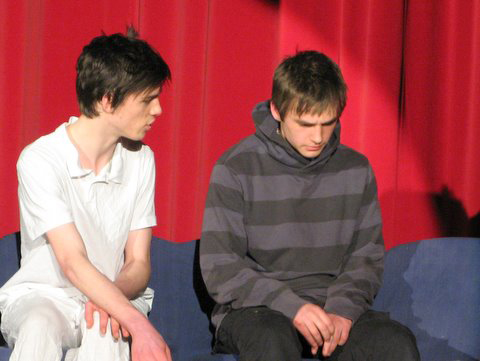
On Saturday 19th March, fourteen young people from Arran High School put on a show called Pot Noodle, written, produced and acted entirely by themselves. The result was astonishing. Pot Noodle boiled over with humour and irreverence and was often deeply touching.

There was a samizdat, unofficial feel about the Saturday night event, staged in front of a smallish audience consisting of parents and the ‘usual suspects’ who turn up to support all creative work on the island. Someone remarked afterwards, to general agreement, ‘Where were the other pupils? They’d have loved it.’ An event packed with such questioning thought and so much zany fun should have played to a packed house. But perhaps the sense of being among a selected few made those present felt privileged to see a production that starred (there is no other word) young actors and writers of such talent.

Heather Gough, in a brief address during the interval, stressed that no adult had been involved in any way with the writing and production, though she and Sarah Cook had been on hand ‘just to make sure it happened.’ The whole idea had initially been part of Arran’s McLellan Festival, though it took some time to come to completion. The Festival had provided the opportunity of attending workshops with a professional director, and there is no doubt that this experience had linked with the young people’s own creative talents and helped towards a standard of extraordinary and justifiable confidence in their own writing and acting.

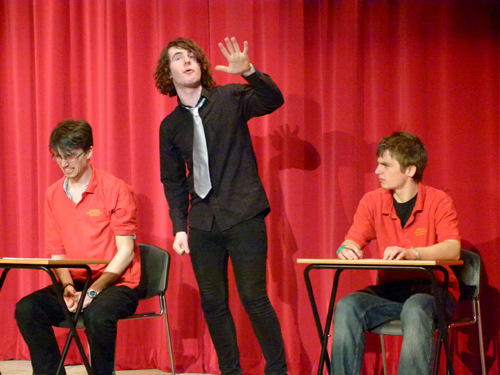
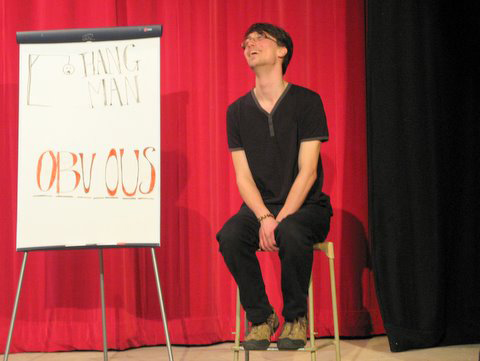
Pot Noodle consisted of short scenes, skilfully linked by John Baraclough as the guru of sound and light. These cameos added up to an overall picture of fresh, funny thinking, coupled with some very real concerns. Cameron Flewitt in the central part as a kind of lunatic master of ceremonies oversaw these episodes, several of which he had written, with an assured comic talent that had the audience enraptured. Bespectacled and compulsively watchable, his lanky, laconic presence had an easy command that made the watchers feel in safe hands, as did the equally talented Gavin Davidson and Donald McEachern. This trio set up a berserk central core, intelligent, smart, often surreal and completely in command of their material, and they were joined by others with their own form of the same original talent. Katharine O’Donnellly gave a fine performance in her piece called War Dream, in which a distraught girl connects with her lost solider brother, and the ever-touching Christopher Jenks once again showed how skilfully he can deliver the small twist of vulnerable innocence that points up follies and cruelties. Like Katharine, he focussed on war in his piece called Lost In Action, Presumed … Here, well-choreographed troops were firing across a front line, and the mechanism of war proved with brutal clarity that it had no place for the peace-keeping intentions of the innocent.

Everyone in the small company worked magnificently well, with good, assured stage-craft as they shifted from one short sketch to the next, fluent, wry and often very funny. The big laugh of the evening came when one of them asked another in exasperation, ‘You do have the Internet, don’t you?’ to be answered by a shrug and - ‘I live in Pirnmill.’

As well as the stage show, three short films were shown, made by Katharine O’Donnelly, Hamish Finlay and a partnership between Kieran Robertson and John Tilbury. All were fast-moving explorations of daily life, using the camera to point up surreal possibilities. The Robertson/Tilbury film was clever and amusing, and Katharine O’Donnelly showed her usual sensitive response to the common things of life, while Hamish Finlay displayed a very real ability to ‘see through the camera’. Though refraining from any kind of comment, his Exploration of an Attic had poetic perception and left watchers aware of the strangeness and beauty that lie only skin-deep below reality. Altogether, the evening was an extraordinary achievement, and congratulations must go to every member of this talented cast, whose names we list here.

Grant Adamson, Gavin Davidson, Cameron Flewitt, Iona Flewitt, David Heenan, Christopher Jenks, James McAleer, Rose McCormack, Donald McEachern, Katharine O’Donnelly, Connor Reid, Ceila Swinton-Boyle, Patrick Taylor. 
(see also School for Show-biz – scroll down.)

Click pictures to see larger version.

Europe at Auchrannie

The Sports Hall at Auchrannie was transformed to an outpost of the European Union on Monday 21st March, when a discussion on Sustainable Tourism involved interested people from all over Europe. A row of glass-fronted boxes in which simultaneous translators performed their magic trick of speaking one language while listening to another meant that there was no problem in understanding people from Poland or Lithuania or Italy – the headsets were perfectly clear and so, unusually, were the ideas expressed.

Everyone agreed that there’s a need to cut through red tape and simplify funding applications. They were thinking alike, too, about the importance of preserving the natural heritage of places while making them available to be looked at. ‘Eco-tourism’ was felt to be the right way forward, offering visitors a chance to experience a place with its own way of life but ensuring that their presence does not destroy the very thing they have come to see. Carol Gleeson, Project Manager for the Burren Initiative in County Clare, Ireland, cited the case of nine local farmers who got together with a plan to show tourists the traditional ways of farming that had preserved the land and got the best from it before the advent of intensive production. It succeeded beyond their wildest dreams and is now established as a popular attraction. There were presentations from Poland and Slovakia, where the problems seemed no greater than those experienced in Scotland, but Bruno Marziano from Sicily spoke of a population dwindling in numbers and a state of complete ruination in many of the area’s fabulous historic towns. Ancient buildings are being brought back into use as hotels, thus, he said, increasing tourism without having to build anything, but there is a desperate need for a co-ordinated rail structure, and to establish co-operation in the running of such assets as magnificent Roman amphitheatres. Though he never mentioned the word, Mafia, it floated in an almost perceptible thought-bubble above every head. But, as Signor Marziano said, they were looking now for co-applications comprising ‘both public and private authorities.’

Kenneth Gibson gave an address of welcome to all the delegates and then, as Arran’s busy and hard-working MSP, rushed off to attend a local surgery. Roger Knox MSP drew attention to Marvin Elliott’s beautiful sculpture that stood in the corner of the hall, and spoke briefly about the ‘Ken Again’ raffle now being eagerly subscribed to both on and off the island.

(See below)


Argyll and Bute Council gets an extra £2.455 million

Our neighbouring council, Argyll and Bute Council, was appalled when its budget for 2011was cut to £220.059m, £11.49 million less than its 2010 allocation. It protested vigorously, and after some debate, the Scottish Government has awarded Argyll and Bute an additional allowance of  £2.455 million.

Councillor Dick Walsh, leader of the council, said, ‘We are delighted that the Cabinet Secretary for Finance has reviewed the position and awarded us this additional money.
We have said from the outset that Argyll and Bute Council’s settlement was unduly harsh – almost double the average percentage reduction for all Scottish councils.

The Argyll Rural Schools Network (ARSN), which has been fighting hard to prevent the closure of 12 Primary schools will no doubt redouble their efforts in the light of this news.


Rare bat found

When Victoria Mowatt of Kildonan found a bat lying on the doorstep of her house last week, she thought it was dead – but though very weak, it was still alive. Corinna Goeckeritz, a ranger at the Brodick NTS Country Park, is currently training for her bat licence and will become the island’s bat worker – but she had never seen a bat of the species Victoria had found, and had to look it up. ‘It turned out to be a bit of a rarity,’ she said. ‘It is a relatively large species called Leisler’s bat, which has not been recorded on Arran before.’

John Haddow of Auritus Wildlife Consultancy has been carrying out research on this rare species, and confirms that the presence of a Leisler on Arran is a record. Until now, they have only been seen in Scotland in the Newton Stewart area and Nairn, although bat detector recordings confirm that they are beginning to be seen in the west and south-west of Scotland. It is impossible to say whether the Kildonan bat is actually resident on Arran and has just come out of hibernation too early, or might have flown across from the mainland. Corinna hopes she will be able to nurse the bat (which is a female) back to health, so it can be released where it was found. She praised Victoria for finding the bat and said it would not have survived without her sensible intervention. At the moment, fingers are still crossed that it can be nursed back to health, but it is tucking into mealworms, so it’s in with a good chance.

Corinna pointed out that it is illegal to damage or destroy a bat roost or to intentionally disturb it. She said nobody should handle a bat without a licence unless it is ill or injured – but sometimes help is needed. At the end of the summer breeding season in particular, a young bat newly out of the roost can get lost and end up in a building or on the ground. It may just be dehydrated and will revive if given drops of water on the end of a fine paintbrush – but it is important to wear gloves if you pick a bat up as certain species can deliver a painful bite, and in rare cases they may transmit rabies. A sick or injured bat can be temporarily kept in a shoe box or ice cream container with small air holes in the lid, with a piece of crumpled cloth such as an old tea towel to hold on to. Bats can squeeze through the tiniest gaps, Corinna says, so make sure it can’t escape!  At dusk, the bat should be released near to where it was found. Put the open box on its side out of the reach of predators, and if the bat is strong and healthy enough, it will crawl out and fly away. They can’t take off from the ground, but have to launch themselves to become airborne, so the box needs to be in a high place, on a wall or fence-post.

 If you need help with a bat that is injured or ill, please phone Corinna at the NTS Ranger Centre on 01770 302462 or on 07767 330583 out of hours. Advice can also be found on the Bat Conservation Trust’s website www.bats.org.uk
 

Concessionary fares rumpus

Concessionary fares on the ferry, re-imposed at £1 when the free pass was abolished, are to be further hiked to £2.40 from today, the beginning of April, to the great indignation of Arran people.

Three Arran Community Councillors attended a meeting at the Elderly Forum on 16th April, at which SPT representatives Bruce Kiloh (Head of Transport Planning) and Gordon Dickson were present. The ACC members protested at the unfair discrimination underlying the price hike for Arran people, and also raised the question of second home owners taking advantage of the concession scheme. This, they pointed out, is totally unjustified in the case of people who may only visit their holiday properties a few times a year and are certainly not dependent on the ferry for hospital appointments etc as full-time local residents are. However, screening out the second home owners is not easy. Local post offices check validation of an applicant by either a Council tax bill or utilities bill, but these documents do not confirm permanent residency. All applicants perhaps need to be countersigned by someone with the authority to check the facts before a concession card is handed out. The Community Council will be debating this at its end-of-March meeting.

Meanwhile Katy Clark MP deplores the rise, saying it is ‘disproportionate in comparison to other ferry services to Scotland’s islands, including those in the Clyde.’ It is explained on the grounds that the Brodick-Ardrossan ferry service is over 10 miles, but Ms Clark asserts that it is ‘a direct result of the Government removing the subsidy to SPT’.

Readers comment : I notice that Katy Clark blames the 140% rise on the concessionary ferry fare on Scottish Government. The fact of the matter is that Strathclyde Partnership for Transport (SPT) is wholly funded by the 12 local councils within the Strathclyde area and is not, and never has been, funded by the Scottish Government. Katy Clark should direct her justified anger to the North Ayrshire Labour delegate on SPT,  and Arran's only voice on that body, who did not attend the meeting last December where the  140% increase was passed. J Lees , Sannox


Green support for students

Last week, thousands of students marched to Holyrood to make clear their hope that funding for higher education in Scotland will receive top billing in the forthcoming election campaign for the Scottish Parliament.

Both the SNP and Labour have now committed not to reintroduce tuition fees or a graduate contribution, but the Scottish Greens are going considerably further. Patrick Harvie MSP, who addressed the student march outside Holyrood, said the Scottish Greens believe graduates ‘already contribute enough through the tried and tested method called income tax.’ He stressed that education ‘supports the common good’, and said that Scottish Greens believe university education should be paid for collectively through fairer taxation, with no risk of  deterring students from poorer backgrounds.

Green assault on Osborne’s budget

Patrick Harvie, co-convenor of the Scottish Greens, described the budget as seeming to mean that ‘profits must be hoarded by the rich and losses covered by the taxpayer, while public services are forced out onto the open market. This coalition government is firmly entrenched in Thatcher-era economics, and today brought no sign of respite for a Britain battered by cuts. Corporation tax is to be slashed while the rest of us keep coughing up for the deficit through VAT. Once again, it's a giveaway budget but only for the rich in Osborne's Britain.’

Well, that’s telling them.


Arran’s Green candidate

Steen Parish is the Scottish Green Party’s lead candidate for the West of Scotland. He comes from …..

In the parliamentary session that is now closing, the Greens, though small in number, have often held the balance in important votes. Increasingly, people with leftish opinions also understand that we must respect the world’s resources and refrain from the greed that has landed so many countries in financial disaster. Scotland’s voting system gives every voter two bites at the cherry, with a vote for the local representative and a further vote for ‘list’ MSPs, so there need be no split between ‘tactical voting’ and one’s chosen philosophy.

Steen said last week:’I will work to help build a more equitable and sustainable Scotland. We must embrace the renewable energy revolution and invest more in our young people’s education, well-being and training opportunities. With the best practices from our neighbours and our history of innovation and civic responsibility, we can indeed create a truly prosperous and successful Scotland for all its citizens. A change to thinking long-term is needed. I will always take the long view and ask "who benefits?"’

Contact Steen on www.greenparish.org or 07590 190512.
 

Arran included in fuel discount scheme

Until a couple of weeks ago, Arran was not counted as a Scottish Island when it came to being included in a fuel discount scheme. Other islands, from Shetland to the Scillies, qualified for a cost reduction of 5p per litre, but not Arran, possibly because our post code made us look like part of urban Ayrshire. Katy Clark MP wrote to Justine Greening, the Government Minister concerned, and sent the apologetic but non-responsive reply to the Arran Community Council. Their secretary then wrote to Ms Greening, pointing out that Arran appeared to be grossly discriminated against in this matter. By the end of the week, Katy Clark forwarded a letter saying that Arran was included in the scheme. So we should now see a reduction of 5p per litre on the pump price. It won’t go far in the current rocketing up of global oil prices, but at least it’s a small piece of justice done


Miraculous film in Corrie

On *Sunday 10th April, Corrie Film Club* (please note change of date) shows Jessica Hausner’s extraordinary film, Lourdes. Everyone knows of the constant pilgrimages to the shrine in this French town, which attracts a stream of suffering and disabled people in hopes of miraculous cure, but this film goes further. It accepts that there must be cynicism and a touch of the grotesque about an institution that mingles faith with commercial opportunism, but beyond its documentary exploration of the people in this particular tour group, organised by the Order of Malta, it puts a shrewd finger on something altogether darker.

Sylvie Testud gives an astonishing performance as Christine, an intelligent young Frenchwoman who has multiple sclerosis. Her arms and legs are immobile and her hands are clenched fists, but she watches her companions with an elegant, humane detachment that lifts the film far beyond voyeurism. In the fervour of need, what seems to be a genuinely miraculous event occurs – yet at the same time there is a terrible suspicion that some other agency is at work. All things become possible as the tension mounts, but at the same time a kind of black comedy develops between the people in the group. If there really is divine grace at work, is it taking spiritual strength from one person and visiting it upon another? Jealousy and suspicion are rife, and the boutique background of religious trinkets for sale in every shop heightens the tragi-comedy that is unfolding.

Jessica Hausner, the Austrian director who has made her name as a shrewd commentator on the cruelties that can lie below the conventions of gemütlich European middle-class life, controls the conflicting forms of mystery with adroit skill. Peter Bradshaw said in his Guardian review, ‘As the action of this outstanding movie proceeds, you get the eerie feeling that everything on screen has been invisibly deluged with something very important.’

Visually, the film is intriguing, for Hausner uses a curiously detached technique in which the telling action may happen, not in the conventional foreground, but somewhere in the middle distance of one of her elegantly structured group compositions. You may be either inspired or exasperated by the film’s closing moments, but they are, as Bradshaw put it, ‘a final flourish of Hausner's sheer, exhilarating technique and intelligence, like that of a superb musician.’ Lourdes is her best film yet – certainly not to be missed.

The showing starts at 8.00 pm and is free. The Corrie Hall would be grateful if non-members of the Film Club could make a small donation.

See the 2-minute trailer of Lourds on http://www.youtube.com/watch?v=_7Ec64c3T2I


COAST secures funding for Arran marine project officer

Amidst a climate of budget-cutting, COAST has bucked the trend by securing funding for an island marine project officer over the next three years.  COAST received the funding on Friday last week, following a significant grant by the Esmee Fairburn Foundation.

The money will enable COAST to undertake its operations more strategically and set in train a range of activities planned by the charity, such as local education events, scientific monitoring of the island’s coast and community conservation work.

‘One of the key responsibilities of the project officer will be to engage with the young people of Arran,’ explained COAST’s chairman Howard Wood. ‘The future of Scotland’s marine resource is in their hands. This money will help COAST to promote a wider appreciation and responsible stewardship of our coastal waters, thereby safeguarding its economic, social and environmental value for generations to come.’

COAST’s vice-chair Sally Campbell: ‘This is a genuinely exciting moment for COAST and the island. By having a project officer dedicated to local education, environmental monitoring and wider advocacy, we are putting Arran on the map as a leader in community-driven coastal management. It is an essential step to making COAST’s activities sustainable for the long-term.’ 

The money will be granted to COAST over three years and follows previous grant assistance by the Esmee Fairburn Foundation in the formative years of COAST. Since then COAST has successfully advocated for the setting up of Scotland’s first No Take Zone, been awarded Observer Ethical Award for Conservation in 2008, undertaken a range of community marine education events and set up partnerships for the scientific monitoring of Arran’s coastal waters.

For more information contact Sally Campbell:
                                            E: info@arrancoast.com

                                            T: 01770 600822

Lamlash Bay Marine Surveys - 2011

During the summer of 2010, marine biologist Leigh Michael Howarth of the University of York came to Arran to conduct a series of marine surveys in and around the Lamlash Bay No-Take Zone. Now, every summer for the next 3-4 years he will be returning to Arran to continue the dive surveys and much more. Leigh gives insight to our local underwater environment:
Despite its beauty and rich marine heritage, the Firth of Clyde now ranks among the most overfished and degraded areas in Scottish seas, and indeed in the whole of the UK. However, in 2008, Scotland’s first marine No-Take Zone (NTZ) was established in Lamlash Bay, thereby protecting the area from all methods of fishing. The Scottish Marine Act has since set forth a path for the creation of a national network of similar protected areas. How effective the Lamlash Bay NTZ is at promoting the recovery of marine life and fish stocks is therefore of enormous importance and interest both to Scotland, and further afield.
The theory behind protecting areas from fishing pressure suggests that fishing can remove large numbers of individuals from a population whilst greatly damaging the fragile organisms attached to the seafloor. But by stopping fishing, we can allow those overexploited populations to bounce back and for the seafloor to recover. These beneficial effects have been reported to occur in a large number of protected areas both in the UK and abroad. That’s why last summer myself and local charity ‘The Community of Arran Seabed Trust’ (COAST) conducted a series of marine surveys to determine if these benefits are also being received by marine organisms within Lamlash Bay.
After hundreds of hours spent at sea, the surveys were a huge success and the results are now available from www.arrancoast.com/science/arranmarinescience.html, and are also to be published in the journal ‘Marine Biology’. Overall, the study suggested that the NTZ is protecting fragile habitats on the seafloor, allowing for their recovery and promoting the area as rich nursery grounds for juvenile scallops. Now, over the next 3-4 years, I will be repeating the marine surveys in Lamlash Bay and will be extending the surveys into new sites and focusing on new areas of research. Our recent financial backing will also enable us to buy new equipment such as survey vessels and underwater cameras. This is indeed the start of something very exciting.  
If anyone would like to know how they can get involved, or if they have a room available to rent to myself or my research assistant Tim Johst-Cross this summer (roughly between late June to early September), please contact me at leigh.howarth@york.ac.uk.

Picture : Leigh Howarth and Howard Wood, recording marine life encountered along a 50m transect in Lamlash Bay:


A truly wee gallery makes a big start

Three talented Arran artists quietly opened a tiny gallery in Kildonan earlier this year. They made no fuss about it beyond a few small posters, but visitors have already got wind of it, and are coming to investigate – and to buy, as well. Freya Gaia, Sheila Bryson and Susan Maun produce between them a magical mix of jewellery, photographs, pottery and enamelled copperware, and exhibit it in the minuscule entry to Sheila and Freya’s house. You can find it by taking the Kildonan road on your left at Dippen and following it through tight corners to its straight run down the hill with the sea ahead of you. When the road turns right, slow down and look instead for the track that parts from it on the left. A helpful sign will point you to the wee gallery only a few metres further on.

Don’t expect a shop-window – we are not talking big city stuff here. Go to the clearly labelled door and someone will gladly let you in to browse in the tiny space among detailed small treasures. People are finding this quirky little place enchanting, and the small things it sells are ideal to take home or give to friends. Christine McDonald will soon be joining the little co-operative group with her hand-made soaps, beautifully packaged.

‘Everyone has been so helpful,’ Freya says, speaking warmly of the way neighbours have made no objection to visitors parking in the space between houses, even agreeing to take their share of any needed upkeep of the stony surface. This little corner, not far from where the old look-out tower used to stand, is beautiful, nestled between trees. There is no space for big oil paintings, but little pictures, cards, pendants and beautiful small hand-made things abound. A visit to this tiny gallery makes all comers feel that they have been given an insight into a gentle, modest side of Arran that is full of charm.


Sewing with Children – Part 2

Judith Baines

A usable and attractive sewing kit consists of:

1  A packet of mixed Tapestry needles – blunt – for open-weave fabric.
2 .A packet of mixed Chenille  needles – sharp with big eyes – for closely woven fabric.
3. A pair of sharp scissors.
4. One or two embroidery rings, ideally the plastic frames with the hanger unscrewed.
5.  A variety of fabrics to choose from. Closely woven fabric such as calico or plain
    cotton is good to use in the frames. A double layer is best and any old piece of cotton
    makes good backing material.  Firm fabrics, such as hessian, canvas and pelmet Vilene
    don’t need support.
6. A variety of threads and cords. Save all the pieces of ribbon and ties from chocolate
    boxes and gifts, and collect wools and cottons and silks of  all colours and thicknesses.
7. A collection of beads, sequins, feathers, washers, shells, etc supplies lots of inspiration.
8. A box of dressmaking pins.

None of the above need cost much. We are so lucky on Arran to have ARCAS as a wonderful source of much of the above equipment.  It is possible to assemble a really good sewing kit quite cheaply.

Once children have mastered the “up/down, up/down” technique, they are away. As we saw in last month’s Voice, lovely little clusters can be made by gathering and sewing down snippets of fabrics, beads, etc. The first picture shows a nine year old boy`s cluster.

As soon as children are able to organise their stitches, they can start to use those to help form the pattern.  For instance, the simple ‘daisy’ motif can be used in many different ways. The second picture shows a six-year-old`s calendar in autumn colours and the third is a study in apricot that I did as a sample for older juniors.  Straight stitches one after the other become running stitch, used as an artist uses a drawn line. Lying side by side, they form satin stitch that is like a wash of colour. Small stitches sprinkled about can be like seeds, speckles or stamens and so on.

Small embroidered creations put into ‘aperture’ greetings cards are very satisfying and give children the confidence and desire to persevere.

Adults, too! (Ed.)
 

Wildcat?

We had an excited enquiry from a reader this week. She says:

My husband and I are back home after our first visit to Arran. It won't be the last, as despite the weather we loved the place.
We were staying at the Kinloch Hotel and just after arrival on Friday drove from the hotel south. After passing some highland cattle on a hill on the left side of the road we spotted something crossing the road further up. It looked like a cat but why would a cat be out in the middle of nowhere? We slowed right down, the cat came back to the left side and as my husband scrambled for his camera on the back seat the cat and I stared at each other. Me from the passenger seat and the cat almost right beside me, just at the foot of the hill, on the other side of the fence. It had the black rings on its tail and markings like a wildcat, colour of eyes, shape of its head. It nonchalantly wandered back up the hill and was in no hurry. Unfortunately no picture of course! I decided to Google wildcat arran and this site came up with the article to report sighting - so here you are. I would love to know if there are any known wildcats in this area or was this just a moggy out on a long walk? Elissa.

After we pointed out that there are a lot of feral and feral-cross cats on the island, Elissa came back to say,

It certainly didn't look domestic or feral/domestic. It was thick set, no white markings, ringed tail and stripy flank and a brown colour with piercing greeny eyes. Only thing I can't be certain of is if it had a black tip to its tail. I was so busy looking into its lovely wee face! I just wish I'd had the camera to hand! Or my husband had been quicker to get it!

We know just how Elissa feels. Does anyone know if there are any Scottish wildcats surviving here? If so, do please tell us.

Picture of a Scottish Wild cat taken in the Highlands - not on Arran

Readers Comment to the above article :

Reading the article about the Wildcat on Arran I wouldn't say with any specific knowledge that there are or there are not true wildcats on Arran. However, the wildcat is a very shy creature and it would be extremely unlikely that it would ahve stopped to be seen and indeed continue to stare at a human being. These creatures are truly wild and shy and much prefer to remain hidden. It is possoble however, that this cat could have been a cross with a wildcat, although a feral will take on a much thicker coat and be smaller than a normal domesticated cat due to its more limiting but natural diet. I have a details about wildcats on the website http://arran-cats.com and that refers you to the Scottish Wildcat website where you can find out further details. True feral cats will eb smaller and will look in better condition than a domesticated cat that has been abandoned or lost and is now eeking a living off the land. The latter will be more likely to take notice of humans as it has had previous human contact. True ferals however, like its cousin the wildcat, will treat humans in the same way preferring to remain unseen/hidden.
Please do drop us an email for every siting of a feral or 'wildcat' as we are also trying to keep a record of where Arran Cats are located across the island. Where feasible we can arrange a trap, neuter and return for ferals. Again I provide details about ferals on the website which I hope may be helpful to read to understand this creature a little better.
Linda Hartley
Cats Protection


Driving without a clue

The Road Safety Marking Association (RSMA) is concerned about the dangers caused by the increasingly frequent absence of a clear white line down the middle of our roads. A survey of more than 1,000 miles of single-carriageway A-roads found that on average 14 per cent of road markings are completely worn out; and a further 15 per cent fall into the “amber” zone and immediately should be scheduled for replacement. Less than a third of lines reach the acceptable level of visibility.

There are countless places on Arran where this guidance is missing or almost obliterated. Motorists on the island know too well the hazards of driving on a night of bad weather along a snaking road that has no clear centre line. A white line picked up in the headlights and indicating the curves lying ahead is a vital aid to navigation. On an unmarked road,  drivers are truly ‘driving blind’, and statistics show the accident rate to be much higher.
 
Single-carriageway A-roads are almost always managed solely by local authorities, but the Highways Agency ratings for road markings have never been formally adopted by these authorities, so maintenance standards are, to say the least, patchy. The RSMA report stresses that the high risk of head-on collisions on single-carriageway roads means centre-line markings are critically important.

At a time when local authorities are struggling to save money, a request for white line maintenance may not be welcome – but it is not an expensive measure, when you consider that a pot of paint may save lives. The annual influx of tourists unused to narrow rural roads adds to the hazard. It is one that NAC should take seriously.


Major electricity cable now under construction

For years, plans to generate electricity on Arran through wind turbines, solar panels or hydro schemes have been frustrated because the main cable that runs to the west of the island and links it to Kintyre, is of too small capacity to carry the power generated. However, a seabed survey of the proposed route was completed in the summer of 2009, and agreement has been reached to lay a new sub sea cable from Kintyre to Hunterston.

A new switching/transformer facility on the shore at the Kintyre side of the channel west of Arran is now being constructed, and a completion date of September 2013 has been given for the project.

Kenny Bone of Glenkiln farm put forward detailed plans for a small wind farm on Forestry land some years ago, and although the scheme was accepted to go ahead in principle, it has been held up due to the lack of adequate connection to the national grid in this area. Working closely with the Forestry Commission on Arran, Mr Bone hopes that the provision of the new sub sea cable will enable them move forward with the proposed project.


FAIRTRADE FORTNIGHT 2011

You may have seen the brightly coloured cotton bunting hanging near the check-outs in the Brodick Co-op during Fairtrade fortnight in March.
Arran Fairtrade would like to thank all the primary school children on Arran for decorating the fairtrade cotton bunting so beautifully and artistically. In total, Arran has sent off 409 decorated flags to be part of the Guinness challenge, to make the longest, fairest ever bunting. When joined together these 409 flags will measure 69 metres and will contribute to the total 4,350 metres of bunting to be hung up on World Fair Trade day on Saturday 8th May in London. This will be a call for trade justice specifically for West African Farmers, asking rich countries to drop their distorting subsidies that are keeping poor farmer’s trapped in poverty.
 

Tough times in Canada

Jim Henderson continues his story of the Arran people who went to Megantic County in Canada in 1829.

The first winter was awful. Because the authorities had been slow to deal with the ship-load of immigrants who arrived in the summer, many of them had no proper accommodation to shelter from the cold. As autumn came, followed quickly by winter, many of them were still living in makeshift tents. Earlier settlers who had more solid living places in and around the centre they called Inverness helped them as much as they could – but the most practical assistance came from the local Abenari Indians. These indigenous people gave the newcomers valuable knowledge about how to cope with the fiercely cold weather conditions and how to provide themselves with basic food supplies.

The Indians taught the men from Sannox – a place unimaginable to them – how to hunt the local game and showed them which herbs and berries they could collect and eat. They also taught them how to erect shelters to protect them from the Canadian winter. Without this help, the immigrants might have starved, for as the men-folk toiled to build what homes they could and broke the ground to raise next year’s crops, the women often only had a meagre supply of potatoes or milk to feed the many hungry mouths. But all of them were hard workers, skilled in practical trades, and with the help of the Indians, they started to equip the group with homes, work-places, a school for the children and a place of worship.

The first log cabins they build were basic structures, approximately 6 metres square in size, divided into 2 or 3 sections by partitions made of bark. The floors were constructed with split logs to offer an even surface. The logs were notched at the corners and any gaps between them were filled with a mixture of clay and moss. The roof was clad with strips of bark. They left openings for doors and windows, but having no glass, they made shutters to close them, but of course these could not stop the wind and cold weather from penetrating the building. A stone flag base was used as a hearth so that a fire could be lit for warmth and preparing food, 
but there was no chimney. A small hole was left in the roof, but often smoke filled the cabin, making conditions unbearable. As a makeshift refuge, the men sometimes excavated a small cellar under or beside the houses, but it must have been a hard choice between the smoke or the cold. During that first winter several of the Arran settlers died through illness or hypothermia.

Spring of 1830 brought better conditions and gave the settlers new heart. They set about building better accommodation, preparing ground to raise crops and herding cattle. The men often worked from first light until darkness fell, quite early in the first months of the year, which perhaps explains why the average family had a large number of children. Bed was the warmest place when there was still snow and ice outside. Often the temperatures dropped so low that the metal containers used to hold drinking water burst, and there were many mornings when people woke to find their bedding covered in frost and scraps left on the table frozen hard to its surface. Two men lost their big toes through frostbite. Another was caught during a snowstorm and could not find his way home. Sadly, he was found lying dead, frozen by the roadside only a short distance from the settlement. Others managed to survive through extraordinary toughness.On New Years Day 1830 Dugald McKenzie set out to get flour for his family, which meant he had to ford the river. He stripped naked so as to keep his clothes dry, and although the crossing was short he was so chilled that his numbed hands could not = put his clothes back on again, so he ran for a distance to generate some heat. On his return journey he could not face the icy water again, so he walked upstream with his burden of flour until he came to a place where the river was frozen solid and would bear his weight.

Next week, Jim gives more detail of the settlers’ first year, and lists their names – many of them still well-known on Arran to this day.


A school for show-biz

Still knocked out by Pot Noodle, the ebullience of the show sent back in mind to a year spent teaching in a Primary school that had grown from about 270 children to almost a thousand. It wasn’t ‘something in the water’ but just the result of a post-war boom in new housing and the natural desire of people to start families after the hostilities ended. But the building boom happened quicker in some places than others, and as far as Crofton School was concerned, it was extremely gradual. However, the original wooden building stood in a large field, ideal for the siting of whatever temporary structures could be found. There were several ex-Army Nissen huts and a couple of large hen-houses that had presumably been rejected as not up to the standards of any decent-minded chicken. These were divided in half by screens or curtains, with a class in each end, both heated by a ferocious coke stove that probably gave off noxious fumes, but nobody cared. We hung wet coats above them on wires and worked up a good old fug, and got on with the main business of education – which, as we saw it, was the devising of theatricals.

We were blessed by the presence of a Headmaster who spent most of his day solving the Times crossword except when perusing the theatre reviews. Being about 25 miles south of London, the school offered easy access to the metropolis for a stage-struck middle-aged man who wanted nothing more than to get home, change into evening dress and set forth with his wife for dinner then a show. Nobody disagreed with his priorities. We kept half an eye on the car park and if we spotted a person with a briefcase heading towards the school office, one of us would tap on his door and say, ‘Visitor.’ The crossword would be shuffled into the desk drawer and something official-looking spread out instead, and by some miracle we were able to pursue our strange idea of education undisturbed.

Throughout the war years, Fred the Senior Master had been a producer for ENSA (Entertainments National Service Association), set up in 1939 by Basil Dean and Leslie Henson. His job had been to work up shows that would then be sent off in a van-load of actors and scenery to some theatre of war to entertain the troops. In the profession it was wryly known as ‘Every Night Something Awful’, but he was undeterred, and brought the same rolled-up-sleeves approach to the thousand children he now regarded as his potential cast. The Senior Mistress, by luck or some quiet influence from the Head, was an ex- Wardrobe Mistress. Her end of the chicken hut saw teaching going on below wall-to-wall wires hanging with tutus and cloaks and spangled tights. She spent most of her time at a whizzing sewing machine, running up costumes while delivering advice on writing or (occasionally) maths.

Strangely, it worked incredibly well. The kids were still sitting the Eleven Plus at the time, but amazing numbers of them sailed into the Grammar School, and there were no problems with literacy. You had to be able to read so as to make sense of the script that was thrust into your hands as soon as you could be heard at the back of the hall. The class sizes were huge. Nobody was teaching fewer than 45 children, and those privileged to be working in a real classroom as opposed to half a hut were often coping with 60. What kept it going was the constant excitement and professional buzz of the latest show. A lazy piano could be heard from the hall (a hut) where Fred was rehearsing a chorus  line, on one occasion for The King And I. One small girl asked, ‘What do I do when the King comes in?’ and Fred said, ‘Just keep on trucking , darling.’  In the summer each year, we devised a pageant that encompassed every child in the school. Each class had to invent, write and rehearse its own scene, learning meanwhile about whatever the theme was. ‘Strange Places’ involved much research on Greece, Arabia, Africa and elsewhere, and even the spear-carriers, of whom there were rather a lot, had to take part in choral speaking or dance or mime.

They had a great head of steam, those kids. They knew the impossible could be done at once, as the old garage sign used to say, even if miracles took a little longer. The dull and frustrating concentration on exam-passing has mucked that up quite considerably, but as the players in Pot Noodle showed, you can’t keep a good Thespian down. And once excited enough, education is no problem.


Star groups appear on Arran

On Saturday 23rd April,  Broken Records (with support from Hot Jupiter)
Broken Records released their highly acclaimed debut 7" single, “If the News Makes You Sad Don't Watch It”, in April 2008. This received plaudits from such varied publications as NME, The Guardian, Drowned in Sound, The Sun and The Times. Radio 1’s Steve Lamacq made it his single of the week and Huw Stephens invited them to do a session for Radio 1 at Maida Vale. Limited releases of singles “Slow Parade” and “Lies” led to a scramble of album deal offers, with the band excited to sign to the prestigious 4AD label. They rounded off the year by playing at the Edinburgh Hogmanay Street Party and being tipped for 2009 in Q magazine. In May 2010 the band completed their second album, “Let Me Come Home” recorded in Glasgow with producer Tony Doogan (Mogwai, Delgados, Belle & Sebastian,) and they are currently touring Europe and the USA to promote this. Their drummer is local boy Andrew Keeney. The support band for this evening (Hot Jupiter) made their Arran debut in February so here’s an opportunity for those that missed that evening to see this fabulous trio. Another local connection in the drumming department with Douglas I’Anson.

See www.myspace.com/brokenrecordsedinburgh

To buy tickets at Arran Events.com www.arranevents.com/244

Sunday 24th April. Mochara (with support from The Saggies).
Northern Ireland's Maurice Dickson has been writing and performing his songs for almost 30 years. Catherine Ashcroft, although born in the North West of England, has deeper roots in the West of Ireland. She started playing Traditional Irish music on the whistle at an early age before moving on to the Uilleann Pipes. She regards her main influences as Paddy Keenan, Liam O'Flynn (Planxty) and Dervish. Three years ago, Catherine met Maurice Dickson and recorded her first album at his studio in Cumbria. This led to them collaborating and Catherine guesting on Maurice's last two European tours and also forming "Mochara". In autumn 2010 they released a new CD - Mochara, "In Your Blood". The album and live performances consist of a blend of Irish Traditional tunes and original pieces written by Catherine and Maurice. The evening will start with a performance from local group "The Saggies" (featuring Mike Bailey, Cams Campbell, Donal Boyle, Nicola Swinton, & Jon Hollingworth - a slightly different line-up to their previous well received exciting performances at their last two Arran Folk Festivals), this cajun/bluegrass combo is constantly evolving but promise to deliver the same sparkle that has been in abundance at their previous outings.

See Arran Events.com for a sample of their music and to buy tickets www.arranevents.com/245

Tickets for both these events are now available online at www.arranevents.com or from Brodick Post Office
 

Cams Campbell

interviewed by Laura Selkirk

Meeting Brodick postmaster Alan ‘Cams’ Campbell for coffee, I expected a simple chat about his interest in music and what brought him to Arran. What I got was a fascinating account of a life which has taken him in unexpected directions.

Cams’s musical training began during his childhood in Prestwick. His parents would have liked him to learn to play the piano, but they had neither the money nor the space for one, so he began to play the accordion at the age of six. He did some grade exams and played in Ayr Town Hall before giving up when he went to secondary school, though he still has his accordion.

He left school at 16 and, at his father’s suggestion, joined the army, going to Harrogate to join the Royal Signals. Every apprentice had to sit a modern languages aptitude test, which revealed a flair for languages of which Cams was previously unaware. He was offered the chance to switch from working as a Radio Telegraphist to being an Electronic Warfare Operator, learning Russian. Two years of intensive Russian followed, mostly comprising military vocabulary but including sitting a GCSE.

He might have been in the army yet but for an incident that was to change the course of his life. At 17, after one year in the army, he was sent on an exercise in the Lake District, and this entailed getting to the top of a cliff. Rather than taking the long route up, the sergeant decided they would go straight up the cliff, without ropes. The sergeant dislodged a rock above him, which hit the person below him, who in turn fell against Cams. “I remember the weight of my backpack pulling me over”, he recalls, “and I fell forty feet and landed on a scree slope. I smashed up my leg, both bones, open fractures; my skull was fractured, I’d lost some teeth, I’d broken my shoulder and was all covered in scrapes and abrasions. I lay on the hillside for about four hours until the helicopter came. I went to a local hospital in the Lake District. They didn’t know if I was going to keep my leg or not; so much dirt had got into the wounds. But they managed to save it.”

It was a year before he would return to Harrogate, during which time he was in various hospitals for orthopaedic treatment and skin grafts. He said with a cheerful grin, “The first time I went home, I couldn’t get any clothes on because I had all these fixators sticking out of my leg. So my brother sent his kilt down; I had to stay an extra day till it arrived, so I had something to wear to get home. Maybe that’s when I started to enjoy wearing the kilt!”  He knew he would no longer pass the fitness requirements to stay in the army, but he was allowed to complete his training and graduated in 1991 with the prize for Best Linguist.

He was walking with a stick by this point, but his leg was twisted and shortened, so he went straight back to hospital and was one of the first British patients to be fitted with an Ilizarov frame, pioneered by Russian orthopaedic surgeons. The bone was re-broken and for nine months, as it healed, he turned the screws on the frame each day to pull the bone apart and gradually recreate normal length. “I had to wear my kilt again for nine months,” he says.

During his recovery, he went back to school for two years to do Highers in English, Russian, History and Economics, as his military language qualifications were not recognised for university entrance. After being discharged from the army, he went to St. Andrews University to study Russian, along with Arabic and Information, but having been trained in military Russian, he struggled with the study of literature.

He spent his year abroad in Odessa in the Ukraine, teaching English and enjoying the culture, particularly opera and ballet. He wrote a dissertation on the Odessa opera house, where he was treated to backstage tours, and has passed on his love of ballet to his children Hamish and Freya, both members of Arran Dancers.

His Honours dissertation was a comparison of the novel, War and Peace (a tome of daunting length which he read in the original Russian) with the epic film version. He graduated in 1998 with an MA in Russian Language and Literature, and, being unable to do postgraduate training in Machine Translation as he had hoped, he went to Bradford University to do a postgraduate MA in Interpreting and Translation. This was another lucky twist of fate, as it was here that he met his future wife, Lorraine. He remembers taking his guitar up to her room in their halls of residence to serenade her! Lorraine also studied Russian, although her main languages are French and German.

After graduating, both Cams and Lorraine taught English at a school in Sochi, on the Black Sea coast of Russia, for a few months. Cams then worked as a translator in Almaty, Kazakhstan, for two years before joining Lorraine in Luxembourg, where they lived for the next seven years. As his French improved, Cams was able to use his IT skills for software translation.

It was 2001 before the Ministry of Defence accepted liability for the accident and settled out of court. This helped with student loan repayments, but Cams still suffers pain; the leg, badly scarred, has never regained its full length, and he can no longer run or play sports. “But if that had never happened, I would never have got to university; I would probably have stayed in the army,” he reflects. And he would never have met Lorraine, whom he married (in Prestwick) in 2002. Freya was born in 2004 and Hamish in 2006.

At 21, inspired by a documentary on Bert Jansch, Cams had bought his first guitar and learnt with a friend. During his time in Luxembourg he developed different styles, invested in more expensive guitars, began performing at open mic sessions and was given tuition over the internet by a guitarist he admired in New Jersey. In 2004, he made the first of several trips to the U.S.A. to attend a ‘jam’ in Atlanta, which was where he first heard bluegrass. “Some of the stuff they were playing sounded quite Scottish in origin,” he recalls, “and the energy of it was like ceilidh music, but...different. It really appealed to me. At that point I’d been playing a lot of Celtic music, following Tony McManus, a Scottish musician who pioneered a lot of bagpipe music on the guitar. When I went over there, nobody was playing the stuff I played, so I was a bit of an oddity. The bluegrass music just blew me away, so I started learning that.”

He also attended a music camp in Tennessee, funded by becoming the European distributor for specialist plectrums. “It was just like heaven,” he says, “and I got to play on stage with Tony McManus; I played one of his arrangements with him....a good moment for me.”

As a child, Cams had made many walking and camping trips to Arran. He says, “I’ve always felt home here, and the first time I brought Lorraine, she felt the same.” They had the Arran Banner sent out to them in Luxembourg, and when Brodick Post Office was advertised on Janice Small’s retirement, they decided to have a look. They moved to Arran in 2008. Initially, Cams found that learning how to run a business and be an employer took up too much of his time to allow him to fit in translation work. However, as the Post Office is now in decline, he supplements his income by offering computer repairs and upgrades.  His IT skills have also been useful in creating and running websites for several island organisations, such as the Folk Festival, Arran Music & Drama Club and Lamlash & Kilmory Church, not to mention his own family website.

He had never been interested in theatre until he was persuaded to audition for Arran Music & Drama Club’s 2010 production, ‘Guys and Dolls’. Cast as crapshooter Nicely-Nicely Johnson, he gave a show-stopping performance of ‘Sit Down You’re Rocking The Boat’.

But perhaps he first came to the attention of Arran audiences in the local bluegrass line-up, The Saggy Bottom Boys. In his second year on Arran, he had started going to folk sessions at Catacol, and through contacts made there was asked if he would be interested in forming a bluegrass band. At that time, the Folk Festival was re-forming, but when Irish band Lúnasa were coming to play in Whiting Bay, there wasn’t enough money to pay for a support act, so the Saggy Bottom Boys got together to fill the gap. The audience loved them, so they decided to keep going. The ‘Saggies’ will be playing again in April in Whiting Bay Hall to support an Irish ceilidh band. If you haven’t seen them yet, now is your chance.


Walking on the Wild Side

John Muir- The Call of the Wild. by Lucy Wallace

The past month has seen John Muir’s birthday, and to celebrate the life and legacy of this extraordinary man, Lucy Wallace explains why Muir’s message is as important today as ever.

My first encounter with John Muir was just two years ago, though he had already been dead for 94 years. Our meeting happened through “Ranger Dan” Sealy of the US National Park Service’s Centre for Urban Ecology. Dan was coming to Scotland on a pilgrimage to Dunbar, the birthplace of John Muir, a Scot who became an American hero.  We welcomed Dan to the Wildlife Festival, and arranged for this unassuming man to hijack a bat detecting evening to deliver a talk to the unsuspecting audience on the life and legacy of his hero.

Muir was born on 21st April 1838, and at the age of eleven emigrated with his father from Scotland to Wisconsin.  His early years were filled with bone-breaking labour on the family farm, but he showed signs of genius and eventually found a place aged 23 at Wisconsin University.  Here Muir was set upon the scientific path that would allow him to record and write about the wild places that he visited, but it was his years living rough in the mountains in the 1870s that set his soul on fire. He is lauded in America as the father of the National Parks and it is surprising that he is a relatively unknown figure in his native home of Scotland. The John Muir Trust has done much to redress this balance and now owns several remote Scottish estates, working to promote protection of wild land and outdoor education for the young.  However, most people in this country are unaware of the man or his role in the birth of the worldwide conservation movement. I began to read Muir’s writing, and what I found within his pages is arresting and enlightening.

Muir the visionary
Muir kept detailed records of the habitats he explored, and sought out extreme and dangerous encounters that brought him closer to the wild nature that he admired. A committed Christian, Muir’s passion was fuelled by an evangelical natural mysticism. He did not see man as the God-given custodian of the landscape; instead he regarded the wild places and their inhabitants as teachers, and he strove to learn by their example.  He wrote often of nature’s “loving lessons1, and compared them to the harsh religious schooling he had received at home. In the complex and miraculous web of nature, he saw the hand of God in action. 

Marvelling at the Sierra forests after a violent storm, he wrote: “But though to the outer ear these trees are now silent, their songs never cease. Every hidden cell is throbbing with music and life, every fibre thrilling like harp strings, while incense is ever flowing from the balsam bells and leaves. No wonder the hills and groves were God’s first temples, and the more they are cut down and hewn in to cathedrals and churches the farther off and dimmer seems the Lord himself.2

Muir the conservationist
Muir’s unique spiritual perspective, combined with scientific method and exceptional recording skills, allowed him to see complex relationships in the natural world.  Way ahead of his time, his writing is a rallying call for ecologists: When we try to pick out anything by itself, we find it hitched to everything else in the Universe.3  Although he married and settled with a family, Muir felt most at home in the wilderness.  He understood the healing power of nature for the body and the soul. He wrote of the importance of wild places for society; “Thousands of tired, nerve-shaken, over-civilized people are beginning to find out that going to the mountains is going home; that wilderness is a necessity; and that mountain parks and reservations are useful not only as fountains of timber and irrigating rivers, but as fountains of life.4  This formed the basis of his argument for protecting wild landscapes that ultimately gave rise to the American National Parks movement.

Muir for the modern world
Muir writes about nature in a way that articulates what many who love the outdoors feel, but struggle to express.  We know instinctively that our brushes with the wild are rejuvenating experiences. Most of us on Arran have made a deliberate choice to do so and those that came from outside were drawn here in part by the magnificent natural environment. Nowhere on Arran is untouched by human influence, and yet in the high places, and on the ragged coastlines, nature’s power and intricate splendour thrives in a way that is moving to all who pause to enjoy it.  For me, the joy of living here has been getting to know the details, and like Muir, observing the lives and characters of the island’s wild residents. As each season passes, the delicate piping of the winter redshanks, or the tireless exuberance of meadow pipits in spring, lifts my spirits and roots me in the present.

Muir’s language is luminous, passionate and fiery. It is a paean to a  wildness already long gone from much of America, and it is heartbreaking to imagine what he would make of his native Scotland in modern times. But his work has an greater relevance to our urbanised world than ever before. There is so little left of wild Britain that we must treasure it. We can begin here on Arran by recognising the value of our natural environment not only to us, but to the thousands of tourists who come here each year to experience the healing power of a different pace of life.  If we can go further, as Muir did, and recognise the sanctity and substance of life no matter how small, woody or fierce, we stand to benefit immeasurably from the simple pleasure of finding our own place woven in to this astonishing world. 

Reading Muir: Journeys in the Wilderness:  A John Muir Reader is a paperback containing the selected works of John Muir, with an introduction by Graham White.

John Muir Trust: For more information about the work of the JMT visit the website: www.jmt.org.uk

For more information about guided walks with Lucy, visit her website www.arranwildwalks.co.uk or email info@arranwildwalks.co.uk


1 The Story of My Boyhood and My Youth.


A small fact about nuclear power

The New York Times news service has been talking to experts on the problem facing the Japanese engineers grappling with the crippled Fukushima Daiichi reactors. They provide the following nugget of information. (Truthout website, 15.3.11.)

‘The essential problem is the definition of “off” in a nuclear reactor. When the nuclear chain reaction is stopped and the reactor shuts down, the fuel is still producing about 6 percent as much heat as it did when it was running, caused by continuing radioactivity, the release of subatomic particles and of gamma rays.’

In more conventional engineering terms, we would be looking at a car that continues to move forward when you’ve slammed the brakes on. Whoever would design – or condone the use of - such a thing? And where are the Health and Safety people when you really need them?

Massive protest in the US over workers’ rights

The British press has had little to say over the long-running struggle by people in Wisconsin to defend themselves against total erosion of all collective bargaining. Scott Walker, the Republican Governor of Wisconsin has rail-roaded the passing of a bill that strips workers of the right to negotiate conditions, and people are furious.

Within a few days, ‘firefighters’ opposed to the bill withdrew hundreds of thousands of dollars from Madison's M&I Bank, whose directors had been major backers of Walker’s bill. As the flood of withdrawals of life savings continued, the bank became unable to continue trading, and closed its doors at 3pm on March 10th.

In Madison city on Saturday March 12th, police estimated the number of outraged people attending a rally as ‘up to 100,000’ – more than attended the biggest tea-party protest.

Google Truthout for constant updates.


Spring sun shines for Brodick Country Park volunteer group re-launch

The National Trust for Scotland ranger service at Brodick Country Park has re-launched their local volunteer group this month.
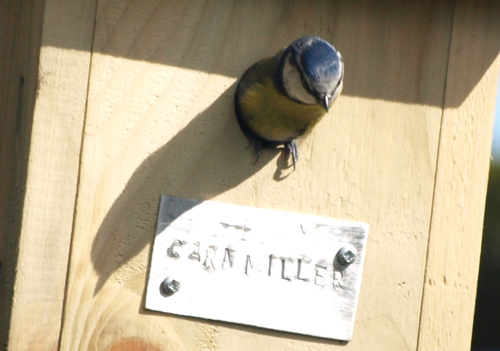
Five keen Arran residents joined Brodick Country Park ranger Corinna Goeckeritz last Thursday to treat the wildlife garden behind the ranger centre to a much needed spring clean. The merry bunch cleared the area around the pond, pruned trees, hedges and shrubs, weeded a path, cleared brambles and installed a bird box with a camera. Work was helped along by some very welcome spring sunshine. The upkeep of the wildlife garden will be one of the regular tasks, along with the control of invasive species such as rhododendron and salmonberry and general hands-on estate work around the country park.
The group will meet once a month. There is no need to book and you don’t have to commit yourself to be there each time, just turn up on the day. It is a chance to get some outdoor exercise and to contribute towards nature conservation at the same time. It’s a great way to meet like-minded people, too, and if that’s not enough to tempt you, the ranger service will provide plenty of tea, coffee and biscuits as well.
The next volunteer day will take place on Thursday 21st April, 10am - 4pm, meeting at 10am at the ranger centre. Please bring plenty of layers and waterproofs, sturdy footwear and a packed lunch and drink. For more information, please phone the ranger service on 01770 302462. For a list of dates for this year’s volunteer days, email Corinna on cgoeckeritz@nts.org.uk.
The National Trust for Scotland is Scotland’s leading conservation charity. The Trust protects Scotland’s most important historic buildings, collections, gardens and wild habitats. In carrying out its work the Trust is dependent upon the support of its members, volunteers and the general public. Charity number SC 007410.

The photo shows Lucy Wallace (Wild Walks on Arran), Angela Freear (Lochranza Youth Hostel), Colin Guthrie and Malcolm Whitmore after the spring clean session in the rangers’ wildlife garden. Missing in the photograph is  Hilary Patrick of Machrie.

Brodick Castle has a vonunteer group ( Castle Friends) please see www.voiceforarran.com/CastleFriends/ to find out what they do and how you can join.


Crewman dies after falling overboard

A 46-year-old Polish crewman has died from his injuries after falling from a landing craft that was laying cables for Scottish and Southern Energy in the Sound of Jura. He had been anchoring the Forth Guardsman at about 8.30pm on Sunday March 13th when he fell and became trapped between the vessel’s side and the anchor cable.

He was retrieved by the Forth Guardsman's own rescue boat and transferred to the Islay RNLI Lifeboat, then airlifted by a Royal Navy Rescue Helicopter from HMS Gannet in Prestwick to Crosshouse Hospital in Kilmarnock. Clyde Coastguards thought the man’s injuries were ‘not too serious’ but news came on the following Tuesday that he had died. His next of kin are being informed. The Forth Guardsman is now berthed at Port Askaig on Islay. FOUR fishing vessels and a lifeboat have saved another fishing vessel after it started to sink off the north coast of the Isle of Rum yesterday morning.

The four crew on board the fishing vessel ‘Caralisa’ issued a mayday call, two miles northwest of the Isle of Rum, after they discovered water in the hold and engine room. Due to poor radio communications in the area, the Caralisa’s mayday was relayed to Stornoway Coastguard by the fishing vessel ‘Rebecca Janeen’ which was one mile away.

The Rebecca Janeen and another fishing vessel, ‘Ocean Hunter’, rushed to the scene and the Mallaig RNLI lifeboat was launched. Two other fishing vessels, ‘Viking Borg’ and ‘Amethyst’ overheard the distress call and also headed to the Caralisa to render assistance.

The Ocean Hunter was the first to reach the Caralisa, followed by the Rebecca Janeen. In all, four pumps were put onto the Caralisa to try to stop the ingress of water. These pumps managed to stop the water level from getting any higher but it took the arrival of extra pumps from Mallaig Lifeboat for the water level to start receding.

Stornoway Coastguard Watch Manager, Martin Collins said: "The Caralisa is now under tow by the Mallaig Lifeboat and is being taken to Mallaig Harbour where preparations are being made to put the vessel on a slipway.

“All the fishing vessels who took part this morning are to be congratulated on an excellent job. Without the combined efforts of all four fishing vessels and the lifeboat there’s a good chance that the Caralisa would have sunk.

“We now have the best outcome to an incident, all the crew are safe and well and the boat has been saved.”

Fishermen haul ‘spooky’ message in a bottle

by John Kinsman Marine Editor

Earlier this month – on March 3rd, to be exact – the fishing boat Dawn Maid, which works out of Oban, brought in a heavy glass bottle together with its dredged scallops. Crewman Andy Reid spotted it first, and when he and the skipper, Robert Scott, opened it they found two messages inside. Bizarrely, the handwritten notes were dated March 3rd, the same date and month, but 76 years ago.

Alan MacLean of Isle of Mull Scallops which operates the Dawn Maid, said, ‘It was a bit spooky, the messages having the same day and month, though the bottle was put into the sea all that time ago, in 1935.’ Deryn Hewitt of the same company called it ‘a pretty hefty bottle stamped Brothwell & Mills Ltd, Worthington.’ He added, ‘I would not like to be hit by it anyway. I think it was made for lemonade".

The messages in the bottle contained nothing but the names and addresses of the writers. One was  Mr K Dunn SS Loch Dunvegan, Lancefield Quay, Glasgow. The other said Willie J MacKinnon, SS Diamond, c/o 45 West Nile Street, Glasgow. They were not working on the same ship, so were they both ashore at the time, and perhaps tossed the bottle into the water as a laugh? We will never know. And neither did the writers. However, Alan MacLean thinks he might have found a relative of one of the note-writers living in Tobermory. Wait and see
 

SANNOX CHURCH, HOPE STILL ALIVE ? AN APPEAL

John Inglis

A recent Banner article gave notice that HIFAR had withdrawn from loan negotiations with Triodos Bank over the  purchase of Sannox church in the face of  requirements that involved additional expense with no guarantee of success. The sale of the church, manse and Dundarroch is now under discussion with another purchaser. In the meantime, however, Triodos Bank have been both helpful and encouraging. They have visited the site, waived the need for a further survey and given advice about how the credibility of the loan application could be improved, something that HIFAR has been working on under the leadership of Margo Wheeler.
          The whole project involves renovating the church and Manse, upgrading Dundarroch and using the income from the  holiday–letting of Dundarroch and the rent from an Arran family in the manse to service the mortgage. A negotiable difficulty has arisen between the differing estimates of the bank and HIFAR over the extent of the realisable rental income, with the bank being understandably cautious, as they are obliged to be. This gap has begun to narrow with the welcome and unsolicited provision of £80,000 in a mixture of donation and interest- free loan. For the mortgage application to succeed the gap must be closed and, towards that end, HIFAR is appealing to anyone interested in the project to make a pledge of money in the form of either an interest-free loan or a donation.These pledges would be drawn on only in the event of the local community having a second chance to purchase. In the event of the community succeeding in purchasing the church all sorts of practical help and support would be needed.
         The purpose of all this is to ensure that the historically and architecturally important Sannox church is renovated and kept under community control, that the manse is made fit to house an Arran family and that Dundarroch makes a contribution to the  Arran tourist industry. The Corrie and Sannox village committee and HIFAR would seek to run the site under a small management committee with the church used for various functions and public access retained. Of course, as stated earlier, negotiations to purchase are under way with another party and these may succeed but, since plans for a religious retreat involve  building on the site, unlike the HIFAR project, they could incur planning difficulties which may be insurmountable. In this case the opportunity may revert to HIFAR as the United Reformed Church have indicated. A decision about thus is expected in June. This is why a viable mortgage application and business plan must be in place to take advantage of the opportunity should it arise and why community support is needed. Notice of support should be sent to  Margo  margowheeler@binternet.com .