Issue 11

Arran’s musical ‘Island treasure’ triumphs with magnificent debut recording

Arran's Jazz Café band have just released their first recording, entitled Just My Size, and it comes as no surprise that it's a complete success. It's a culmination of their increased presence and popularity, largely achieved by expanding from their traditional home of Whiting Bay to perform gigs all around the island and indeed, a slot on the Waverley cruiser earlier this year.

The band was formed in 2000 after a letter sent to the local paper from trombonist John Gibson, bemoaning the fact that there were all sorts of musical groups on Arran except jazz. It started as a fledgling outfit (including Jim Donaldson and his amazing one-string bass, for those that remember) and gradually built up a loyal following over the years. With the line up present on this CD having stayed constant for some considerable time, the team work that experience brings is very much evident on this recording.

In recent times, the band's repertoire has vastly increased and a selection of their most popular items appear on this new recording, coming in at just a minute shy of an hour's entertainment. It also comes complete with sleeve notes giving a potted history of the band, and quotes from fans (The quote from 'DB, Kilmory' had me laughing out loud, but I'm not going to reprint it here!)

The Jazz Café Band are a big draw on Arran and with good reason. Their versatility and rhythmic vitality with a wide range of jazz standards is astonishing for a purely amateur group of musicians. In recent years, one of the band's major 'discoveries' is cornettist Biff Simpson's talent as a vocalist: exuberantly exciting in 'Steamroller Blues' and serenadingly silky smooth in 'I'll Be Seeing You'. 'When Biff puts a song over, you know you've been sung to', says the sleeve notes. I really couldn't put it better myself.

The main instrumental features on clarinet (Alison Prince), trombone (John Gibson) and cornet (Biff Simpson) are slick, tastefully done and well managed, and it's underpinned by some superb work by the 'rhythm section' of Tom Buchan (guitar) John Tilbury (electric bass) and Malcolm Kerr (drums).

The success of this recording has been assured by the painstaking efforts of Jon Hollingworth, who recorded, mixed and produced it all.

It's wonderful to now have a permanent reminder of the band's versatility and sheer entertainment value. This recording deserves to sell and sell, and find them even more fans. The CD can be bought from selected retail outlets on the island, Arran Events website and band members. It costs £10 and is worth every penny!

Dave Payn


Corrie Film Club Christmas double bill.

On Sunday 11th December, two films will be shown, with supper in between. The first is the wonderful animated film called The Illusionist, which starts at 6.30 pm and is ideal for children and for anyone who simply wants to laugh and enjoy some lovely things to look at.  
Based on an unpublished script by Jacques Tati, the Sylvain Chomet film is the story of a conjuror whose trade is beginning to look seriously old-hat (though his white rabbit is brilliantly malevolent.) His one fan is a young girl called Alice, who follows him devotedly despite his efforts to shake her off. On a very shrewdly observed tour of Scotland, the Tati conjuror meets every shortbread-tin convention in the book and is surprised by them all, in exactly that innocent-at-large way that is so endearing about Tati himself. The dialogue is minimal, but the story unfolds with great beauty through animation and body language. The enchanting musical score was written by Chomet himself.

After a break for a festive supper, the evening continues with a screening at 8.30 pm of Soft Top Hard Shoulder.  In this rare British road movie. Peter Capaldi plays Gavin Bellini, son of a Glasgow ice-cream baron who has just sold the business. Gavin is due a share, he learns from a casual meeting with Uncle Sol in London – but if he is to get the money, Gavin has to present himself in Glasgow in time for his father's birthday. He sets out at once in an unreliable Triumph called ‘Crazy Horse’ and on the way stacks the cards against himself even higher by picking up Yvonne, a hitch-hiker with a past. (Elaine Collins.) Both of them are at firs sight lacking in charm, but their discoveries about each other are oddly touching as well as funny. Capaldi himself wrote the script, and the 1992 film was directed by Stefan Schwartz. If you’ve ever been on a drive that turned out to be somewhat fraught, Soft Top Hard Shoulder will ring bells. Even for the driver of a proper car who never stops for hitch-hikers, this tough little comedy is rattle-bang good value.

All are welcome to attend both or either film. There is no charge for admission, though if you are not a member of the Film Club, a voluntary contribution to Corrie Hall’s running expenses would be gratefully welcomed.

For this years programme see http://www.arranart.com/corriefilmclub.html


Mhairi Hall Trio in Brodick Hall

On Saturday, 19th November, members the audience gathering for the monthly Music Society concert were slightly surprised to see the three instruments for the featured group arranged in bright light on the stage instead of at floor level as usual. What’s more, Jon Hollingworth and Andy and Nikki Surridge of Arran Events had set up a professional sound system. There were some glances of alarm. Was this going to be an event at disco volume? But no. Within the first few notes, everyone was reassured.

Mhairi Hall is a classically trained pianist, but from an early age was drawn to the traditional music of Scotland. She formed a trio with percussionist Fraser Stone and Michael Bryan on acoustic guitar, and together they play music that is both classic and rooted in tradition, highly inventive and yet evocative of time past. It’s an extraordinary fusion, exciting, skilled and often deeply moving. Mhairi writes much of her own material, but keeps a finger-hold on the silken thread of Scottish music that has for centuries had a powerful emotional effect on the people of this country. Born and brought up in Aviemore, the Cairngorm is her familiar territory. As she said during one introduction, ‘”A good winter” means a winter with plenty of snow.’ There can be joy and exhilaration in blizzard conditions for those who are out on the long, sweeping runs, enjoying the whistle of skis over fresh whiteness. Her piece called A Good Winter caught this feeling exactly, specially in its fade to nothing at the end, as a quiet, repeated riff vanished to nothing. Her Cairngorm Dance that followed was very different, a vigorous, jazzy jig that touched on rock but still retained its Gaelic roots. At all times played with beautifully controlled empathy despite the excitement, it featured sudden stops of brief silence that were powerfully effective.

After the interval, a new piece called Sea Eagle began with pianissimo guitar, beautifully played by Michael Bryan as the music soared into a strong lead then floated away into distance.  Tullochgrue, a strathspey written by Donald Grant, who was born in Elgin in 1760, formed the basis for an extraordinary celebration of a house where ceilidh and craic ‘and the occasional dram’ were a way of life. The gentle start was as nostalgic as an old photo album, warming into easy jazziness then quietened into an open, easy happiness. Those watching carefully might have seen Michael quietly re-tuning the bass string for the last section while piano and drums continued. He did the same thing in the final piece, with an unobtrusive shift of capo up a couple of frets. It takes assurance to do that, and a faith that things will go on undisturbed. With the highly sensitive performance of Fraser Stone on drum kit, the music remained mobile and interesting throughout.

The final number, a sequence of four pieces called People and Places, was a triumph. Beginning with a hand drum, suspense was built up, then a pibroch tune took over on guitar, fast but steady, developing power as the keyboard came in like a dream sequence. The second section, Kinapol, named for Mhairi’s family home, had the steady rocking of childhood, while the third, written in the 18th century to celebrate Barbara Grant, who fought off a would-be kidnapper, was charged with urgency and highly simulating. The final section was written for Mhairi’s history teacher, David Taylor, who introduced her to traditional music and encouraged her to play it. This, with its all-out reel quietening sometimes into thoughtfulness then bursting into excitement again, had the audience in rapturous response, and there were cheers and whistles and stamping as the evening came to an end. As one listener rightly said, ‘It’s the Arran Music Society, not the Arran Classical Music Society. It’s here to promote all kinds of music.’ Certainly, the night had proved her right. As people went out into the dark from the Mhairi Hall Trio, they carried with them a warmth and happiness that will last long.


Fine work at the Brodick Castle art exhibition

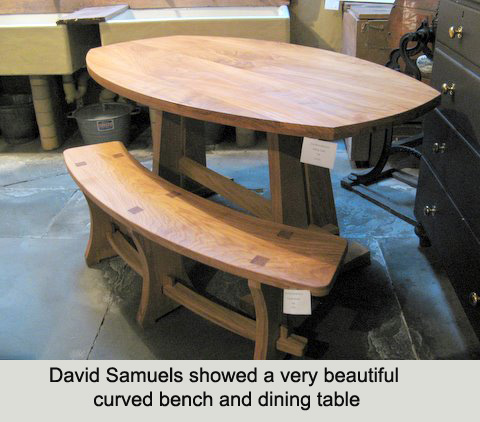
This year saw a wide spread of exhibitors, including some who have not shown previously, and there were some outstanding and memorable pieces of work.

Edward O’Donnelly, better known as a highly talented film-maker, showed a stunning water-colour composition called Maze that might at first glance have been a dark etching. The great inward pattern dominating its space nursed, consumed or enticed hundreds of tiny figures towards its centre, each one individual. As in life, one might reflect, their collective presence formed a mass that, though intricately detailed, was part of the overall pattern. The concept stays long in the mind, as does the picture’s controlled and subtle artistry.

Josephine Broekhuizen’s magical  Holy Isle had a black bird as a solitary presence in the top left corner of a glory of trees. The picture had a slightly Douanier Rousseau feel to it, an intense pleasure in the patterning and colouring of branches, but with an open sense of sky and light, beautifully designed and executed.

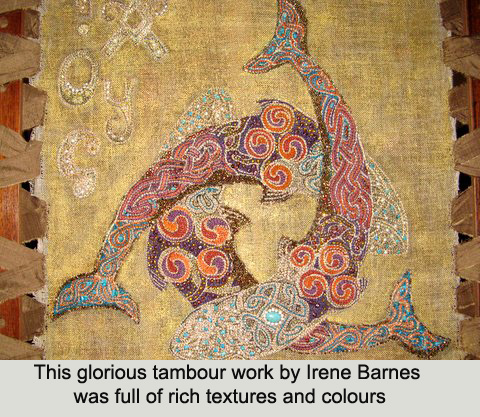
Irene Barnes showed a fabulous tambour-work hanging called Ixoyg, where a design of fishes danced in ebullience among rich subtleties of texture. The title comes from IXOYE, a classic acrostic consisting of the initial letters of five Greek words forming the word for fish - Iesous Christos Theou Yios Soter, which means Jesus Christ, Son of God, Saviour. Irene’s work combines  a sense of worship with a great joy in created life.

Yvonne Bailey, with her customary assurance of vision and technique, showed three paintings, among which the Mare and Foal had tremendous presence and solidity. Donald Campbell, with a more flamboyant handling of paint, contributed an excellent snowscape of a tumbling waterway called River Gryffe Houston, Winter, while Nicky Gill’s poetic vision called Riders at Sandbrae had a timeless quality. Sheila Findlay is another consummate professional,and ring of branches, but with an open sense of sky and light, beautifully designed and executed.her small oil sketch called Beach Boy caught exactly a child’s absorbed interest as he investigates a rock pool. Jim Williamson again demonstrated his matchless mastery of water colour in his glowing, fluid Sunset,  each area of colour set down perfectly right and left untouched.

On a much larger scale, Michael C.Grant de Longueil showed, among six excellent compositions, a painting called Study of Waves off Kildonan that repaid long gazing. The movement and ferocityof the water was exhilarating exactly because it had been accurately seen and freely rendered – in all senses, a big achievement. Shelagh Collins, in complete contrast, showed intensely personal small pictures, the best of which was her exotic and decorative Searching for Faith.

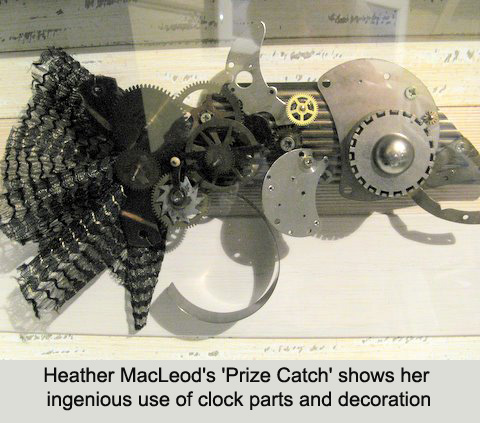
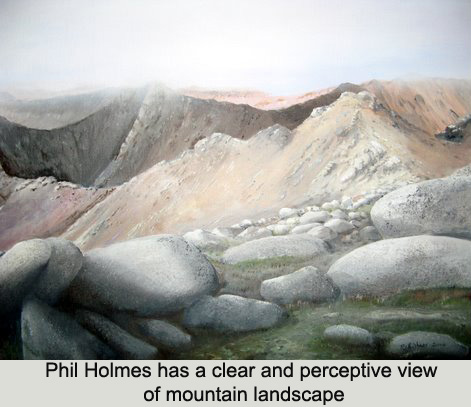
Phil Holmes showed mountain studies with a rare ability to make coherentsense of the shapes and textures that such craggy landscape presents. His View Northwards from Goatfell exemplified this clarity of vision and had a beauty of design and light that is all his own. Heather MacLeod meanwhile has found unexpected fascination in combining small pieces of clock mechanism with painting and appliqué of sequins, beads and all manner of decorative things. The result is a series of intriguing pictures, all of them witty and skilful. Her Prize Catch is a big fish that is utterly unlikely to be netted or hooked, and leads its own extraordinary life within a frame that, in context, seems like a waterless tank. Susie Thompson’s inventive creation called The Pearl Fisher has something of the same quality, a strange, skeletonic white dragon that looked as though it might be made of fish-bones, though it is in fact porcelain, studded with real pearls from mussels.

Masako Ritchie is an artist of such outstanding talent that her work should be in the international museums. The finesse she shows in her handling of Japanese sumi ink combined with other materials is extraordinary. Such an exposed technique allows for no correction or amendment – it has to be right first time. Every stroke of the brush, every placing of a piece of frayed gold fabric that will become a grass blade, is exact and unalterable, and such refinement of technique and judgement is very rare. It is impossible to convey in words the quality of her work, since each construct is its own poem. Arran is privileged to have her among us, creating such beautiful things

Click on the pictures above to see larger versions.


Calum’s Road

The National Theatre of Scotland and Communicado Theatre Company brought sheer magic to Lamlash in its production of Calum’s Road earlier this month. The subject seemed at first an unpromising one – how could a dramatic story be made from an obstinate man who, despairing of the local Council, built two miles of road in the small island of Raasay? The question was brilliantly answered by David Harrower’s extraordinarily inventive script, devised from the original book by Roger Hutchinson. Just six actors spanned the generations that saw a child grow up and a man live and labour and die, and their skill in shifting from role to role and decade to decade was consummate. They showed the heartbreak as a community drifted away when the lack of a road cast them into isolation, and evoked the tenacious, sometimes crazy vision of Calum, who with his wife and young daughter kept faith in what seemed an impossible idea.  The building of the road became an almost tangible reality as blocks, though in reality of light plywood, were handled with sweating effort. The choreography of this constant, detailed movement was beautifully handled, and the cast had a quality of sheer physicality that made the story ring true.

Ian Macrae in the title role had an expressive economy that could make tension out of stillness and used silence to convey every flicker of the dedication and grim humour of Calum. He is a quite extraordinary actor, able to become whatever is needed, through the simplest of changed movement or the use of a tiny prop. The same skill was true of each one in this small group. Angela Hardie as Julia had utter lightness and freedom, though able to link beautifully with Ceit Kearney as the child was seen from later perspective as a woman. Scott Fletcher was equally adroit as his two parts as Alex and Young Iain, who matured into the wise, wry Old Iain in the skilled hands of Finlay Welsh.

Alasdair Macrae, actor and musical director, provided a persuasive emotional setting for the action with his presence on stage as fiddler player and drummer as well as varying characters, and above all, perhaps, praise must go to the stage managing and technical presentation. A video backdrop projected the road and the island, and at one point saw Calum driving the evocation of a car up the ramp onto a CalMac ferry. It provided snow and gale, and the wonderfully managed sound and light took the packed audience far beyond the Community Theatre in Lamlash and out to an island where bad weather could threaten death. The whole experience was extraordinary, and we can only hope that the National Theatre will put Arran on their tour list again.


Judith – battered but intrepid

Judith Baines, our lovely writer on embroidery with children, is in hospital with a dreadfully complicated leg fracture after tripping over her dog, but despite that, has managed to send us a piece on making embroidered cards for Christmas, with the usual delectable pictures. All congratulations to her for being such a trouper, and warmest wishes from all of us at the Voice. We hope to see her restored to robust health very soon.


Latest on the Waverley

Since our last issue, Argyll and Bute has joined with other concerned local authorities anxious to see the continuance of the Waverley, chipping in £15,000. We also hear from Katie Clark MP, enclosing a letter from Chloe Smith, Economic Secretary to the Treasury about the possibility that fuel duty could be waived for such worthy causes as the grand old paddle steamer. The Marine Voyages Relief Scheme exists for just such cases, and H M Revenue and Customs is looking into the question of whether the Waverley is covered by that provision.


Electric Ferries – the future

Submarines have always worked on electric motors, since they can hardly be emitting a cloud of diesel smoke while under the water – but battery-operated surface ships, are a novel idea. CalMac is perhaps eyeing the future with some concern, realising that oil will go on rising in price as world supplies near extinction – or else it has had a sudden pang of conscience about emissions. Whatever the reason, it has commissioned two battery-driven ferries, to be constructed at Ferguson's shipyard in Port Glasgow at a cost of  £22m.

The basic difficulty about electric power is the problem of storing it. Battery technology still struggles for a solution to the problems of weight and bulk. It’s the stumbling block in electric car design, and marine engineering grapples with the same dilemma. For this reason CalMac has commissioned relatively small ferries of 900-tonne ships, designed to carry up to 150 passengers and 23 cars on short routes, powered by two lithium-ion battery banks with a total of 700kWh. Lithium-ion is the most efficient electricity storage system known at present, but even so, the batteries weigh up to six tonnes each.

The ships will recharge these batteries from the national grid overnight, drawing on renewable energy, but in fact they work on a hybrid system rather than a fully electrical one. Small diesel generator sets feed power to a 400 volt switchboard that supplies power to electric propulsion motors. The charged batteries supply a minimum of 20% of the energy consumed, so they are useful, but not adequate on their own. All the same, calculations show that the design will reduce lifetime costs and lead to considerable long-term savings. Exactly the cost of diesel continues to rise.

In ecological terms, the electric ferries are obviously a good thing, with a marked reduction in Carbon Dioxide, Sulphur Oxide and Nitrous Oxide emissions. Design-wise, the hull shape and power configuration will realise an impressive 19-24% savings of power input to the propulsion units over a conventional diesel mechanical set-up. Fergusons are also looking at the possibility of using energy from local wind, wave or solar systems to charge the batteries, making the process even more environmentally friendly. The first vessel is anticipated to enter service in the spring 2013, the first ever sea-going Roll On Roll Off diesel electric hybrid ferry.

Would such a system work for Arran? At the moment, probably not, because of the much greater size of the vessels needed and the longer crossings involved. It all depends on battery technology. The experimental ‘flow’ batteries that work on constant electrical transfer could evolve into a system powered by the ship’s own movement and if that happens, we will be into a whole new world of propulsion methods and power generation. For the present, alas, that’s no more than a gleam in a technical dreamer’s eye.

http://www.cmassets.co.uk/en/our-work/projects/current-projects/hybrid-ferries-project.html


What outlook for young people?

North Ayrshire is rightly proud to point out that 56.6% of its young people go on to further education, an excellent figure. But there is a less palatable record that suggests an uneasy balance. A report following the visit of Michael Moore, Member of Parliament for Berwickshire, Roxburgh and Selkirk, revealed that there are 1975 16-24 year olds in North Ayrshire who have no jobs. At 12.9%, this is the highest in Scotland. An overall picture of the British islands shows an even worse picture. Data from the Office for National Statistics indicate that one in five young people between the ages of 18 and 24 cannot find a job. The figures confirm what we all know; that further education, for so long touted as the way to better employment prospects, can no longer offer any such benefits.

The myth that unemployment is due to laziness or lack of initiative does not hold up. Almost all of us know young people who have written countless job applications, without success. The Post Office had five times more applicants for Christmas temporary work this year than it could employ.

One thing waits on another. There are no jobs because employers can’t afford to offer them. Shops are closing, small firms contracting, for the circular reason that high fuel prices and low employment rates are resulting in endemic poverty, both for employer and employed. On top of this, we have the absurd notion that such a cash-strapped population can somehow pay off the debts of profligate banks. We live in a Catch-22 of recurring insanity, in which the simple proposal to support the nation’s people and enable them to earn is regarded as anathema.


Contrasting fish views.

EU Fish News, the website dedicated to reports on the fishing industry, has been at sharp odds within itself recently, carrying views that are directly opposed to each other. On one hand, EU Fisheries Commissioner Maria Damanaki said at a conference in Lisbon that if  there is no end to a damaging ‘vicious circle’ hitting fish stocks, there will only be a handful of sustainable species left by 2022. She laid into the current fishing industry with vigour, saying, ‘We have fished too much. We have thrown away fish we don't want to land or for which we don't have quotas. And we have used taxpayer's money to build up bigger and bigger vessels. The result is that today seventy-five percent of our stocks are over-fished.’ This, she claimed, would lead to ‘economic disaster for our fishing industry, particularly small-scale fishermen, who cannot easily move to other waters. We must turn this around and hinge our actions on sustainability – and sustainability only.’

In the same issue, the National Federation of Fishermen’s Organisations (NFFO) was reported as protesting furiously against cuts in permitted days-at-sea. Its representatives told UK Fisheries Minister Richard Benyon that winning a halt to these cuts must be an ‘absolute priority’ for the UK at the forthcoming December Council. Their statement continued, ‘All parts of the NFFO back the priority given to halting the effort cuts’ and claimed that the Cod Plan would force vessels ‘to shift into small-mesh fisheries and into targeting shoaling species, including cod, because they take less time at sea to catch.’  This sounds like a nasty threat. Maria Damanaki may have quite a fight on her hands.


Easy to use website for air travellers.

Fed up with mousing from one airline site to another, trying to work out which goes where, when and at what charge? Fret no more. The simple and beautifully comprehensive site called Skyscanner does it all, providing a straightforward one-glance bar chart that shows every available flight by all airlines to your chosen destination. You can see the whole lot at one go, and when you click on the flight you fancy, the price comes up, with the cheapest alternative clearly shown, together with a link for booking. You’ll still have to watch out for nasty hidden charges for baggage and card use and for a seat (is there any way to fly standing up? I don’t think so) – but at least sorting out which company to entrust yourself to is now easy. www.skyscanner.com  Whew. A great relief.


America in turmoil

After all these years of regarding the USA as the world’s leading advocate of unbridled capitalism, it’s all changing. The assumption that anyone can be rich and rise to the status of president has taken a nasty knock since the economic crisis. Finding themselves under the cosh for being involved in a bonanza of purchasing that is now seen as culpable, people feel duped and misled. The simple economic fact that 1% own most of the wealth of the US gave a shape and a name to the huge movement that now seems unstoppable. Click on the website, We Are the 99 Percent to see the hand-written letters posted there, each telling its own story. The simple message it bears has a punch. Here’s one sample:

‘We are getting kicked out of our homes. We are forced to choose between groceries and rent. We are denied quality medical care. We are suffering from environmental pollution. We are working long hours for little pay and no rights, if we're working at all. We are getting nothing while the other 1 percent is getting everything. We are the 99 percent.’

The police break-up of the Occupy movement has not stopped this immense coalition of indignant and near-desperate people. Footage of students sitting silently on the ground being doused with a rust-coloured aerosol pepper spray shows their extraordinary control. There is no movement of reaction, only a sustained chant by hundreds of people that eventually causes the cops in their riot gear to regroup in uncertainty then return to their vans.

For daily news about what’s going on in the States, look at www.truth-out.org , which comes up free on your screen every morning with reports and video footage, coupled with responsible writing from such respected figures as Noam Chomsky. You’ll see facts and opinions there from intelligent Americans whose words will never see light in the orthodox world press.

What started as Occupy Wallstreet has become international and hydra-headed. Police brutality may chop off one head, but a hundred others replace it. In London, people camped quietly outside St Cathedral while the Church of England struggled to sort out the relationship between God and Mammon. There is, alas, little doubt about which will win that little debate, but the larger movement goes on.

These are extraordinary times, for what is happening is not revolution. It’s a coming together of millions of people who have understood that the unbridled making of profit is no way for a world population to live with itself. Since the coming of the Internet, we are in communication as never before. This is a time of historic change, and children of later generations will ask what it was like to be there. The least we can do is know.

www.truth-out.org.  Don’t miss it.


Jazz Café Band at Kildonan Hotel

After a bit of time off while the Jazz Café players get used to their excellent new bass player, Stewart McDonald, they are back in business again, kicking off the festive season with a gig at the Kildonan Hotel on Friday December 2nd, from 8.00-ish until late-ish. All welcome.


‘Music from Many Lands’ – a concert by Lochranza choir

Sunday 20th November was a lovely day on Arran; the weather was balmy, calm and bright. A fine day for gardening or a walk, yet a fair number of people made their way to Whiting Bay church to enjoy a concert by Lochranza Choir.

Douglas Hamilton accompanied the singers on a piano keyboard; he played throughout the afternoon in a most sympathetic style, paying attention to the soloists and also to his wife Diana as she conducted with the greatest competence. This choir has members from Lochranza but also singers from around the island are willing to travel weekly in order to join in the music. 

The choir held folders and no doubt this is necessary with their huge repertoire of songs, but I wish they would put them away from time to time and all attend fully to Diana; one lady seldom allows her gaze to miss any of Diana’s directions and if one can do it ….

That said, this was a fabulous concert. The choir tore into the start with the Border Ballad, March, March, Ettrick and Cheviotdale. In contract, Ile Morrison then sang Ae Fond Kiss. It was the loveliest version of this love song I have ever listened to. In solemn mode the choir gave us Agnus Dei from Fauré’s Requiem, and it was moving. In her clear voice, the soprano Alison Richards sang Pie Jesu, and Ian Buchanan raised the standard just a notch as he sang Libera Me.

A German song, How Lovely are Thy Dwellings, from Brahms’s German Requiem, came next, and Fronde’s lovely Panis Angelicus was sung, to everyone’s great enjoyment, by Laura Selkirk. The first half was completed with music from Mozart and Stanford, sung in Latin.

Then it was the interval – and a Bun Feast was enjoyed in the transept. Tea, coffee and lashings of home baking were served by church members and everyone, including the cingers, chatted together. The audience had paid very little for all the enjoyment, and one lucky raffle winner went home with a bag of Fair Trade goods.

Rutter’s arrangement of The Saints Go Marching In opened the second half. Diana order us to do some audience participation – and after a quick rehearsal, we did!  Two well-known Scots songs followed and then Ian Buchanan gave us Songs My Mother Taught Me by Dvorak. I was transported back to my childhood when we used to use Grandmother’s wooden wind-up gramophone to play Family Favourites with her 78rpm record collection. The beautiful Chorus of the Hebrew Slaves (another 78 rpm favourite) followed.

At this moment I must mention that a choir member, Fiona Crawford, introduced each item. Her manner of doing so was racy and amusing, and gave the choir time to draw breath, for there was never a moment wasted. The versatile Laura Selkirk then gave us Second Hand Rose, speaking of her hard life yet sparkling throughout the jazzy number. Then tunes from my favourite musical, Westside Story by Bernstein, were sung to us by anything-but-wilting choristers. John Cruikshank, saved to the end, ripped through Glorious Devon by Edward German and Quilter’s Fair House of Joy – two splendid works, beautifully sung. The Battle Hymn of the Republic brought the concert to a close.

The Rev. Elizabeth Watson thanked one and all; a fine sum had been raised for Church Funds, with a donation to the choir. I was home in a minute, but most of the choir would be a while in their cars – driving up the Boguille or elsewhere – no doubt singing.


No news on ferry fares for coming year

Transport Scotland has yet to provide Calmac with fare scales for all Scottish Government-funded ferry contracts for the summer 2012 timetable. As a result, Calmac is not able to accept any bookings for ferry services beyond March 30 2012 – a situation which Argyll and Bute council fears will have a serious effect on the local economy.

Councillor Duncan MacIntyre, Argyll and Bute’s spokesperson for transport and infrastructure, said: ‘It is unacceptable to have a situation in which people who are trying to book sailings for spring or summer next year find themselves unable to do so.’ He pointed out that if local haulage companies and suppliers cannot book vehicles ahead on ferry services, this could result in shortages of essential supplies for island communities, and is urging the Minister to act on the question without delay.

Calmac usually publishes ticket pricing information in its Explore brochure, available from October each year. The company not yet been able to publish its 2012 brochure because of the lack of fare scales from Transport Scotland.


Walking on the Wild Side: Nightwalking

It’s December on Arran, and the wheel of the year is dipping in to the darkest phase. If the weather is good, the low winter sun hits the eyes in cold hard rays, but if the island is shrouded in cloud, light slips in and out of the short days almost unnoticed. 

Walking in the mountains at this time of year means preparation, extra equipment and warm clothing.  One of the essentials is a torch. There is a certainty to the darkness in December, and I carry a torch with me now wherever I go. Trying to avoid the darkness cuts short the day and so it is in the dim pre-dawn light that I set out for the hill, and I know that I will return under the cover of dark. The weary trudge out of the glen in the gathering gloom is part and parcel of winter walking, and not always welcome, but the darkness focuses the senses and condenses the experience.  Some of my most intense memories are of the mountains at night.

Mountains have moods, and the same peak can have a hundred different faces depending on the prevailing weather, wind, and time of day. Camping wild and high in the mountains is a great way to feel the changes that come with darkness.  I recall my first mountain camp, two of us pitched by a lake in a lonely cwm on Cadair Idris. As darkness fell we retreated to the warmth of the tent for an early night. Much later I needed to pee, and crawled out of the tent in to the black night.  A mist had fallen, so there were no stars or moon visible, but the beam of my torch picked up the startled eyes of dozens of sheep. Like small green lanterns, they hung in an unblinking circle around our tent, the whirling mist revealing and obscuring each pair of eyes in turn. There was something very creepy about these sheep and fear of their luminous eyes kept me awake until dawn.

Night time is a great time to practise navigation, and the dreaded “Night Nav” is usually a set exercise on Mountain Leader Assessments. My most unpleasant night time mountain experience was one such exercise here on Arran. We set up camp on the shore of Coire Fhionn Lochain, under normal circumstances an idyllic place to spend a night, but on this occasion a storm was raging overhead.  After a hurried tea we went out in to the lashing rain to practice our navigation, heading on to the stony ridge above the coire. The torchlight created a white cocoon of dazzling light around us, beyond which the darkness was intensified and we could see nothing.  Rain soaked in to our clothes, our fingers went numb, and the wind wrestled with us so that we staggered around like drunks trying to feel our way in the dark. It was grim.  A sudden gust of wind snatched the flapping map out of my wet gloves and I watched as it hung in the air just out of arms reach, before being swept off in to the black sky above. I never saw that map again!

By contrast, on a clear but moonless winters night on Ben Macdui a couple of years ago, the stars alone illuminated the glistening white plateau so well we dispensed with our torches and walked by starlight. It was as if the land itself had an inner glow that was reflected back at the Milky Way.  We could see for miles, to the furthest extent of the mountains, where the frosty edge of the Cairngorms dipped down towards the darkness of the Aberdeenshire coast. It was like being on a magic carpet of snow, flying through the sky. On a night like that, the only place to be is roving the hills, on a twinkling island 4,000 feet up while the rest of the world is fast asleep.

The sheer beauty of the mountains at night can be breathtaking and sometimes the darkness brings even bigger surprises. The mysteries of the Cosmos best reveal themselves to the naked eye at night, and being high up in the mountains gets you closer to the action and away from light pollution.  I count myself lucky to have seen the Northern Lights from a mountain top in Norway. However, the one nightwalking experience that I treasure more than any other happened here on Arran just last winter.  Descending from Cir Mhor at dusk with my husband, the sun had set and the sky was a deep velvety blue, still smeared with pink at the horizon.  No need for head torches yet, but the going was tricky in deep snow and slippery boulders. Suddenly, our surroundings were illuminated and we looked up to see a burning ball of fire soar past. The trajectory of the meteorite took it at eye level across the hollow void of Glen Sannox, where it fizzled out in a puff of sulphurous light above the dark glen. It was a chance occurrence, a once in several lifetimes experience, but as they say, you have to be “in it to win it”, and walking at night is a great way to find these surprising and magical moments that come at you out of the gloom.  

Safety First:
Walking in the mountains carries a risk of accidents, and this is increased further at night.  There are ways of minimising the risk to yourself when mountain walking at this time of year:

  • Take plenty of warm clothes, food and drink
  • Carry a map and compass, and know how to use them.
  • Carry a headtorch and spare batteries, or even a spare torch.
  • Choose a route that will be easy to follow in the dark.
  • Let someone know where you are going and when you plan to be back.

In full “winter conditions” other equipment such as ice axe and crampons may also be necessary.


History of Agriculture on Arran

The Corn Laws introduced at the beginning of the 19th century to protect British farmers made life difficult for people on Arran, as elsewhere. The new legislation caused an increase in the cost of wheat, making bread expensive and resulting in increased demand for vegetables in order to keep families fed. Landowners were aware of this, but their response was to push for further efficiency in agriculture.

The invention of the metal plough, as opposed to the lighter one made of wood meant more strength was needed to pull it. As a result, the Shire horse was introduced to the Island and breeding of the hardy Highland was stepped up. The new roads increased the need to use horses, and the Highland Agriculture Society of Scotland noted in 1880 that most farms now had their own horse. On Arran, a few reared the famous ‘Douglas’, augmenting their meagre income by hiring out this smart trotter, harnessed to a buggy for tourists to drive. With so many horses using hard-surfaced roads rather than the old tracks, keeping horses properly shod became vital, and almost every community had their own farrier. Lamlash had two smithies, one in the area of the present Aldersyde, the other opposite Glencraig. Including horses, cattle and sheep, livestock increased by 3,000 head. The local cow breed was unique to Arran, evolved from four different varieties, the Ayrshire, West Highlander and Arran cows, together with Irish stock.

In 1770, John Burrell had formed a kind of administrative committee for Arran.  Some of the names included  are familiar to this day. George Couper, William MacGregor, Patrick Hamilton, John Hamilton, Gershom Stewart (minister of Kilbride), Duncan MacBride, John Pette, John Fullarton, Gavin Fullarton, John Hamilton, Thomas Brown, William Ogg, Hector MacAllister, Alexander MacGregor, John MacCook, and Adam Fullarton, as well as Burrell himself. Of these, at least four were directly or indirectly employed by the Arran estate manager, while ten of the whole number were dependent on the Hamilton interest, and bound to support Mr. Burrell's measures, so the committee could hardly be regarded representative of more general wishes on the island. This was of course hardly surprising, as the concept of popular government was as yet unknown.

The improved ferry service resulted in a huge boost to Arran’s population. By 1823 it reached 6500, the highest ever recorded. Landowners did not entirely welcome this explosion. Improved agricultural ‘efficiency’ meant that fewer workers were needed, and unemployment became common. Against an economic background in which only a few people were earning reliable money, they regarded the increasing numbers of new residents as a problem. For many, the appeal of a fresh start in an unknown country was a strong one, and this solution was supported by land-owners who saw surplus workers as a social problem they did not want to deal with. The invitation from Canada for new immigrants began to be taken up with increasing readiness. A steady trickle of islanders had been emigrating to North America over the years but by 1829 large numbers of Arran residents were taking ship for Canada.  


Silly verse department

Our editor, Alison Prince, was moved to write the following spoof version of a well-known poem while mulling over the implications of planning restrictions, and it won a small prize in the Literary Review.

Plans

Kubla Khan was having a bad day.
The planners had turned down his Pleasure Dome,
decreed or not, and boring men had come
from something called Environment, to say
that Alph the sacred river could not be
developed as a chain of poolside taverns
since it was under ten metres from caverns
measureless to man, which last February
had been declared a new Heritage Site.
He could of course apply to Xanadu
District Council for permission to
open a tourist centre, though they might
insist first that he exorcise the ghost
of the woman wailing for her lover.
Parking for eighty cars, third party cover
and new drains were mandatory. Worst
of all, the damsel with a dulcimer
was out. ‘An Abyssinian, you say?
More illegal immigrants? No way.’
Mistake. She was Roedean, called Jennifer.
Kubla glared, then signalled to his men.
Briefcases scattered. Incense-bearing trees
blossomed unheeding as blood flowed. Then peace
descended. ‘Now,’ he said. ‘We’ll start again.’


Argyll and Bute consults on massive project

On November 22nd, over 90 people dropped in to Oban’s Rowantree Hotel  to look at the CHORD project, a £30million  proposal to improve the area’s key waterfront towns, Campbeltown, Helensburgh, Oban, Rothesay and Dunoon. People left their comments on the proposals and talked to the project team, and their  comments will now be collated and added to the project webpage at http://www.argyll-bute.gov.uk/project/492.

Councillor Duncan MacIntyre, chair of the Oban CHORD project board, said: ‘I’d like to thank all those who took the trouble to come along. We have embarked on an ambitious programme of redevelopment and regeneration for Oban, and it is vital that the community feels a part of that.’

Good stuff. Here on Arran we could do with more of that hand-on consultation approach


Tall Tales for Small People

Although billed as a children’s show, anyone who has had the good fortune to see Communicado perform before would recognize this as a vintage production.  From the varied and colourful set, consisting of a step-ladder and a versatile cart which becomes on demand a bed, a barn or a table, to the fiddle and drum music with its nostalgic East European flavour, to the magic tricks which captivate the eye, we are given a feast of a context for three tales told Scheherazade-like by the father of a Traveller family who have bargained for a night’s camp on an estate in return for entertaining the gamekeeper with stories.

The three stories are enacted by everyone on stage.  One story is about a Traveller girl who loses her family at the fair and how she is nearly captured by death’s messengers to be used for dissection. A splendidly macabre black coach and horses appear out of the dark.

While this story plays on the terrors of the night, another uses humour to depict the difficulties a young couple face with a constantly crying baby.  At birth the baby flies across the room and is gracefully caught.  It is the postman, babysitting, who notices that the gross fairy baby is a changeling.  He advises the couple to throw it over the waterfall – ‘Don’t try this at home’, the audience is warned.  The couple get their baby back but it cries just as much as the changeling.  A lesson there somewhere.

My favourite story was about an old ‘Dafty’ who fed the forest birds – these actors were wittily characteristic. The Dafty has fallen in love with the beautiful swan on the lake.  She moves about the stage, flexing her soft shiny wings in a dreamy dance.  As a child I would have been enraptured. The old man has pined away for love of the swan. The birds consult together: informed, the swan goes to the old man’s hut and changes him into a swan. They fly away together. In such scenes as these the music draws us magically into the required mood.

Full marks to the director Gerry Mulgrew and the Communicado team.  Here’s hoping this was the second of many National Theatre of Scotland collaborations to visit Arran.


One day Rag Rug workshop with Sharon Wedge

My  granny made traditional  rag rugs using  old hessian sacks as the base and strips cut fom old clothes prodded through the weave, to make a very thick hardwearing  rug.  What could be more  ecological than recycling  ? I'd always wanted to have a go and learnt from  Sharon a few winters ago.


In November this year she ran a one day Saturday rag-rug workshop in the High School. It was great fun and Sharon not only tutored, she provided all the materials, tools, snacks and a delicious home-made lunch. The tools, are a pair of scissors to cut fabric strips; and a prodder to pull loops of fabric through the hessian. The skill, is in the selection of colours and design (draw it onto the hessian with a felt tip pen). ARCAS is a great source of fabrics.

Here's some of Sharon's fabulous work which she brought along as examples and inspiration. (these are large, about 8ft by 6ft)


Christmas Concert in Corrie Parish church

Corrie Parish Church is once again hosting Peter Alexander Wilson's Christmas Concert, when he together with Crawford Logan (well known as Simon Templar on BBC Radio4) and four singers soprano Laura Elizabeth Sheerin, Mezzo-soprano Frances Marshfield, Bass-Baritone Stefan Berkieta with of course Tenor Peter Alexander Wilson, and this year they will be accompanied by Jamie Forbes Thompson who played with the Summer School at the Gala Concert in the High School;

as well as the old favourites, there will be a medley of Christmas songs to join in with.  

They will I know give us something to celebrate the start of Christmas. The date for your diary is Saturday 10th December in Corrie Parish Church at 7.30.  


Shame Below the Waves

http://www.salmon-trout.org/

Imbalance’ – or just a lot of dead fish?

The Scottish Salmon Company, which runs the St Molio’s fish farm in Lamlash, shows a dramatic fall in profits for this quarter. Sales volumes of 4,686 tonnes for the quarter represent over 1,000 tonnes  reduction on the same quarter last year, 5,468 tonnes. According to a report on the Fishnews EU website, the SSC ascribes the loss to ‘an imbalance in production cycles.’ This may, we suggest, be due to an outbreak of disease that caused lorry-loads of dead fish to be taken off the island. The company intends to rectify the situation with £40 million funding in place to develop new and existing sites


Handmade Christmas Cards 2 by Judith Baines

As I am in hospital having “spectactularly” broken my left leg I am afraid I can only share with you a couple of techniques that I already have on my laptop!

1. Iron Christmas fabric onto Bondaweb
Cut out any Christmassy shapes – eg, bells; snowmen; trees; stars; etc, and then iron on to a suitable plain background.
Embellish with stitching, sequins or beads.

My example shows a bauble made with three third-circles of different fabrics joined with machine zigzag with a little gold jump ring as the hanger.

2. Buy some enchanting stuff called Angelina Fibres.  You will find sources on the net.  This you tease out thinly onto baking parchment, place another sheet of baking parchment on top and iron fairly briefly.  You will then be able to peel off a delightful thin sparkly sheet of “fabric”.  The colours can be mixed and the fuzzy edges can be very useful.

Using some nice dark backing fabric – midnight blue silk dupion is lovely – cut shapes from the Angelina fibre and apply.

In my examples I cut cloud shapes that overlapped edges and used star sequins of various sizes to stitch them to the background.