

Fine work at the Brodick Castle art exhibition
This year saw a wide spread of exhibitors, including some who have not shown previously, and there were some outstanding and memorable pieces of work.
Edward O’Donnelly, better known as a highly talented film-maker, showed a stunning water-colour composition called Maze that might at first glance have been a dark etching. The great inward pattern dominating its space nursed, consumed or enticed hundreds of tiny figures towards its centre, each one individual. As in life, one might reflect, their collective presence formed a mass that, though intricately detailed, was part of the overall pattern. The concept stays long in the mind, as does the picture’s controlled and subtle artistry.
Josephine Broekhuizen’s magical Holy Isle had a black bird as a solitary presence in the top left corner of a glory of trees. The picture had a slightly Douanier Rousseau feel to it, an intense pleasure in the patterning and colouring of branches, but with an open sense of sky and light, beautifully designed and executed.
Irene Barnes showed a fabulous tambour-work hanging called Ixoyg, where a design of fishes danced in ebullience among rich subtleties of texture. The title comes from IXOYE, a classic acrostic consisting of the initial letters of five Greek words forming the word for fish – Iesous Christos Theou Yios Soter, which means Jesus Christ, Son of God, 
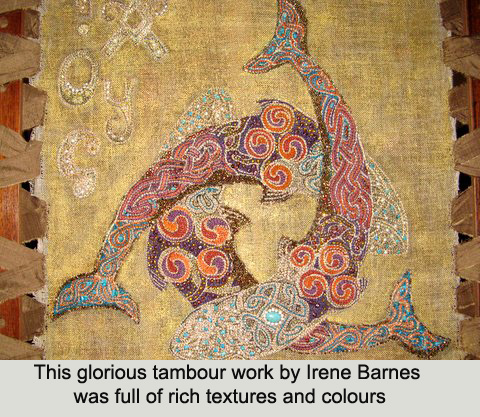 Saviour. Irene’s work combines a sense of worship with a great joy in created life.
Yvonne Bailey, with her customary assurance of vision and technique, showed three paintings, among which the Mare and Foal had tremendous presence and solidity. Donald Campbell, with a more flamboyant handling of paint, contributed an excellent snowscape of a tumbling waterway called River Gryffe Houston, Winter, while Nicky Gill’s poetic vision called Riders at Sandbrae had a timeless quality. Sheila Findlay is another consummate professional,and ring of branches, but with an open sense of sky and light, beautifully designed and executed.her small oil sketch called Beach Boy caught exactly a child’s absorbed interest as he investigates a rock pool. Jim Williamson again demonstrated his matchless mastery of water colour in his glowing, fluid Sunset, each area of colour set down perfectly right and left untouched.
On a much larger scale, Michael C.Grant de Longueil showed, among six excellent compositions, a painting called Study of Waves off Kildonan that repaid long gazing. The movement and ferocityof the water was exhilarating exactly because it had been accurately seen and freely rendered – in all senses, a big achievement. Shelagh Collins, in complete contrast, showed intensely personal small pictures, the best of which was her exotic and decorative Searching for Faith.
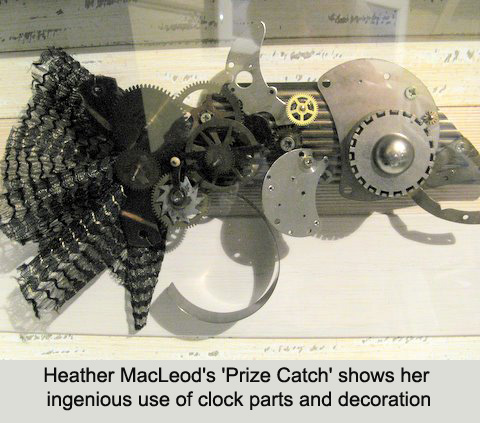
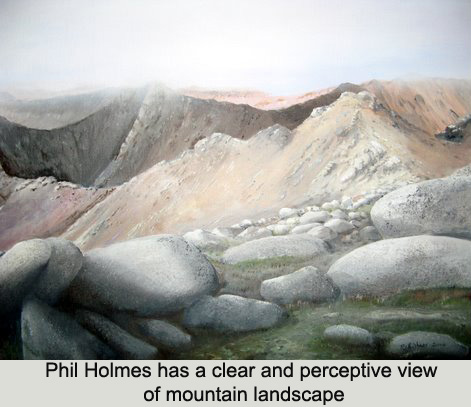 Phil Holmes showed mountain studies with a rare ability to make coherentsense of the shapes and textures that such craggy landscape presents. His View Northwards from Goatfell exemplified this clarity of vision and had a beauty of design and light that is all his own. Heather MacLeod meanwhile has found unexpected fascination in combining small pieces of clock mechanism with painting and appliqué of sequins, beads and all manner of decorative things. The result is a series of intriguing pictures, all of them witty and skilful. Her Prize Catch is a big fish that is utterly unlikely to be netted or hooked, and leads its own extraordinary life within a frame that, in context, seems like a waterless tank. Susie Thompson’s inventive creation called The Pearl Fisher has something of the same quality, a strange, skeletonic white dragon that looked as though it might be made of fish-bones, though it is in fact porcelain, studded with real pearls from mussels.
Masako Ritchie is an artist of such outstanding talent that her work should be in the international museums. The finesse she shows in her handling of Japanese sumi ink combined with other materials is extraordinary. Such an exposed technique allows for no correction or amendment – it has to be right first time. Every stroke of the brush, every placing of a piece of frayed gold fabric that will become a grass blade, is exact and unalterable, and such refinement of technique and judgement is very rare. It is impossible to convey in words the quality of her work, since each construct is its own poem. Arran is privileged to have her among us, creating such beautiful things
Click on the pictures above to see larger versions.


