

The first geologist comes to Arran
James Hutton was 61 when he first came to Arran, but he had the energy and curiosity of a much younger man. He had given up farming in order to explore the mysterious rocks and minerals that lay under the soil of the earth and was determined to work out why they should crop up in strange places.
Between 1767 and 1774 he was a member of the committee that was master-minding the construction of the Forth & Clyde canal, called in because of his growing reputation as a minerologist – but his interest was in the structure of the underlying rocks themselves. He started to travel all over the lowlands of Scotland on horseback or, where necessary, by sailing boats, studying the landscape and geology of the terrain.
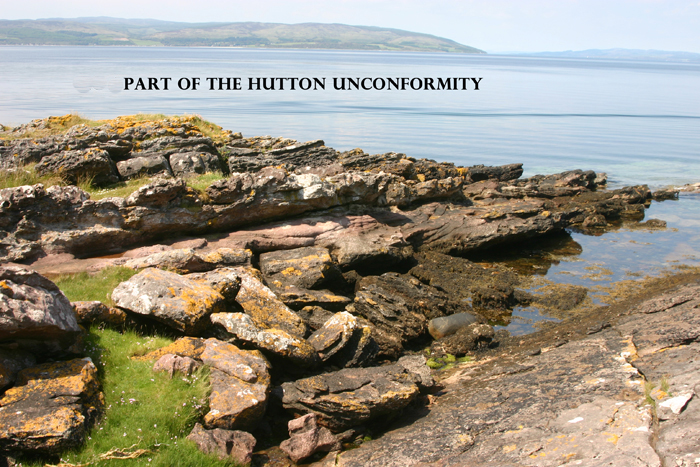
In 1787 he stared across at the craggy profile of Arran, and decided he must explore it. He crossed to the island and was at once fascinated by its rugged slopes and strange coastline, where such a mingling of different kinds of rock coexisted. It seemed to him that the accepted Biblical idea that the world had been created in a complete and finished state could not be true. It seemed obvious that some of these great rocks had parted from the larger strata to which they belonged. At the north of the island, between Newton and Laggan, Lochranza, he came upon an outcrop that baffled him. It was about 300 metres in length, and consisted of different layers. There was old red sandstone, carboniferous sandstone and new red sandstone, laid in layers above what we now know are dalriadan schists of the late Precambrian era. There were Permian conglomerates and Aeolian sands, with seams of carboniferous calcareous sands and limestone. It was a wild mixture, and there could be only one explanation for their coming together. At some time, these immense deposits had been in fluent movement. This did not conform to the idea of a permanent state of things created at one stroke.
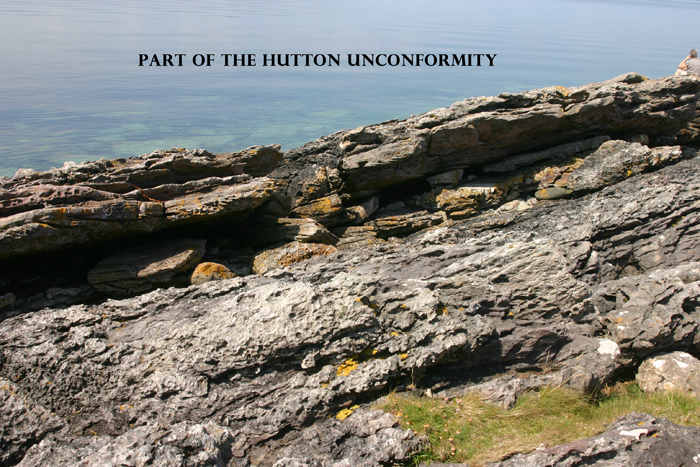
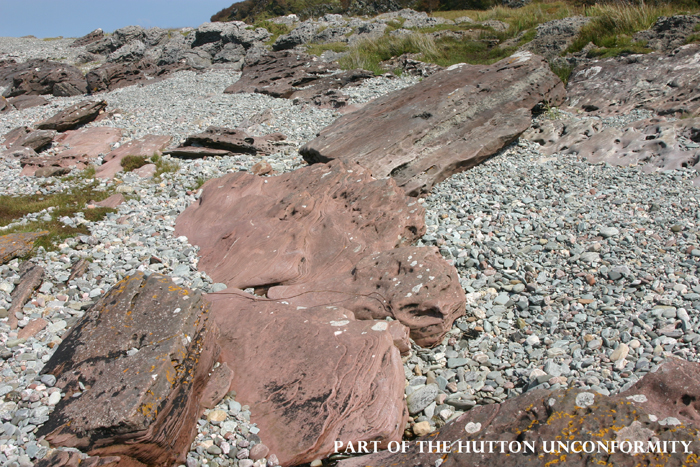
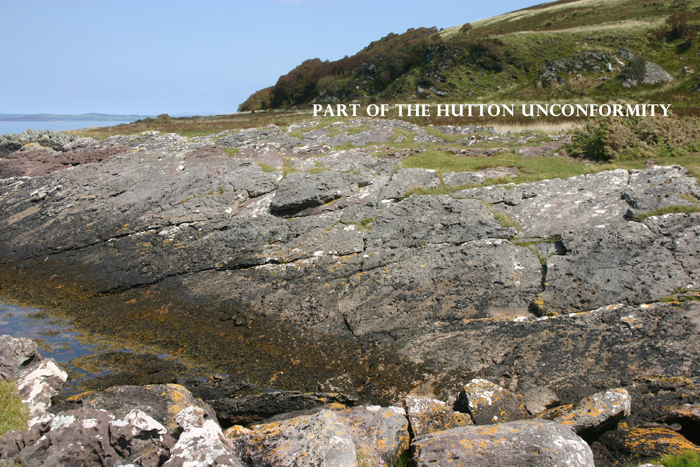
Click pictures above to see in more detail.
For this reason, the rock stratum at Newton, leaning in schist at an angle quite different from the sandstone lying at other angles, is still known as Hutton’s Unconformity. He saw that these rock formations must have come together over a long period of time, probably many millions of years. He also realised that the sea had played a part in this, for the raised beaches that are so notable on Arran show clearly that much of the flat land round the edge of the island was once under water.
Angular unconformities had been noted by earlier geologists who interpreted them in terms of Neptunism as ‘primary formations’, but Hutton suspected that they were evidence of later movement. He observed that ‘solid parts of the present land appear in general, to have been composed of the productions of the sea, and of other materials similar to those now found upon the shores.’ The more radical idea of Earth as a cooling mass of minerals did not occur to him, but he was the first person to deduce that the world familiar to us now had once been a very different place. He had already been working for many years on a book to be called Theory of the Earth; or An Investigation of the Laws observable in the Composition, Dissolution, and Restoration of Land upon the Globe. In it, he suggested that the earlier world had been composed of sea and land, with tides, currents, and ‘such operations at the bottom of the sea as now take place.’ He went on to assert that ‘while the present land was forming at the bottom of the ocean, the former land maintained plants and animals; at least the sea was then inhabited by animals, in a similar manner as it is at present.’ It was a bold concept.
Hutton wrote a paper on his findings that was read to meetings of the Royal Society of Edinburgh in 1785. Later that year he read an abstract of Concerning the System of the Earth, its Duration and Stability to a Society meeting, and had it printed and circulated privately. His theory of ‘plutonism and uniformitarianism’ suggested that the earth was much older than previously considered by academics and theologians. Some of the latter were outraged by this radical idea. A leading Irish academic, Dr. Richard Kirwan, FRS (1733 – 1812) said Hutton’s theories were blasphemous – but James Hutton worked on.
More about Hutton and the effect of his discoveries will appear in the May issue of Voice for Arran


