Dramatic Scottish History
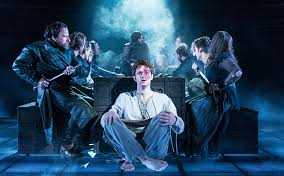
For this year’s Edinburgh International Festival, the Scottish playwright, Rona Munro, was commissioned to write a series of three plays on the lives of James I (The Key Will Keep the Lock), James II (Day of the Innocents) and James III (The True Mirror). Epic in its concept, this trilogy – each play over 2 hours long – entertained and educated in turns and the effect was, for the most part, exhilarating. I was particularly interested in this wondering how it might compare to Robert McLellan’s Jamie the Saxt.
We had chosen to do the marathon – all 3 plays on one day. Whilst this was a tad mentally exhausting it did bring a narrative continuity and an artistic totality to the experience.
The Scotland of 600 years ago was presented very cleverly, through Munro’s writing and an intelligent and adaptable set design with a contemporaneity which led the audience to the conclusion that our long dead political ancestors were facing circumstances not so very different from today – they simply had a different way of dealing with them, through “up close” personal violence and vengeance instead of spin and denigration through the media!
 James I only reigned for 13 years, having been a prisoner of the English king, Henry V for 18 years and marrying Henry’s cousin, Joan Beaufort which thirled him to England for the rest of his reign. His tenure was distinguished by bringing law to an unruly Scotland and establishing the power of the monarchy in order to improve government but ended in his own violent death.
The role of James I was played superbly by a young Scottish actor called James McArdle who portrayed the young king with passion, dignity and, at times, ferocity. A huge cast, including a sterling performance from Blythe Duff, created a breathless medieval world of battle, intrigue and turmoil and left us desperate to see what would emerge in the second play.
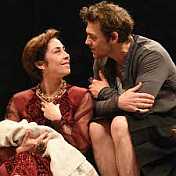
 James II was a minor when he became king at the tender age of six so that the rule of Scotland was divided between two powerful families, the Crichtons and the Livingstons. William Crichton was keeper of Edinburgh Castle and Alexander Livingston held Stirling Castle but as ambitious as these two were, a third earl was destined to shape the history of Scotland – William, 8th Earl of Douglas of the infamous Black Douglases. On his majority, James II spent most of his time bringing these powerful earls under his control and freeing the Scottish borders from the last remaining English garrison. It was achieving this in 1460 at the Castle of Roxburgh when he was killed by flying metal when one of his own canons broke apart. Again, convincing performances and clever stage design, including effective puppetry used to portray the boy king, left the audience keen to move on to James III.
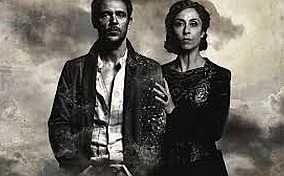
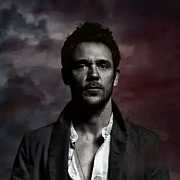 Yet another Scottish minority heralded the reign of James III. This time, his mother, Mary of Gueldres, ensured that powerful earls were kept at bay and a successful marriage to Margaret of Denmark which brought Orkney and Shetland under Scottish rule secured the largest territorial status of Scotland to date. James III, however was not destined to be a happy or successful monarch and died in a civil war fighting his eldest son on the opposite side.
This play had an extremely modern feel with interesting and powerful performances from Jamie Sives as the king and Sofie Grabol as Queen Margaret. Grabol is best known to us for her role in The Killing but she is a very talented stage actress.
The verdict on the plays was that they were an important addition to the modern Scottish canon but opinions might have varied as to their message.
Performed in Edinburgh just before the referendum might have seemed to some a resounding performance for the YES vote, although those on the NO side might have disapproved of the plays as propaganda and it will be interesting to see how they fare during the London tour.
Neither view would be correct, I think. These were plays about politics and humanity in the widest possible context using a neglected era in Scottish History to tell the tale. I think Robert McLellan would have approved given that the research was as meticulous as this period allows and there was humour and pathos in measures which would be favourable to the author of Jamie the Saxt. The only thing he would not have liked was the very minor use of the Scots tongue.