

Carradale: Marine Harvest Salmon Fish Farm Escapes
More than 16,000 Atlantic salmon escaped through a hole in a net overnight on 2 June at Marine Harvest’s Carradale fish farm. The damage to the net is believed to have been caused by a storm. The business support manager at Marine Harvest in a typical understatement said: “It’s a substantial loss, no doubt about it. Around 16,000 fish escaped each weighing around 10lbs. (4.5kg). These were worth over £240,000”. On the opposite side of Kilbrannan Sound, just 5 km (3miles) away is Arran’s west coast, with traditional salmon and trout rivers. This farm lies nearly opposite Dougarie Point.
Marine Harvest said the fish, which were not sexually mature, pose little threat to local salmon populations. Mr Bracken added: “Immature fish would tend to go out to sea. It’s unlikely they would head upstream to breed.” But it has to be asked, what happens if these farmed fish return to Kilbrannan Sound’s local rivers when they are mature? Interbreeding between wild and farmed salmon is becoming a problem. With increasing storms due to climate change and storm surges, the salmon farming industry should be looking at the very least to better, double netting.
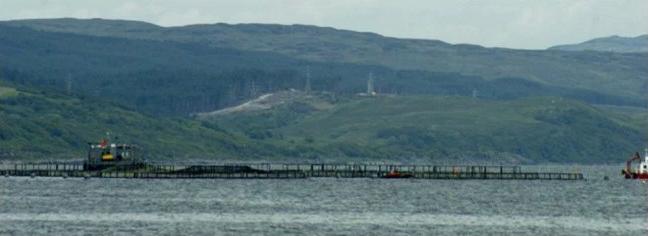 The escape from Eilean Grianain at Carradale is believed to be the largest from a Scottish salmon farm since 2009, when 59,000 fish escaped from a farm at Strone Point on the west coast of Loch Striven in Argyll operated by Lighthouse Caledonia, now part of the Scottish Salmon Company. Another recent salmon escape occurred in November 2014; operated by the Scottish Salmon Company, 2090 salmon escaped from Quarry Point fish farm situated at Crarae on Loch Fyne. Incidentally, Ireland’s largest single salmon farm escape in history was 230,000 salmon missing after storms significantly damaged a salmon farm in Bantry Bay, on 1 February 2014. Adding together these losses, it is clear animal husbandry and indeed the containment equipment employed is inadequate to cope with climatic conditions and storm surges.
Escapes are a serious problem as farmed salmon differ genetically to wild populations. In the wild, salmon are loyal to a particular river returning each year to spawn. Every river’s salmon population has adapted over thousands of years. If these escaped farmed salmon cross breed with wild populations they pose a significant threat to their gene pool. Farmed fish are designed to be aggressive feeders that grow fast. But, they are not used to dealing with predators, and do not have carefully attuned strategies for growth, maturity, timing of migration and resistance to disease that relate to their local environment. Scottish Salmon and Trout Association (S&TA) believe the fish from Carradale are mature, therefore they will migrate into important salmon rivers in the Firth of Clyde, genetically diluting wild stocks. “There is a real danger that these fish may survive in sufficient numbers to breed with wild salmon in this area, leading to the genetic dilution of the wild fish population with farmed fish, which are largely descended from Norwegian and not Scottish fish. This is very bad news for the long term survival of western Scotland’s wild salmon,” said Guy Linley-Adams, solicitor to the S&TA.
A research study, published by Professor Gage of the University of East Anglia, showed escaped farmed salmon are just as fertile as their wild cousins. While previously it was thought they may be less successful in reproducing in the wild, opinion is now changing. Professor Gage noted in the New Scientist in March 2014 that there is “ample evidence that escaped farmed salmon can survive at sea and get into spawning rivers. In some Norwegian rivers, large numbers of farmed fish have been recorded – accounting for as much as half of the salmon population in these environments. There is also evidence that farmed fish have successfully mated with wild populations: the genetic signatures of salmon in some Norwegian rivers now exhibit significant changes that are entirely consistent with wild/farmed hybridization”.
Scottish Ministers said in 2011 that they wanted to increase production of farmed Atlantic salmon by 50% by 2020 – that is about 70,000 tonnes extra capacity. If average farm size is just above 1,000 tonnes then that could be 70 new salmon farms! What a depressing thought if nothing is done to massively reduce the risk of escape.


