

Fish Farming in Lamlash Bay
Some readers may have seen the notice from SEPA, the Scottish Environmental Protection Agency, in the newspapers about an application from the Scottish Salmon Company (SSC), who propose an increase in cage depth from 10m to 12m in order to increase the number of fish held in the Lamlash Bay fish farm. Stuart Turner from Lamlash has been doing some research, and he points out that this means more feed, more fish excrement and more chemicals being released into Lamlash Bay. These chemicals are needed because the fish are kept at such a high density that they are vulnerable to sea lice, among other things, and these are causing a huge problem throughout Scotland:
www.salmonfarmingkills www.scotsman.com www.thecourier.co.uk
Stuart goes on to note that, despite its name, SSC is mainly owned by a Ukrainian banker and a Norwegian investor and although The Scottish Salmon Company Limited has an Edinburgh address it is a subsidiary of The Scottish Salmon Company PLC, which is registered in Jersey. There’s a list of their largest shareholders here. The details are that SSC is majority owned by Northern Link, a private equity backed by Edinburgh-based, Ukrainian-born, banker Yuri Lopatinsky. Northern Link and other shareholders own shares in SSC through a custodian bank, Six Sis AG. The second largest shareholder is Frode Teigen, a Norwegian investor who owns shares in a string of fishing and aquaculture companies including Marine Harvest and Austevoll Seafood.
Voice readers will be well aware that Lamlash Bay lies in the newly designated “South Arran Marine Protected Area” (MPA) which is an attempt to help rejuvenate the badly damaged fish stocks and marine diversity in the Clyde. COAST is not opposed to fish farms if they can be proved to be sustainable. Unfortunately they have not received information which shows they can be ecologically sustainable. Their view is that if we managed our wild fish populations sustainably there would be no need for fish farms. They will be discussing their response to this proposal in detail themselves but will be opposing an expansion of current activities. In the meantime they would encourage people to make their views known to their elected representatives and to SEPA.
If you would like to contact SEPA please send an email to registryangussmith@sepa.org.uk, and to our MSP’s email address: Kenneth.Gibson.msp@scottish.parliament.uk.
The application can be found on the SEPA website.
Stuart suggests some of the following points could be made in any response to the application:
- The fish farm is within a designated MPA. MPAs allow for multi-use but the assumption throughout the MPA consultation has always been that there will be no expansion of the fish farm within the MPA.
- Lamlash Bay frequently fails to meet the Food Standard Agency criteria for Harmful Algal Blooms (HABs). More organic waste from more fish and fish feed will not help to improve this situation.
- The fish farm is located too closely to the mussel farm. An expansion of the fish farm will only increase the potential of the fish farm to impact adversely on the mussel farm.
- A great deal of money and time was spent on an interceptor sewerage pipe by Scottish Water to take organic waste out of Lamlash Bay. An increase in organic waste from the fish farm will impact on the health of the wider bay and the seabed under the cages.
- The community on Arran with the backing of North Ayrshire Council has already made its position clear with regard to an increase of fish farm activity in the Lamlash area and around Arran. The community strongly rejected the proposal for a fish farm north of Hamilton Rock and has been opposed to any other increase in activity.
- The fish farm has suffered from fish disease in the past necessitating the transportation and incineration of tonnes of stock. An increase in the carrying capacity of the cages will only exacerbate the potential for disease.
- By increasing the cage sizes there will be the potential for greater numbers of farmed fish to escape into the wild if there is a breach in the nets. There has already been a major unplanned release of salmon from the farm at Carradale this year.
- Lamlash Bay is one of the most scenic bays in the Clyde and a huge draw for tourists and leisure craft. The fish farm is already an unsightly industrial installation and a source of noise pollution in one of the most natural areas of the bay. An increase in capacity will inevitably lead to an increase in associated operations, infrastructure and noise pollution.
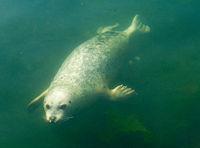 Meanwhile, ITV News on the 8th October ran a story about the number of seals being shot to protect salmon farms. Official returns sent to the Scottish government by salmon farms show that 110 seals were shot in the first part of 2015. Although officials say this is a 5% decline on the same period last year, campaigners are calling for a ban on the killings, and supermarkets are being urged to stop sourcing farmed salmon from ‘seal-unfriendly’ salmon farms. Protests are planned in Edinburgh (30 October) and in London (9 December) before a protest outside the RSPCA’s head office in Sussex (10 December).


