

‘Certified’ fish not truly sustainable
Sally Campbell of C.O.A.S.T is appalled that farmed fish may now be labelled “Sustainable” and “Responsibly Sourced.” She holds that it is vital to oppose the certification of farmed fish, as follows:
This is important for us all. As soon as a “Label” gets given, Salmond, Lochhead and others will trumpet the productivity of the Aquaculture Stewardship Council and every inshore area of the west of Scotland will be targeted for fish farms. The label will be used to “help” local authorities to allow planning. It is a really, deeply depressing picture. Please pass on to anyone who is interested in the sustainability of inshore waters. (If you are a WWF member please jump up and down!)
Sally holds that we need to oppose the spread of the fish farm industry on the following grounds:
- waste pollution and chemical contamination
- killing of wildlife including marine mammals
- sea lice infestation and the spread of infectious diseases
- the farming of non-native species
- escapes
- unsustainable and non-certified fish feed
- transgenic plants including GM soya in feed
- copper-treated nets and biocides
- use of antibiotics
- use of toxic chemicals such as cypermethrin and emamectin benzoate
- mortality rates of 20%
- deaths of workers
You can find C.O.A.S.T.’s response to Scotland’s National Marine Plan on www.arrancoast.com.
We reproduce a shortened piece about the Lamlash Bay fish farm by John Campbell, for the interest of anyone who has followed its chequered history. The full text is on the C.O.A.S.T website.
The Monk and the Fish Farm
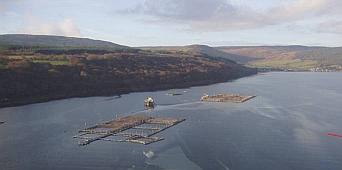 I wonder what Saint Molaise (or Molios in today’s parlance), who is reputed to have once lived as a hermit on the Holy island in Lamlash Bay, would have thought about a salmon fish farm named after him and located in the bay. Maybe he would have praised its aims to feed the masses or maybe he would have questioned its need, knowing that on his doorstep fish would have been plentiful in the surrounding coastal waters at the time. Today of course we have the fish farm and little or no fish in the surrounding seas, which doesn’t make sense in terms of ecological diversity. The NTZ in Lamlash Bay is a start to address this imbalance, and it is important to grasp this opportunity for the bay to provide a focus for recovery of the marine environment.
COAST keeps an eye on the fish farm to ensure that those responsible for its operation keep its possible impact on the waters of the bay within its existing licence parameters. SEPA has already turned down an application to expand the fish farm beyond its present licence requirements because the site appears to be operating very close to or perhaps even beyond its assimilation capacity. The ‘dilute and disperse’ approach for disposing of environmentally significant contaminants is a pollution disposal philosophy commonly practised until the 1970s but largely rejected today as an acceptable means of contaminant disposal.
So what is happening at the Scottish Salmon Company’s (TSSC) operation at St Molios – and how do we know? At least it is not truckloads of dead fish that has been the case in the past! The answer is that SEPA has provided COAST with information in response to a ‘freedom of information’ request and this provides a very interesting window on what is going on.
Every marine fish farms regulated in Scotland is subject to a renewable CAR [Controlled Activities (Scotland) Regulations] licence, Water Environment 201. This is granted by SEPA, provided that the sponsor can demonstrate that the site will provide the necessary assimilation capacity. This is measured by applying a standard mathematical model of how much waste sediment is dispersed and how much deposited on the seabed. No one site is the same as any other, as there are differences in tidal flow, sea bed topography etc. Because of this, each site has its own dispersion characteristics and therefore its own restrictions in scale. These should ensure that each one can keep within its permitted limits. SEPA lays down limits to quantities of fish stocked (biomass) and hence the permitted quantities of food to be used. It also limits the quantities of medicines and other chemicals applied.
The reported results for St Molios are reproduced by permission of SEPA on the C.O.A.S.T website and show a scale of quantities used that is fairly typical of any similar moderately sized operation.
COAST will continue to monitor performance, helped by the fact that there is much more information available that has relevance to the environmental condition of Lamlash Bay as a whole.


