

Weaving with Children
The ever-inventive Judith Baines continues her series on things children can make from simple materials.
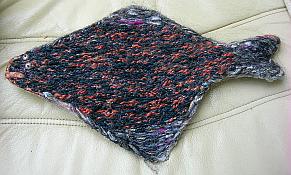 Interesting looms can be made from wire coat-hangers. Cut the hook off with wire-cutters near the end of the twist and bend the end inwards. Bend the wire frame into the required shape – a heart, a leaf, etc. The photo shows a flat fish – perhaps a plaice! Because the warp doubles up as you wind it round the wire, it provides a warp on both sides of the wire framework, so when it comes to weaving in and out of these strands, you can make the work double-sided. This is shown in the picture of the plaice. The warp stays in place if you bind the wire shape first. Children will need help with both the binding and warping up. Once that is done, however, these shapes can be great fun to weave, either by using your fingers or a big needle that will take four or five different threads.
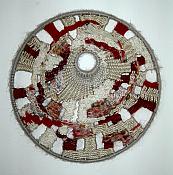
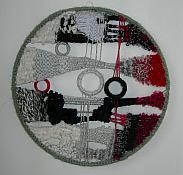 Rings bound and warped in the same way are also good to weave. One of them in the photos shows an impression of cinders and the other is from a lovely shell. The smaller ring in the middle of the latter allows a ray effect to be achieved.
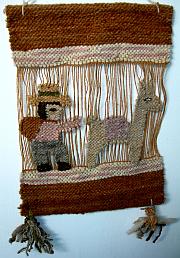 Other simple looms can made by warping up the triangular shape in a Y-shaped stick. There is no need to fill the whole shape, as you see illustrated in the lovely little Peruvian weaving. That does not use multiple threads but the single threads are very thick. Next time we will look at the learning that can be had from simply winding threads round a piece of card.
The Beading workshop that Judith ran for Arran Visual Arts last month was a great success. She says, ‘The three helpers were great and it meant that the students were able to choose from several items and select their own beads, which, of course, they loved doing! Four of them in the Lochranza area plan to have some more sessions.’ She adds that ‘The Dippin Beaders’ are now listed with The Bead Workers Guild as a recognised group.


