Issue 8

An appeal

Although nobody gets paid for contributing articles to the Voice, or for helping to edit it or doing the hefty job of designing it and putting it online, we do have expenses to cover. In addition, we’d like to produce it as a printed paper production, at least during the busy months of next summer, for we know there are a lot of people who don’t use computers and would like to see what we are up to. But this will mean we have to ‘prime the pump’ by undertaking printing and paper costs in advance. It was impossible in the summer that has just passed, but we have the coming winter to try to put some funding together for this. If you would like to contribute, you can either use the Paypal facility on our website or send a cheque made out to Voice for Arran, posted to Aorangi, Whiting Bay, Arran.


McLellan Arts Festival

September sees the exuberant McLellan Festival bursting forth again, full of good things and wonderful surprises. The Royal Northern College of Music will again be fielding a master-class course for its most expert students, many of whom are already in demand from international opera houses, and anyone who was present at their stunning Opera Gala last year will be keen to hear them again. Local singers are already perusing copies of the Mozart Requiem for a joint performance of that magnificent work on the final Saturday, September 10th, in Lamlash Church.

The festival kicks off on Friday 2nd September, 8.00pm, when the Ormidale Glasshouse will be hosting Arran and Beyond, with the splendid singing group, The Wild Myrtles, plus the well-known poet Alexander Hutchison, plus contributions from Arran’s thriving group of local poets.

The following morning, Alexander will be running a poetry workshop in Corrie Hall, starting at 11.00am. Anyone interested will be very welcome – you don’t have to have any experience. On the same night, also in Corrie Hall, there will be a crackingly good ceilidh, with a delectable supper, entertainment, music and dancing, all for a mere £5.00 at the door.

On Sunday evening, 4th Sept, a service in Corrie Church will feature singing by the Royal Northern College students and Arran’s own Peter Alexander Wilson, who is one of their tutors.

Because of illness, the hoped-for production of Robert McLellan’s short play, ‘Jeddart Justice’ on both the Tuesday and Wednesday has had to be cancelled. Unfortunately the historic film of McLellan’s story, ‘The Daftie’ will also be cancelled, but will probably be shown at a later date.

‘Arran on Film’ is a wonderful compendium of archive film shot on Arran from 1930 onwards, put together by the talented director, Edward O’Donnelly. This will be shown on Thursday, 8th September, with ample opportunity for the exchanging of memories and reminiscences!

This year’s fabulous Opera Gala takes place in the Community Theatre at the High School, on Friday 9th September. It’s a showcase of new talent that will without any doubt be shining out in the musical worlds of Europe, Asia and the Americas. The young people you will hear are stars in the making, some of them already becoming well known. To make sure of a place, it’s worth pre-booking a ticket from the Book and Card shop in Brodick. At £10 including a glass of wine or a soft drink, it’s a chance you will never get again, and you will be able to boast, ‘Ah, yes. I heard her/him in 2011, on Arran.’

Finally, Saturday 10th September sees an equally Gala performance of the wonderful Mozart Requiem in Lamlash Church, with Royal Northern College singers taking the solo parts and local singers boosting the chorus.

Children and young people of school age are welcome to attend all the events at the McLellan Festival free of charge.


Fabulous gift of a grand piano for Arran

For many years, the wistful idea that Arran could own a good grand piano has been talked about, but now, due to the immense generosity of Dr Colin Guthrie, the idea has become a reality. On September 6th, just in time for the big events of this year’s McLellan Festival, a magnificent 6'6" grand piano made by Kawai, a firm renowned for the easy action and beautiful tone of their pianos, will be arriving at the Lamlash Community Theatre.

The story of how this miracle came about began at the McLellan Arts Festival last year. When Peter Alexander Wilson brought his Royal Northern College of Music students to give their memorable Opera Gala, he was concerned that the island had no top-quality piano. Finding that the community had already set up a Piano Fund with a small start of £800, he began to cast around seriously for a suitable instrument. Martin Smith, who owns Peter Smith and Sons (Pianos) in Paisley, was keen to help, and the well-known pianist, John Wilson, came up from Manchester to try out the instruments in the showroom. He also came over to Arran to assess the hall acoustically, and decided that the Kawai would be the perfect piano for the island’s needs – but affording it remained a problem.

Dr Colin Guthrie enabled the dream to be realised. Modestly and with no fuss, he contributed £20,140, enabling the piano to be bought outright. It will be housed on an A-frame, allowing ease of movement in and out of the community theatre in the high school, where it will be kept, and undoubtedly it will attract top-flight pianists who seek to perform on a first-rate instrument. On September 9th, when the Royal Northern students again give a magnificent Opera Gala, those who attend that event will hear the piano all its glory. John Wilson, who had so much to do with choosing it, hopes to be present to give a short recital before the main part of the evening starts.

Colin Guthrie (pictured) is modest about his great contribution to the island. ‘The Arran community gives so much,’ he says, ‘and I’d just like to give something back.’ A wise and intensely creative man, he has lived on Arran full-time for three years since his wife’s death at a sadly early age, and has no truck with the commercial greed that is so dominant in today’s life. Music is important to him, and so are the detailed, simple pleasures of knowing every inch of a beach and its unexpected gifts. His cottage in Brodick, bought ten years ago as a holiday home but now his permanent centre, is full of the fascinating natural shapes of driftwood, eroded metal and the remains of machinery, seen for their visual possibilities. With the sensitive awareness of a natural and highly perceptive artist, Colin lives by standards that are not self-seeking or competitive, and Arran, which he describes as ‘emotionally digestible’ has in countless ways given him value that he treasures. That he has chosen to give the island such an opulent gift as a token of that value is a rare and touching thing, but as he says with characteristic modesty, ‘It’s something that will last.’

Colin at home with wonderful things found on the beach

Corrie Film Club

On Sunday 11th September, Corrie Film Club will be showing In Bruges, a 2008 black comedy set, as the title makes clear, in the beautiful, canal-threaded Belgian city that so many tourists wander through, armed with camera and chips.

The film stars Colin Farrell and Brendan Gleeson as two London based hit men, Ray and Ken, who are lying low after a botched job that has resulted in the death of an innocent boy. Their gangster boss, played by Ralph Fiennes, has told them he will be in touch, but meanwhile, the guilty two have nothing to do but take in the charms of the medieval city. Ken is deeply impressed by the glories of Bruges and feels himself to be enlightened and reformed, but the less experienced Ray is oppressed by the death of the boy, which happened on Ray’s first job. As Ken starts to feel himself newly sensitised, Ray meets Chloe, who is with a film crew shooting a movie starring an American dwarf named Jimmy, and he, too, has a change of heart. When Harry sends instructions for a new job, Ken doesn’t want to do it, and neither does Ray. But the pair of them are in the grip of Harry, who is about to descend on Bruges in righteous anger at the two slackers he has employed, and the outcome looks sure to be untidy, to put it mildly. Somewhere between laughter and dismay, this film is gripping and unpredictable, and the imperturbable beauty of Bruges sails over everything.

The showing starts at 8.00 pm, in Corrie and Sannox Hall. Entry is free, though a donation to the hall’s upkeep would be appreciated, and all are welcome.


Portrait-painting weekend

If you have ever wanted to get to grips with the art of painting a portrait, here’s your big chance. Neil MacDonald will be running a weekend of two workshops, 10.00 am to 4.00 pm, on the weekend of Saturday and Sunday September 24th/25th, at the Rangers’ Centre in Brodick Castle grounds. A model will sit during the two days. Organised by Arran Visual Arts, the weekend is open to all comers, at a cost of £70 to non-members, £50 to members. (Joining AVA is a clear benefit if you could be interested in ongoing workshops.) To book, send your cheque, made out to Arran Visual Arts, to Alison Barr at 6, Manse Crescent, Brodick, Arran, KA27 8AS.


An unsatisfactory meeting

On August 2nd, the Clyde Inshore Fisheries Group (IFG) held a ‘consultation’ meeting in the Auchrannie Glencloy Suite to ‘discuss’ the draft Fisheries Management Plan drawn up by the IFG itself. The quotes indicate that neither consultation nor discussion was seriously on the menu. The meeting had not been advertised locally, and when the first people started to come in, only two rows of chairs had been set out. The room filled up, with people standing at the back, slightly outside the folding doors and finding it hard to hear because of the noise from the adjacent restaurant.

As insistent questions were put, Billy Sinclair abandoned the Power Point presentation and instead outlined the IFG’s basic demands, which were to expand fishing to include other species such as razor fish, and to limit land-based line fishery to almost zero. The detailed paper handed out made reference to biological concerns and stock sustainability, but questions on how this sustainability should be achieved and maintained were consistently side-lined. Mr Sinclair paced to and fro irritably, and it became more and more clear that the IFG regards Clyde waters as its own territory and wants no regulation. One questioner pointed out that fishermen would have no livelihood whatever if the commodity (ie. fish) on which their industry was based became extinct, but this, too, failed to be taken up as worth consideration.

People started to leave the meeting, and at the end, those remaining were in agreement that the underlying crisis that threatens to overwhelm marine life in Clyde waters was being completely ignored in favour of short-term interests.


Letter to the fishermen

Following the above meeting, Rory Cowan sent us this copy of his letter to the CIFG, with detailed recommendations.

29/08/2011

Clyde Inshore Fisheries Group
PO Box 8509
Prestwick
KA9 9AE

Dear Sirs,

I attended your meeting at the Auchrannie on Arran earlier this month and enclose my comments.

I cannot help but think that the real problem is being deliberately ignored and what is being done is tantamount to rearranging the curtains on the Titanic as it sinks.

The real problem that needs to be addressed is the here and now and the function of the Clyde IFG appears to be to delay the day that someone will need to grasp the nettle.

I offer here a solution which will affect the commercial fishing industry no more than it is affecting itself right now and which will promote a sustainable fishing industry and valuable food source for generations to come. The alternative is a maritime desert, which is well in course of creation.

The time for pussyfooting around with discussion and consultation is long past and there is plenty of data already gathered, the most compelling of which is the change to, and volume of catch being landed.

The time for action is NOW and further delay is to the detriment of the interests of absolutely everyone concerned.

Is there a politician out there with the courage to do what is needed? I very much doubt it.

Yours faithfully,
H R Cowan,
Kildonan, Arran.


Corrie trip to Ailsa Craig

On the wet morning of August 4th, ten people, mostly from Corrie, drove down to Girvan and went on a fishing boat to Ailsa Craig, that sugar-loaf-shaped island that stands out of the sea beyond Pladda. The boat’s owner was out to check his lobster creels, but he obligingly circled the Craig so that we could see the thousands – perhaps millions – of gannets that nest on the northern cliffs of the steep island. There were so many that they looked like colonies of white flowers decorating the astonishing natural architecture of the rocky columns and gulleys. As David Underdown said with poetic insight, ‘It looks like some Victorian fountain table feature.’ Frozen sugar-guano, arrested in mid-flow. More frivolously, a flight of puffins rushed ahead of the boat, their little wings working overtime.

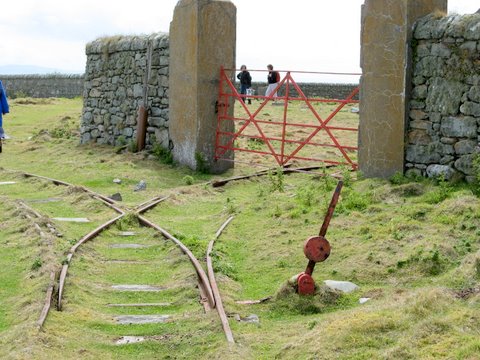
Completing the anti-clockwise circuit, we came back to the landing stage and ignored its severe notices warning that any persons setting foot on it did so at their own risk. The sun shining and the grass was full of flowers and rabbit droppings and sometimes the bones of the birds that live and die there. Dotted about forlornly were the abandoned artefacts left from the days when a colony of people lived there – a stone bread oven, a winch, the remains of an engine, a derelict gas stove with foxgloves growing beside it. There used to be a living on the Craig, when people hewed the fine granite for the making of Scotland’s best curling stones. They’d built a narrow tramway to carry the hefty blocks from the quarry place to the quay, and had a donkey to help with traction. The eroded sleepers are still in place, and sometimes the rails, with a set of points where the line branched. There was a haulage system in place, with pulley wheels to stop the rope chafing against rocks. A baby slow-worm, temporarily held in place under a walking boot, slid smoothly away when released, not by the head-then-tail method that true worms use, but moving all over, like the khaki-golden legless lizard that it is. Every stone is covered in glorious patching of turquoise-grey and lemon-yellow lichen, half-buried in heather and abundant mosses.

After a picnic lunch outside what used to be the dwelling-house, some people tackled the steep climb up to the fort on the hill, built in the 14th century from a small quantity of sandstone found among the granite. The less energetic walked along the shore, making for the astonishing foghorn built to warn shipping of the hazard that the island presented. Housed in a kind of small temple, its massive curved horn still stares out to sea, silent now, through its bellow could be heard from miles away. It worked, amazingly, on compressed air. Most of the pipes have rusted away, but the mechanism can still be seen. Had the little colony managed to last out a few more years, until the advent of the Internet and easy communication, they might still be there to this day. At that time, human physical ability was their only asset, and the deaths of men whose strength and skill were essential to that way of life brought it to an end. We looked back across the wake of the returning boat with some regret, for the rocky island remains a strangely tranquil place, brooking no argument but secure in its intrinsic strength.

Click your mouse on any of the pictures below to see a larger version.


Paul Tinto in Edinburgh award-winning play

Arran’s Paul Tinto, well known as an accomplished actor even before he left school, is one of a trio who have just won a Scotsman Festival Fringe First Award for a play called Release, put on by Icon Theatre. It has also been nominated for an Amnesty International Freedom of Speech Award – a double accolade seldom seen, and indicating that this three-hander is making a strong mark on public awareness.

Release is a powerful 75-minute drama dealing with the difficulties encountered by people released after a prison sentence, and the lack of rehabilitation and support that ex-prisoners all too commonly find. The three actors play at least ten very real and convincing characters in little over an hour, and expose a scenario in which the pressures and uncertainties are all too likely to result in re-offending and further imprisonment.

Both The Times and the Scotsman have reviewed the play well, with Joyce McMillan of the Scotsman using Release as her theme in a further piece about the demands for harsh sentencing that have followed in the wake of the riots. The play is currently running at the Pleasance Dome in Edinburgh, so if you are over there to dip into the Festival’s delights, don’t miss it.


Weaving with Children

The ever-inventive Judith Baines continues her series on things children can make from simple materials.

Interesting looms can be made from wire coat-hangers. Cut the hook off with wire-cutters near the end of the twist and bend the end inwards. Bend the wire frame into the required shape – a heart, a leaf, etc. The photo shows a flat fish – perhaps a plaice! Because the warp doubles up as you wind it round the wire, it provides a warp on both sides of the wire framework, so when it comes to weaving in and out of these strands, you can make the work double-sided. This is shown in the picture of the plaice. The warp stays in place if you bind the wire shape first. Children will need help with both the binding and warping up. Once that is done, however, these shapes can be great fun to weave, either by using your fingers or a big needle that will take four or five different threads.

Rings bound and warped in the same way are also good to weave. One of them in the photos shows an impression of cinders and the other is from a lovely shell. The smaller ring in the middle of the latter allows a ray effect to be achieved.

Other simple looms can made by warping up the triangular shape in a Y-shaped stick. There is no need to fill the whole shape, as you see illustrated in the lovely little Peruvian weaving. That does not use multiple threads but the single threads are very thick. Next time we will look at the learning that can be had from simply winding threads round a piece of card.

The Beading workshop that Judith ran for Arran Visual Arts last month was a great success. She says, ‘The three helpers were great and it meant that the students were able to choose from several items and select their own beads, which, of course, they loved doing! Four of them in the Lochranza area plan to have some more sessions.’ She adds that ‘The Dippin Beaders’ are now listed with The Bead Workers Guild as a recognised group.


NAC considers ‘Cultural Partnership’

North Ayrshire Council’s Executive is seeking to develop a new Cultural Partnership between the Council and representatives from North Ayrshire’s arts, heritage and culture sector. If agreed, the Partnership would be ‘underpinned by a strong sense of community with key arts and culture organisations invited to nominate a representative to become part of a strategy group.’

The report states that ‘a strong working partnership with a cohesive cultural strategy would help boost not only arts, heritage and cultural opportunities, but would contribute to the growth of civic pride within North Ayrshire.’

Well, yes, everyone knows that. What’s needed is less bureau-speak and more actual communication. Work from the ground up, not from the air downwards.


Stagecoach divvies up the profits

Not as many buses as we’d like? Fares a bit high? Yes, but it is making lovely money for its owners and shareholders. Brian Souter has just awarded himself £51 million, and his sister, Ann Gloag, nets just under £37million. The lucky shareholders are rejoicing in an issue of £340m. Let nobody tell you they couldn’t have kept running the useful X16 route from Ardrossan to Edinburgh.


Crocosmia in my garden

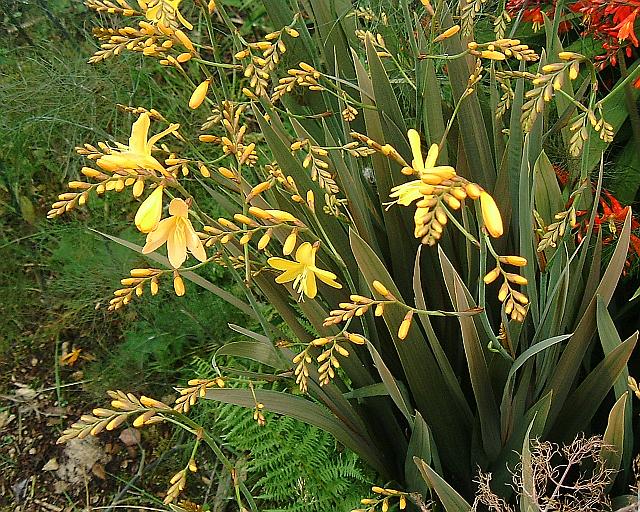
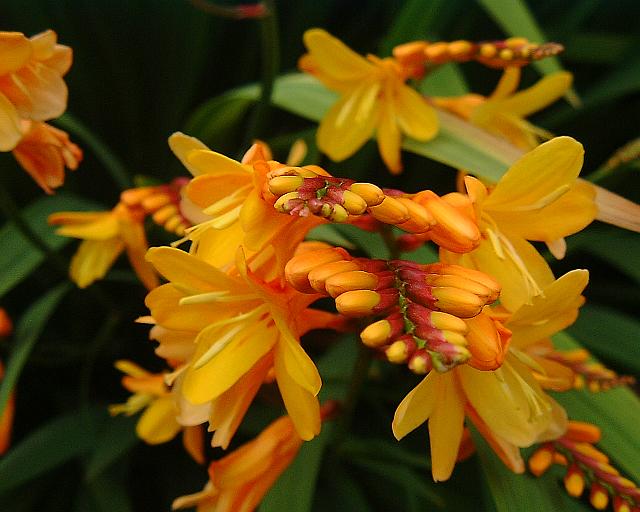
This month the roadsides of Arran are bright with spikes of little orange flowers, a garden escape and successful coloniser which originated in South Africa. It's called montbretia and their cheery survival is an indicator how tough and adaptable their family is.

They are cousins to Crocosmia, whose many named varieties have been bred for the garden in every shade of yellow red and peach. The little brown root corms increase rapidly underground so a few corms soon make a generous clump. Given a sunny site, on Arran they need no winter protection or special care; some of them self-seed generously and even interbreed; making it a hard decision to pull up love-child seedlings..at least until they have flowered.

Click your mouse on any of the pictures below to see a larger version.


Marine Research in Lamlash Bay

Marine biologists from the University of York are now well underway with this year’s surveying of Lamlash Bay. Leigh Michael Howarth, the PhD researcher leading the team, sends us this account:

This summer is proving hugely exciting, there is just so much going on. Myself and fellow researcher Tim Cross are continuing with the SCUBA surveys that started last year. We began by recording all the life we encountered during dives whilst simultaneously measuring the abundance and size of all the scallops. These surveys will then help determine if the No-Take Zone is of benefit to local scallop populations and other marine wildlife in the area.

Then we introduced our new idea of taking photo quadrats, in which we take detailed photographs of the seabed. Then, using specialised software, we try and determine if the seafloor within Lamlash Bay No-Take Zone is showing any measurable signs of recovery.

Another new addition to this year’s surveys is our baited underwater video camera system. With this, we are beginning to collect data on the fish populations within and around Lamlash Bay. The footage recorded so far has been both exciting and surprising, revealing species long thought to be gone from Arran’s waters, including juvenile cod, haddock and whiting. A collection of video clips have been made available on the Community of Arran Seabed Trust’s (COAST) website and are proving to be very popular.Tim Cross, Leigh’s fellow-researcher, takes up the story. “On the whole, I think the work’s been going really well. We’ve had some pretty challenging conditions, what with unusually cold waters this late in the year and huge numbers of lion’s mane jellyfish, but the work is involving and interesting, and it’s great to be part of a project with such long-term potential.”

Two Masters students, also from the University of York, have also begun conducting other new surveys on Arran. Ross Greig has been working with Arran’s only traditional creeler, Charlie Weir, to gather background data on the size, sex and age of crabs, prawns and lobster in our local waters and Rachel Bower has been trying to investigate the social effects of the No-Take Zone on local businesses, residents and tourists. Please contact Ross at rwsg500@york.ac.uk , or Rachel at rebower88@gmail.com if you would like to be included in their surveys.


COAST scheme to create MPA sparks interest

People were keenly interested by the COAST road shows and their plans to propose a Marine Protected Area (MPA) round the south coast of Arran, and many of them were happy to stick Post-It notes on the map showing the proposed area that would include the existing No-Take Zone (NTZ) in Lamlash Bay. The proposed MPA would be a three mile limit around the south of Arran (from Corriegills Point to Drumadoon Point) which would prevent scallop dredging and bottom trawling for prawns but, unlike an NTZ, would permit creeling, scallop diving and sea angling. The Lamlash Bay NTZ, would keep its current status.

In addition, Ross Greig of York University (pictured) would like to find out how much sea angling used to happen on Arran before the fish began to disappear from the sea. If you have any knowledge or family memories of this, he’d be very grateful if you could fill in the following questions and e-mail them to him. The title of his survey, ‘I once caught a fish…’ is suitably nostalgic, and brings into sharp focus what we have lost.

“I once caught a fish....”

A series of short questions to assess angling in Arran and attitudes towards conservation. Please print the survey form and when you have completed it, hand it in to the COAST office at The Old Haybarn in Lamlash.

Please click here to print the survey form.


There’s still time to join this year’s Arran Mountain Festival!

Corinna Goeckeritz

There’s still a chance to book on some fantastic hill walks during the 2011 Arran Mountain Festival, although spaces are limited and they are filling up quickly! As usual, all walks are led by qualified mountain leaders with lots of local knowledge. Groups are small and accompanied by a co-leader as well for extra support and banter, making for an intimate atmosphere. It’s not just about bagging hills in the safe hands of a guide – you’ll also find out about Arran’s natural and cultural history. On most walks, there are good chances of spotting some of Arran’s amazing mountain wildlife such as red deer and golden eagles. Take a look at the festival website to see what’s on offer.

How about the Goatfell Murder Walk, which leads you to the site where the body of Edwin Rose was discovered under a boulder 122 years ago. With the expertise of local historian Stuart Gough, make up your own mind: Was he murdered or did he fall to his death?

If you don’t fancy quite as big a hike, the Lochranza Laggan Loop takes you along the stunning coastline at the northern end of Arran. The route has some very interesting geological features and is steeped in history. There are usually plenty of seabirds to spot and with a bit of luck, the resident otters might be out to play!

Similarly, the Holy Isle walk offers a less strenuous and shorter, but by no means less rewarding and interesting, day. The Buddhist-owned island truly is a special place, with stunning views across to the main Arran hills. Even though it’s just a short boat ride away from Arran, it feels entirely different and definitely has its own atmosphere. Spot rare breed sheep, goats and ponies and admire colourful Buddhist rock paintings along the way. The walk is led by local wildlife guide Lucy Wallace and Andrew Binnie, the Community of Arran Seabed Trust’s (COAST) new project officer, so as well as finding out about the terrestrial wildlife, you’ll discover all about Arran’s pioneering No Take Zone and its inhabitants.

As last year, we are running a National Navigation Awards Scheme accredited navigation course. At the time of writing, there are still spaces available. This certificated one and a half day course will equip you with the basics for navigating in the hills using map and compass, so you can head out on your own in the future!

Even if you are an armchair mountaineer, there’s something for you in the festival programme. On Friday 16th September, don’t miss the second instalment of the “Best of Kendal” outdoor films. The film night in August was hugely popular, and we are hoping for an equally good turn-out for the second batch of adrenaline-pumping films. The evening is kindly sponsored by Wooleys the Bakers, who will be supplying tasty treats such as soup, filled rolls and mini-pizzas (food tickets are available on the door for an additional £5).

On Saturday night, after leading the A’Chir ridge walk, charismatic Mountain Guide Mick Tighe will entertain us with a lively illustrated talk about his mountaineering adventures in Scotland and Scandinavia. A professional guide and climber, Mick has a very impressive mountaineering CV. He has worked as a Mountain Rescue training officer and team leader of Lochaber Mountain Rescue. He also features in “The Pinnacle”, Friday night’s main film. So no doubt, he’ll have a few interesting stories to tell! The Shorehouse in Brodick is kindly sponsoring this event. Following the talk, it’s time to put on your dancing shoes for the annual Mountain Festival Ceilidh, when the String Road Potholes will keep you off your seats. All dances will be called, so even beginners can join in!

I hope we can tempt you to join in and celebrate Arran’s breath-taking mountains with us. Whether you are a first time visitor or a local, we very much hope you will support this community-run festival, be it by signing up for a walk, attending our evening events or by simply spreading the word!

A massive “thank you” is due to all the volunteer walk leaders and committee members and our sponsors and supporters, without who the festival would not be possible.


Sellafield – what now?

The Sellafield Mox nuclear fuel plant on the Cumbrian coast was closed on August 3rd, 2011. It was set up in the early ‘90s to produce mixed-oxide (Mox) fuel, which is made by re-processing plutonium and uranium previously used in power production. Tepko, the Tokyo Electric Power Company, had signed up to use 50% of the Sellafield output in its nuclear plants, but the Japanese earthquake and tsunami changed all that. Following the disaster, Tepko, who own the Fukushima plants, could buy no further fuel, and Sellafield lost its only market.

© The Guardian

Reader’s letter

Ferry committee and Arran Community Council

When the Arran Community Council enlisted the help of MSP Kenneth Gibson regarding the difficulty of getting information from the Ferry Committee, he was not aware of the longstanding dissatisfaction felt about the lack of publicly available minutes. Mike Lunan’s football coach analogy, “Coach’s team talk is not made public” is fine for a private organisation but the Ferry committee is an important instrument of local government and vital to Arran. When “transparency” has become a watchword for national and local government it is extraordinary that the Ferry Committee proceedings should remain under cover.

It may be that the ferry service is one that “30 years ago islanders could only dream of having” but with the increase in wealth and prosperity until recently is that surprising? The Community Council has not criticised the Ferry Committee actions since we don’t know what they are, but we feel justified in expecting to see the minutes and we’d like to decide for ourselves whether the committee is truly representative of the wider Arran community. This is vital, of course, in discussing the issue of what type of RET will best serve Arran. Let’s have this out in the open.

John Inglis
Chair of Arran Community Council


Was the new High School a stitch-up?

The private finance initiative (PFI but in Scotland PPP, private/public partnership,) is turning out to be a very expensive way to build schools and hospitals. A cross-party committee of MPs has told George Osborne he must wean the government off this money-wasting scheme. Why the sudden fuss? Probably because the Financial Times on August 8th of this year gave extensive coverage to the fact that the taxpayer is paying ‘well over £20 billion in “extra” borrowing costs – equal to more than 40 big hospitals.’

The attraction is that it’s a ‘buy now, pay later’ deal. As in the case of Arran High School, the public sector (NAC) commissions the project, but the private sector built and maintains it. The commissioning authority doesn’t have to raise the money up-front, so if it already has debts, it has not (at least, on paper) added to them. But of course it pushes a huge debt ahead of it, for later generations to face for the next 30 years or so. Maintenance of the building is in the hands of its private provider, not the local authority, as we know to our cost. The bills for checking gutters and changing light-bulbs are apt to be extremely high – far more than if local workers did these jobs.

‘A racket’

George Monbiot, writing in the Guardian 23.11.10, advised that we should stop honouring these private finance deals, since they are against the national interest. He pointed out that the NHS now owes £50bn to private companies for infrastructure that cost only £11bn to build, since the maintenance charges came to £15bn. In the summer of 2010 Edinburgh Royal Infirmary, because of the extortionate terms of its PFI contract, faced a shortfall of £70m. The contract stipulated that it must not reduce maintenance work, so instead it was forced to cut beds, nurses and doctors.

Plainly, these binding conditions are, as Monbiot puts it, ‘an outrage, a racket.’ In his view, the debts resulting from contracts such as the one governing the new High School were incurred without the consent of the people and against the national interest. As such, they come under the legal terms of Odious Debt, usually applied to sums extorted by dictators in the developing world. It means that the debt has not been agreed to by the citizens whose taxes pay for it. In 2008 Ecuador refused to pay debts that had been incurred by previous governments against the wishes of the people.

It is a fact that nobody on Arran knew about the PPP scheme to build 4 new schools in North Ayrshire until we were informed of a ‘done deal’. The blame, however, does not lie with NAC. Monbiot points out, ‘Blair’s administration gave public bodies no choice: if they wanted new projects, they had to use the private finance initiative.’ And the private finance deals are notoriously secretive. They are never published, so nobody can read them – not even MPs. There is no way to be sure if the costs are justified. If a public body wants a new school or hospital, it has to show that a private finance deal is the cheapest way to do it. But the snag is that once a bidder for the job is chosen, the original estimates are junked.

‘Odious debt’ is of course a hot potato, but it is cooling rapidly. Iceland had little hesitation in declaring a ‘Can’t pay, won’t pay’ approach to its creditors after the collapse of its banks, and is doing very nicely as a result. Greece, according to a newly-published book, is thinking of the same thing, on the basis that the Eurozone landed it with a huge loan that it couldn’t repay. The mighty US itself, with debts in the trillions, is shrugging them off through printing money, which comes to the same thing. No cash? Then let’s use the pretend stuff. But it’s worth watching the situation, because PPP’s credibility is badly blown, and the Westminster government seems at last to be waking up to what’s been going on.


Arran’s Agriculture

The second instalment of Jim Henderson’s survey of Arran’s agricultural history takes us up to 1800.

In 1766, when the seventh Duke of Hamilton was only 11 years old and still at Eton (he died only three years later) his trustees commissioned John Burrell, a factor at the Duke’s Firth of Forth estates, to draw up plans for ‘improving’ the Arran estate.

An old croft at Pirnmill.

Massive tar sands protest in the US

On Saturday 20th August, campaigners began to gather outside the White House in Washington to begin a two-week-long protest against the Alberta tar sands pipeline. They have turned up in cars and camper vans from all over America, prepared for a long sit-in. About 1,500 people have signed up to accept the possibility of arrest and it’s predicted to be the biggest green civil disobedience action the US has ever seen.

The State Department is expected to produce its final environmental analysis of the pipeline by the beginning of September, and from then, Barack Obama will have 90 days to decide whether going ahead with the project is in the national interest. The massed crowd outside the White House knows this is the last chance to persuade the President to stop the planned 1,600-mile pipeline that will carry oil from the tar sands of Alberta across rich American farmland to the Gulf of Mexico.

The existing ‘Keystone XL’ tar-sands project has caused immense environmental protest. Its pipeline from Canada already brings 591,000 barrels of diluted bitumen, the technical name for the thick oil mixed in the sands, to refineries in Oklahoma and Illinois. The extra energy needed to mine the oil from the sands of Alberta and to process it creates 40% more greenhouse gas emissions than conventional oil, and the open-pit mining that is already happening has devastated Alberta's forest lands. The new pipeline would increase the capacity to 1.3 million barrels a day and deliver the crude to refineries on the Gulf Coast.

Here in Scotland, our own Co-op has voiced its concern about the desperate oil-seeking technologies now being unleashed. Its current Re:act magazine carries a piece called The Future of Fuel, pointing out the serious dangers of ‘fracking’ for shale gas and calling for an expansion of renewable, non-damaging forms of power generation. Well done, the Co.

PS - Despite all this public outrage, President Obama decided on August 29th to go ahead with the pipeline.


Sustainable power generation

Tidal turbines

There are two different ways to derive energy from the movement of the sea. The big one at the moment is through the use of tidal turbines submerged in the water but working essentially in the same way as wind turbines. The other, which we will feature next month, uses the movement of the waves through a relatively simple technology. There’s also Ocean Thermal Energy, which works on the same heat exchange principle as ground source heating for houses. But for now, let’s look at turbines that use the movement of the tides.

Tidal power is still fairly new. The world's first tidal turbine was tested in 1994 in Loch Linnhe, but it’s now in the Museum of Scotland – this technology has been developing fast. We now have the Sound of Islay Tidal Project, being constructed in the fast-moving water between the islands of Islay and Jura. It consists of ten 1MW Hammerfest Strøm HS1000 Tidal Turbines which will be fully submerged on the seabed just south of Port Askaig. ScottishPower Renewables (SPR) claim that this Tidal Array, costing £40 million, will generate about 30GWh of electricity, providing energy for 5,000 homes, around double the number of houses on Islay and Jura.

The map shows the position of the turbines, in the narrows between the two islands.

How does it work?


Each turbine looks approximately like the picture on the left.

The numbers on the next picture show the system.


Marine News

FISH opens Tobermory Lifeboat Day

Fresh from wowing an Arran audience, FISH, the acclaimed musician and former front man with MARILLION, bustled over to Tobermory where he played a gig and then opened the Tobermory Lifeboat Day on the following Sunday morning. A diver and keen supporter of the RNLI, FISH was more than ready to help raise funds for the RNLI.

Mull and Iona School Pipers piped the lifeboat Elizabeth Fairlie Ramsay across the bay, and the volunteer crew welcomed hundreds of people aboard before the Severn Class lifeboat took part in a display with the Royal Navy's Rescue Helicopter Rescue 177 from HMS Gannet, Prestwick.

The picture shows Fish with Tobermory Deputy Second Lifeboat Coxswain at the event.

Yacht rescued

On August 18th the 56ft yacht Tenacity ran aground on rocks at Rubba Fionn-aird, some 5 miles north of Oban. Four people were on board, one of whom sustained facial injuries in the collison. Oban's lifeboat Mora Edith MacDonald came to the aid of the Tenacity, but on the ebbing tide, had to stand by to ensure the yacht was stable when the water was at its lowest at 3pm. The lifeboat then returned to station and came back to the grounded yacht with a ‘daughter boat’ that managed to get a towline on the Tenacity, as the picture shows.

The yacht was taking on water but her pumps were coping and the lifeboat volunteer crew escorted her into the marina on the Isle of Kerrera where arrangements were made to have her hauled out later that night.


Heather Corbett Concert

A review by Samantha Payn

How fantastic it was to hear Heather Corbett, supported by Dave Lyons and Julia Lynch tonight at the Community Theatre in Lamlash.

“Percussion” covers such a wide range of sounds, and Heather offered us such a wide, wide range of music. From ragtime (“The Entertainer”, “Jovial Jasper”) through jazz (“Blues for Gilbert” and a Loussier-style “Solfege” by CPE Bach), pieces specially written for Heather (“Sakura for Marimba and Piano” by John Hearne) to classic showpieces like Khatchaturian’s “Sabre Dance” and Rimsky-Korsakov’s “Flight of the Bumblebee” – all brilliantly played by Heather and her friends.

Heather played the marimba, the vibrophone and the xylophone – I’d forgotten that the xylophone was once a phenomenally popular music hall act, but watching Heather I could see why. Just about everyone had a xylophone or something like it as a child, but the contrast between what we all achieved as toddlers and tonight’s performance was mesmerizing. Seeing her hands fly over the notes with such precision making such lovely music was an experience not to be missed.

The Isle of Arran Music Society is really lucky to be able to entice world-class musicians to our island to play for us, and it was a real privilege to be at tonight’s concert.