

The History of Agriculture on Arran
Changing from the old runrig system to something like modern farming did not happen easily. An old Jacobite, James Bain Fullarton, led the resistance to Burrell’s plans for Arran – and people had good reason for complaint. Prices were rising fast, producing easy profit for the upper layers of Scottish society but somehow failing to ‘trickle down’ to working people. The price of corn rose by at least one-third, and cattle were making double the money seen in the previous thirty years. By 1766 it had risen still higher. The new farming system was producing rich profits, but there was no benefit to people who had lived in the same simple way for centuries. Burrell and the Dukes of Hamilton saw the situation as one that could only be improved by progress. It was decided that the 99 run-rig farms on Arran, then supporting some 1100 families, would be divided into 250 farms, each to support one family. The change sounded simple, but in fact it took 70 years from 1772, when the first leases came up for renewal, to the completion of dividing the Duke of Hamilton’s estate into 458 family farms. This was far longer than Burrell anticipated. Most of the changes on the western side of the island did not happen until well into the nineteenth century.
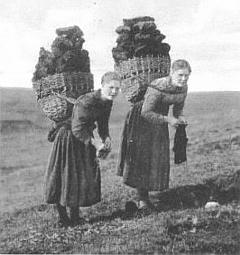 During this time, the population count was rising, but the islanders were struggling to meet increased rents or, in some cases, to survive at all. Burrell’s policies led to as many as 800 families losing their holdings and therefore their homes. Burrell did what he could to soften the blow. He spent money on mining work at the Cock of Arran and boring for coal at Lamlash, and tenants at Corriecravie and Tormore were relieved of the collective responsibility of debt. He also offered incentives to make the new system work well, with for instance a prize of 6 guineas for the best field of cabbages. Meanwhile, modernisation was in full swing.
The 1800’s heralded the arrival of Robert Bauchop who surveyed on Arran for five years, drawing up plans for the new land divisions due to come into effect in 1814. Both he and the 10th Duke of Hamilton (1767 – 1852) were enthusiastic supporters of Burrell’s recommendations. As leases expired the old runrig system disappeared with them. Arran farmers had to make good the debts of their neighbours to obtain the tenancies and were required to build a new house within a year, for which they were allowed relief of one year’s rent. Some managed to do this, but others could not, and inevitably, there was discontent. As always in times of social unrest, protest was viewed as undesirable, if not downright sinful. Grave fears were expressed that many of the population had become ‘more openly abandoned in wickedness.’ This frightening scenario probably prompted the religious revival led by the Rev. Neil McBride.
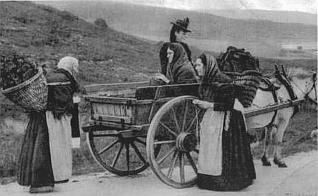 Farmland management was not the only thing to change at this time. A road was built between Brodick and Gorton Alister, Lamlash, paid for by the Government and the Landowner. This made travel much easier and increased the use of wheeled vehicles as opposed to heavy wooden sledges. In 1817 the String road was built, connecting Brodick and Shiskine, and the Ross to link Lamlash and the South End. Another new road linked Brodick and Sannox. Progress indeed. And for all the complaints and hardships, Arran’s population reached 6500 in 1823, the highest ever recorded. There may have been some incomers, for the island became much better connected to the mainland when the steamboat Helensburgh began sailings from Greenock to Arran via Rothesay, returning via Millport.
Despite these successes, an increasing number of people could not meet the new rents demanded, and the big farms were not the same thing as the traditional, self-regulated system that they were used to. By 1880 the Hamilton Arran estate comprised 99 farms supporting over 1,100 individuals, but the nature of the work was very different. Mass employment had set in. It was reported that one farm in the Southend of the island had a population of 300 souls (between 30 & 40 couples with their families), working as agricultural labourers rather than self-employed peasants. For those not engaged in this large-scale work, there was little to hope. The old system had gone, and they could not afford to buy their way into the new one. From the landowner’s point of view, these people were a problem and a nuisance. Emigration provided a useful answer, though it probably only attracted the more capable of the dispossessed people. A steady trickle of islanders had been emigrating to North America over the years but by 1829 large numbers of Arran residents were being encouraged to find a new life in Canada.
For those who stayed on the island, the industrial revolution was beginning to take effect. The new roads, improved transport and development of the rail network system on the mainland, began to influence many changes in the Arran lifestyle. Working with iron became newly vital as horses working on hard road surfaces had to be shod and cartwheels needed to be iron-rimmed. Almost every community had its own blacksmith, as can be seen from the various ‘smiddy’ references still found on the island. Lamlash had two smithies, one in the area of the present Aldersyde, the other opposite Glencraig. The local blacksmith had many uses, not all of them agricultural. He sometimes acted as a desperate port of call for locals suffering from toothache. Progress, even if it disrupts life and causes difficulties, is often a great benefit – specially in the arts of medicine.


b-420x280.jpg)