
With the visitor season starting and all sorts of activities scheduled, please bear in mind that the Voice is happy to give publicity and support to any event you may be planning. Our charges are painlessly small, and all enquiries for adverts are designed with meticulous care. Just click on Adverts or e-mail info@voiceforarran.com, and we do the rest.
Cookie assurance
From May 26th 2012 all website owners and operators will be required by law to obtain consent from all users to approve the use of cookies on their site. Cookies are small text files stored on users’ computers which allow websites to store information about the user’s activity on that site. We would like to assure you that the Voice for Arran web magazine does not use cookies.
Prize-winning Iranian film in Corrie
A Separation, made only last year, will be shown at the Corrie Film Club on Sunday 10th June, starting at 8.00 pm. Directed and written by Asghar Farhadi, the film gives a subtle and perceptive insight into the relationship of a troubled middle-class Iranian couple. It won the 84th Academy Award for Best Foreign Language Film in 2012 and scooped a startling number of awards at the Berlin International Film Festival.
Simin wants to separate from her husband, Nader, for reasons concerning the status of women in Iran. Nader, trying to cope alone with his elderly father, who has Alzheimer’s, hires a young woman to help with the task. Her name is Razieh. She comes from a poor suburb and is deeply religious. Her family needs the money she earns, but she has not asked the permission of her hot-tempered husband to take the post. Nader’s father is physically and emotionally demanding, and she finds the work very heavy, especially as she is pregnant. One day while she is cleaning, the old man wanders out of the apartment, and she is horrified to see him at a news-stand across a busy road. For his own safety, she tries to restrain him to the flat, but when Nader finds his father with an arm tied to the bed, he is outraged. He throws Razieh out of the flat, and she falls and suffers a miscarriage.
Nader and Simin have not been able to conclude their divorce, and Nader is blamed for causing Razieh’s miscarriage – an offence that counts in Iran as murder. They end up in court, and at last a separation is worked out, but throughout the struggles and conflicts, the story has focused on the couple’s 11-year-old daughter, Termeh, painfully caught in the dispute. She, whatever the decision, will be the loser. Beautifully acted, the film puts a revealing finger on an Iranian conflict of universal significance.
for more information on Corrie Film club see here & check dates on the Corrie Hall Diary Here
New North Ayrshire Council, new intentions?
John Bruce, as the Arran-based new councillor, told the Voice that better communication would be a high priority for the SNP group. He said, ‘It will be our intention to provide as a council a regular factual news service and a much-improved NAC website.’ This is very good news, as NAC has in the past compared very badly with Argyll and Bute, which provides a constant stream of information.
The election results are of course well known. Tony Gurney (SNP) swept home well ahead of the field, with 982 votes, followed by Arran resident John Bruce, also SNP, with 837. Independent John Hunter came third with 792 and Labour’s Peter McNamara made it into fourth place with 721.
Marc Head of Whiting Bay, whose campaign consisted of a single sheet of ideas, made available to everyone through shops and Post Offices, had a strong following, and clocked up the impressive score of 588 votes. Probably unknown on the mainland, this demonstrated strong support from Arran. Better luck next time!
North Ayrshire Council now has a narrow SNP majority, with 12 representatives to Labour’s 11. The six Independents, plus a single Scottish Conservative, will hold a pivotal situation in any vote, so it will be interesting to see what priorities will emerge for the newly constituted body.
Brilliant Lev and Djordje play in Whiting Bay
Many people will remember that first extraordinary occasion when the Rostov String Quartet arrived from Russian and bewitched everyone with their fabulous playing. Lev Atlas, violist with the Rostov, has remained in touch with Arran ever since, and has been heard playing everything from classics to folk music to jazz. Equally exciting is Djordje Gajic, the astonishing accordion player who has twice wowed the Arran Music Society with his spell-binding mastery of that versatile instrument. Now, they join forces for a concert in Whiting Bay Hall on Friday, June 15th, starting at 7.30 pm, which promises to be quite amazing.
Both Lev and Djordje are world-famous virtuosi at the top of their profession. Lev is the Senior Lecturer for Strings at the Scottish Conservatoire and is lead viola with Scottish Opera, and Djordje (which sounds like ‘Georgie’) is in constant international demand for performances. The pair of them have a vast repertoire, drawn from every field and every mood of music. They shift from the classicism of Bach to the gypsy music of Hungary and from sultry Spanish tango to the shifting speeds of Klezmer. Djordje’s accordion is a vast, hand-made Italian instrument containing more than 4.000 moving parts, and it can sound like anything from a full-blown church organ to a merry-go-round.
Tickets at the door are a mere £8.00, and Music Society members can add this concert to their stamped card that gives them a free one.
Arran Folk Festival
From June 14th – 17th, Arran will be host to a fabulous constellation of talent. The Festival kicks off on Thursday 14th with a Welcome Concert and Ceilidh in Brodick Hall, with Bobby Watt, Anna MacDonald and Lori Watson with Rule of Three.
Friday 15th sees an afternoon Open Session at the Douglas Hotel from mid day until 5.00 pm, and after a break for something to eat, gallops on into an evening concert, again at Brodick Hall. It features ODI, an Irish singer/song-writer, Jim Hunter and Graham Flett, and The Dead Man’s Waltz. This amazingly titled group say their songs are about ‘tales of romance and small town criminality.’
Saturday sees no let-up, with a further Open Session at the Douglas in the afternoon and a concert at Brodick Hall with the astonishingly talented Heather Young, whose age, at only 16, suits her name. She is followed by Moses, well known for their first album, The Swimming Zoo, and the festival culminates in performances by Mochara, a starring duo of two celebrated players. Maurice Dickson and Catherine Ashcroft combine the Irish tradition with the influences and rhythms of North Africa. A treat indeed.
If this is not enough, the fabled Survivors session will be roaring on at the Ormidale from 9.00pm onward, free for all those still on their feet and able to play or sing.
All details from www.arranevents.comArran actor in Chariots of Fire heads for the West End
As we mentioned last month, Arran’s own Paul Tinto is in the cast of a new play, Chariots of Fire, based on the 1981 film about British sprinters in the 1924 Olympics. Adroitly aimed at this London Olympic year, the play opened at the Hampstead theatre on May 9th and runs until June 16th, and then transfers to the Gielgud theate in London’s West End.
It’s a physically demanding commitment. The Hampstead theatre has been impressively converted into a running track, and every member of the cast has been training hard in a converted warehouse. Eight shows a week is demanding enough purely in terms of athletic output, but the actors will need a level of fitness that permits them to deliver lines or sing a song without gasping for breath. Paul has been understandably busy, but found time to answer some questions about himself for the Voice, as follows:
I don't think being Scottish in theatre is a disadvantage. More and more casting directors now are willing to audition actors doing accents other than standard English if they look suitable for the role. And if you are lucky enough to get a job playing in another accent, it quite often opens other doors. In fact, in Chariots of Fire, there are Scottish actors playing Englishmen and English actors playing Scots. An outsider looking in would be forgiven for thinking that there had been a miscommunication when dishing out the parts!
The UK is much more accepting nowadays of regional dialects. Gone are the days when all RSC Shakespeare leads and all BBC dramas had to be done in RP. Accents can give a different dynamic to a role and that is being capitalised on more frequently. if you can perform in other accents, it helps you a lot.
It was actually film that got me interested in acting, but theatre was more accessible when I was at school, and it was through Lamlash Junior Drama Club that I ended up being on stage. I’d originally asked if I could help with back stage work, but they weren't actually rehearsing a play at the time, so I got involved in on-stage games – and realised I wasn't afraid to make an idiot of myself. The rest is history.
My first two jobs were actually in TV, and I'd love to do more if the opportunity arose. I do love theatre and wouldn't want to give it up, but there is something about the style of certain films directors that has always struck a very powerful chord with me. Film is something I’ll always be interested in.
I don't feel experienced enough to give anyone advice on the profession. A tutor at LAMDA once said, ‘Your training is seven years long, three here and four out in the profession - then you'll start to get a vague idea of what's going on.’ He was right. All I can say is, if you want to get into theatre, you need to have an idea of why you want to do it – and more importantly, keep hold of that idea. Even if your reason is simply, ‘Because it's fun and I seem to be able to do it a bit,’ hang onto that mind-set, and don’t start to feel you are in competition with others to be better. Such competition makes you lose sight of your enjoyment of the job and breeds bitterness and jealousy.
In reality the business is very cut-throat and you have to have a thick skin. You are not always going to be offered a role, people will criticise you, you won't always be working and you might often have very little money in the bank. But, for me, it seems worth it for the times you are working. If you start to feel it’s not worth it, then it's time to stop. There are plenty of easier ways to have a comfortable, affordable lifestyle.
Apart from things to do with acting, I like to meet up with mates and play football, go rock climbing, play music, I also really like going out and exploring London - some people hate the city but I quite like it. And when I do need a small break, Arran feels like heaven to come back to.

Corrie boys generate a possible prize
Trefor Goronwy and Oisean Gold, of Corrie Primary School, have been nominated for a science and engineering award for creating their own wave powered electricity generator. Their entry has been chosen as one of three finalists in the P6 to P7 category of the Junior Saltire Prize Award 2012 competition, which was open to every school in Scotland. All the Primary Seven pupils worked together to build the model generator.
Their teacher, Jane Boyle said, ‘The boys have worked very hard on their model. They used only recycled materials, such as copper wire, to create their model, which I think appealed to the competition’s organisers.’
Jubilee in Brodick
Tuseday June the 5th will see celebrations break loose at the Brodick Street Party. For anyone who doesn’t already know, the programme for the day runs as follows:
10:00 Display by the Brodick Keep Fit ladies team .
11:00 Unveiling of commemorative plaque by Lady Jean and raising of the Union Jack by the Brodick Cadets.
11:30 Historic Tour of Brodick
11:30 Entertainment by the Brodick Tiny Tots and Street Wise groups
11:30 The barbecue gets going.
12:00 A display by the Arran Dancing Dogs.
13:00 Arran Brass Band.
13:00-15:00 Prize races for children, with ice cream, jelly, cake and juice. Brodick children will be presented with a specially commissioned Brodick Jubilee mug (while stocks last).
13:00 Face painting in Jubilee Red, White and Blue.
13:30 ‘Ain’t Misbehaving’ sing outside Arran on a Plate.
14:00 More from Arran Brass
14:00 Crazy Croquet on the lawn of the Douglas Hotel.
15:00 Highland Dancers - with pipe music, the Pom Poms and Oisean Gold
16:00 The Arran Pipe Band leads a parade to the ferry terminal to serenade the arriving ferry.
22:26 The Mountain Rescue team light the Jubilee Beacon on top of Goatfell. It will be seen from the mainland and beyond. (No, we don’t know why the timing is so precise, but Brodick Improvements, who heroically master-minded the whole thing, probably do.)

Archaeological find – discovered then gone
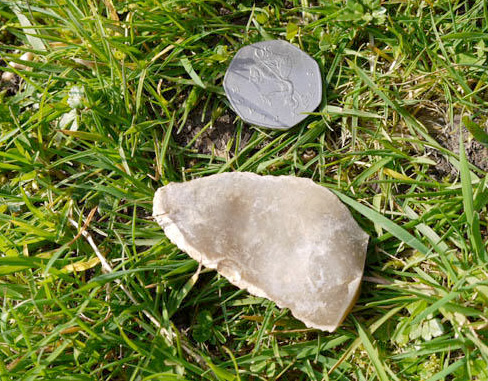
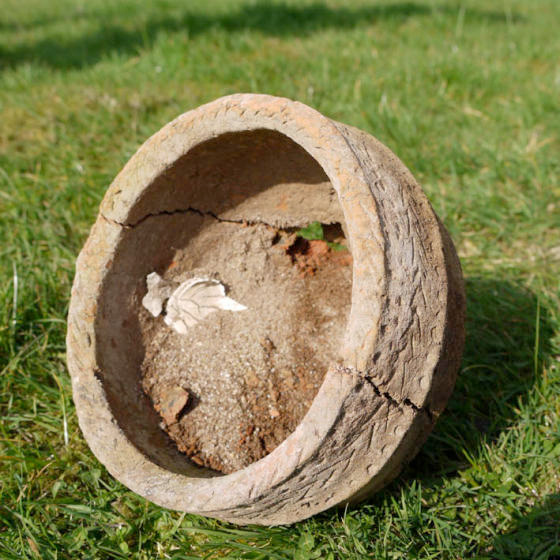
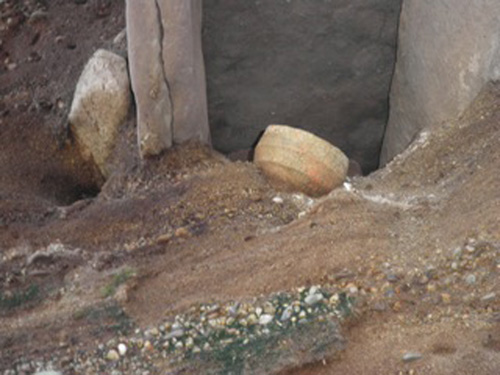
In mid-May, a land slip at Thompson's Sannox sand quarry uncovered an ancient kist when the ‘door’ stone fell away. Inside it were a burial urn or food vessel of a recognisable type and a flint knife.
Clearly, this was an important find. Historic Scotland were called in, but had to recover the pot from landowner Charles Fforde, who had taken charge of it, but in whose hands the ancient artefact had apparently broken in two. Historic Scotland removed the flint knife and most of the stones, but left one in the debris. A member of the press arrived and was told to leave by a Historic Scotland person. Then the mechanical digging went on.
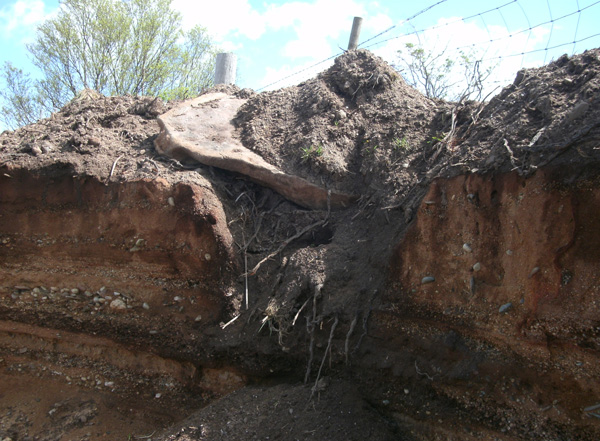
A photo ( above) taken by John Inglis of Corrie shows the debris after the destruction. He commented, ‘The whole thing is a scandal. Historic Scotland seem to have acted like high handed vandals. Why were locals and school children not brought to see the goods in situ?’ John wanted to know, too, why the press (not the Voice on this occasion) should have been prevented from photographing it. Most fundamentally, he asked, ‘Is it coming back to the island?’ And, of course, ‘How can we stop this happening again?’
Good questions.

Diary for The Voice for Arran – June


I celebrated the first wild roses with a silk painting, drawing the flowers and leaves with gold gutta before flooding the paint into the petals and leaves.
The verge plants I did by layering two or three colours of net in a ring as a background to the machine embroidery. I then tore the net to get a soft, random effect.
It is fascinating to look at verges in June as different groups of small plants colonise them depending upon light and location.
Click pictures above to see them in more detail.
Recognition for Ruth Mae
Most Arran people are familiar with the beautiful work of Ruth Mae, who shares a studio with furniture designer and builder, David Samuels, at Southbank Studio, East Bennan. Ruth produces exquisite turned bowls, some of them robust and others astonishingly delicate. Using holly wood for its dense, fine grain, she creates small bowls that are as fine as porcelain. Many of us also love her lively wire sculptures of horses – but it is her mastery of turning that has won her a place in a prestigious London show.
Ruth has been invited to contribute work to an exhibition at the Fleming Collection in Mayfair, known to cognoscenti as ‘The home of Scottish art in London.’ Under the title of ‘Made in Scotland’, the exhibition features work from more than thirty makers based in Scotland and includes jewellery, tapestry, engravings, glass and silver. Ruth is the only maker working in wood in the exhibition and she has been told that her work is attracting a lot of attention and some sales. She was delighted to see that the poster advertising the exhibition features some of her work.
In addition, Ruth has been invited to be one of six exhibitors from Scotland in an exhibition that is part of the North Yorkshire Open Studios programme this month. The show is to be titled ‘From the Edge - Crafts from Rural Scotland’ and will take place in Thirsk.

Here on Arran, Southbank Studio will be part of the Arran Open Studio Event in August, when visitors and residents can enjoy meeting artists in their working environment. See www.arranopenstudios.co.uk
Only two martins back
Like a renewed promise of faith, a pair of house martins returned on May 2nd. They perch on the telephone wire as before, to preen and chatter between swooping off to catch invisible things in the sky. After three weeks, they remain the only ones to return out of the dozen or more that left, so it must have been a bad migratory winter. Sadly, the eaves where they nested last year are being repainted at this minute, so they will have to find a new home. Fingers crossed for them
Ferry news
CalMac fare concession for Oban
Martin Dorchester, CalMac’s new Managing Director, has agreed to an improved fare structure for the ferry service between Oban and Mull. Up to now, a 5-day supersaver ticket has been available at a 30% reduction, but this is to be extended to a 9-day supersaver. If for Oban, why not for Brodick? Arran’s tourism needs all the help it can get.
Passenger-only Dunoon-Gourock route
News of this unpopular change was withheld until after the Scottish parliamentary elections in 2011, and Robert Wakeham, who runs a good website called ForArgyll, called it ‘a shoddy little political dodge dating from the political stone age.’
New ferry firm for Orkney and Shetland
Transport Scotland has appointed Serco Ltd as the preferred bidder for the NorthLink ferry routes between the Scottish mainland and the northern isles of Orkney and Shetland.
NorthLink is a subsidiary of the state-owned David MacBrayne Ltd, and has been leasing its ships from the Royal Bank of Scotland. NorthLink staff will transfer to Serco under TUPE (Transfer of Undertakings (Protection of Employment) regulations, so there will be no job losses, but NorthLink will be brought to an end or, as the press release picturesquely says, ‘be confined to limbo as an empty envelope.’
The Guardian once described Serco as ‘the biggest company you have never heard of’. Its fingers are everywhere. It runs trains in northern England and the London’s Docklands Light Railway, though its only shipping line so far is London’s Woolwich Ferry. It supports Royal Navy ships in Scotland and runs Shetland’s Scatsta Airport. Oh, and it also supplies speed cameras. CalMac may be feeling a little jittery over the appointment of this many-headed giant to a Scottish ferry service. Is this the thin end of a Government wedge designed to break up the existing, virtually nationalised services? A battle for the Clyde may well be in the offing.
Post Office puzzle
Alison Prince
I love the Post Office, I really do. It’s a treasure to all of us, and the Government is treating it extremely badly. But some of its little ways can be hard to understand. When a book posted by a friend had not turned up after ten days I phoned Brodick Sorting Office to ask if there was any way to trace it, and they said, ‘Anything undelivered goes to Ireland.’
After another week, a card arrived, saying an under-stamped package could not be delivered because there was money to pay on it. I logged in to Royal Mail with a password used before, but got spat out as an unknown person, so stuck the required stamps on the card and sent it back to Brodick. Brodick told Ireland. Ireland sent the book to Arran. Brodick delivered it. The package was by now fairly scuffed and battered, having been in transit for nearly a month.
The French farce process does not involve the sender, who is unaware that the package was under-stamped the package, so is likely to do it again. The addressee has to guess whether the article in Ireland is something wanted or not, but can only find out by paying a £1 handling fee as well as extra postage. Perhaps it’s an innovative way for the PO to make a bit more money. If the Government hadn’t stripped it of handling pensions and licenses, we’d all be happier.
Water can be wasted – that’s official
The south of Britain has been struggling with the worst drought for years. You’d think that, in such a crisis, the government would tell the water industry to pull its socks up, mend its pipes and stop wasting the precious liquid. But no such thing.
Ofwat, which sounds as silly as its rules appear to be, must know that millions of gallons are running to waste through the leaky pipes that Water Boards neglect to mend. Yet for the next three years, it is only asking the industry to reduce this profligacy by a paltry 1.5%. Caroline Lucas, the Green MP, rightly called the wastage ‘scandalous’ and pointed out that if such profligacy goes on, a shortage of water will settle in as the normal state of things. Meanwhile, the Water Market Reports for May 2012 are abysmal. They declare a total water efficiency of 30%. In any decent school, this is a failure. Black Mark. Must Do Better
Libraries ‘must adapt’ – but how?
Research from the Carnegie UK Trust shows that Scots love their libraries. More than three-quarters of us believe them to be very important or even ‘essential’ to our community. But a Carnegie report called ‘A New Chapter – Public Library Services in the 21st Century’, warns that if libraries are to survive they must ‘pioneer new ways of providing services.’
Nobody seems to know how this pioneering is supposed to happen. Martyn Evans, chief executive of the Carnegie UK Trust, said, ‘It's clear that people in Scotland still love their libraries’ – but then retreated into socio-babble. ‘Library services need to develop innovative ways of attracting visitors and providing a new range of relevant services, along with a re-think about how the buildings are used as community hubs …demonstrate the impact they have on a wide range of social indicators …’ The eyelids grow heavy and fall shut.
Across Scotland, libraries already provide Internet access, author talks and countless activities. They have more than one million regular users, who borrow books, audio books, CDs and DVDs. Annie Mauger, chief executive of the Chartered Institute, addressed the ‘series of challenges and opportunities’ with an impeccable probity that overlay a touch of desperation. ‘We welcome the contribution the Carnegie UK Trust can make to developing this vision as well as promoting forward thinking, and supporting creative and innovative practice.’
There was no mention of what actually might be done. Could we suggest that ceasing to cut the book purchase fund might help?
The nuts and bolts of real time
Clocks say different times round the world, because day and night shifts according to where you are on the globe, right? But how about a work of performance art that gives you the real time for your computer, right now, regardless of where you are – but made out of big planks of wood? See http://esquire.ru/clock and all will be explained. We found the video on a Russian site, and the English explanation was a bit baggy-sleeved, but here’s the gist of it.
The wacky idea came from Mark Formanek, who wound it up, so to speak, and set it going in the Berlin Sculpture Park. He had financial support from Datenstrudel, which sounds like something you enjoy with a cup of coffee, and created digital ‘clocks’ that are 4 metres tall and 12 metres from side to side, and change every minute.
The physical task of doing this took 70 workers, using 30 planks equipped with some quick way to fix them together. Over 24 hours of cunningly edited work, they swarmed up ladders to construct huge digital time-figures, say 9.26 or 14.52, from these planks. They made a total of 1611 changes, working continuously throughout the day. The video of the process is synchronized with the time at which your computer is configured, so for three minutes you’ll see the figures being changed to provide the precise time for your computer, wherever you happen to be. Ingenious, and very funny.
http://esquire.ru/clock
Teachers pack it in
Alison Prince
Last weekend, a teacher from Germany came to stay – or, more exactly, an ex-teacher. She was still gasping with relief at her escape from the system, the testing, the constant scrutiny. It seems to be the same in all the big capitalist countries. Our own teachers yearn for the freedom to enthuse and inspire children through whatever start-points present themselves, and a Voice reader who works as a life-style advisor says that a majority of his clients are frustrated and unhappy teachers who feel they must get out, regardless of the resulting insecurity. In America, the whole education set-up seems to be shaking itself apart.
What is the basis for these observations? Conversations with real people and, further afield, the common ground of the Internet. Last week Dana Goldstein of The Nation quoted a survey of teachers in the US, released in March by MetLife, which showed that nearly a third of American school teachers are considering leaving their jobs. Like their colleagues in our own country, they are depressed by the increasing reliance on standardised tests to measure student learning. They are angry, too, about the austerity cuts that have reduced the working week of schools in 292 districts to four days. In California nearly half of schools have cut art, music and drama programmes since the recession, and the same number have laid off school psychologists, nurses and guidance counsellors. Across New York City, 700 school support staff, who often work with special-needs kids, have been axed
American students, meanwhile, are coping with a crippling debt-load. It was reported last week on the US website, Truthout, that the amount owed by students is greater now than the entire owings due on credit cards.
In Philadelphia, there’s a plan to close more than 60 schools in the next five years and people are up in arms about it. Even Canada, which usually seems a civilised place, is seeing mass protest. A students’ strike in Québec has turned into a Citizens' Revolt, exacerbated by the proposed Bill 78 that will make any gathering of over 50 protesters illegal. On May 22, nearly half a million people marched in the streets of Montreal, resulting in ‘kettling’ and heavy fines – but the protest has not stopped. A report in the Truthout website speaks of nightly protests in Montreal, countered by riot police armed with high-pressure water guns and rubber bullets. Despite all opposition, the students are fighting on for equal and open access to higher education
Finland, at the opposite extreme, comes out top of all studies on effective education, and takes a radically different approach. Gentle, child-centred and creative, their schools are virtually test-free. It’s not the statistics they bother about, but the children.
Time for some intensive learning by the top class of Governmental high heid yins, perhaps.
New supply boat launched
John Kinsman
A work boat named Helen Burnie has been built by the MacDuff Shipyard in MacDuff Harbour and is now on the way to Oban, after completing sea trails and tests. 27.75 metres long, the vessel was constructed for Inverlussa Marine Services, based on the Isle of Mull. It is designed as a support boat for a wide range of projects, including renewable energy, diving and surveying, and will start a contract in Shetland delivering feed to fish farms.
Free insulation offer
If your house is too hot in the summer and too cold in the winter, it needs better insulation. Help for this is at hand, as the Scottish Government has funded a free Home Insulation scheme. Angus Bodie, North Ayrshire Council’s Head of Infrastructure and Design, says the free insulation is open to all North Ayrshire residents on a first-come, first-served basis. He adds that households can save around £300 per year on heating bills by installing cavity wall and loft insulation.
Home owners, tenants and landlords are all eligible to apply. Just call 08000 198 220. A real human being will answer – we tried it, to make sure
RECIPE OF THE MONTH
TRADITIONAL CORNISH PASTY.
INGREDIENTS.
2 1/8 cups all purpose flour
1/4 teaspoon salt
1 teaspoon baking powder
1/2 cup butter, diced
1/2 cup water
1 1/4 pounds rump roast, cubed
1 onion, chopped
2 potatoes, peeled and diced
2 small carrots
salt and pepper to taste
2 tablespoons milk
METHOD.
1. In a small saucepan, cover carrots with water. Bring water to a boil and cook until tender
about 10 minutes. Let cool and slice. Sift flour, salt, and baking powder together in a bowl.
Add butter, and rub to the consistency of coarse crumbs. Mix in water. If dough is sticky ,
add more flour.
2. Roll dough out until about 1/4 inch thick. Cut out six circles, each about 5 inches round. Do not stretch the dough.
3. Mix meat and vegetables together, and salt and pepper to taste. Cover half of each pasty base with the filling. Moisten pastry edges, fold pastry over filling. Press edges together
with a fork. Transfer raw pasties to a baking sheet, brush tops with milk, and make a small
slit in each top to allow steam out.
4. Bake at 450 degrees F(230 degrees C ) for 10 minutes. Turn oven down to 350 degrees F
(175 degreesC ), and bake for 35 minutes.

Award Winning Play for Arran
Nutshell Theatre Company is no stranger to our island. As far back as 2007 the company began working with the winners of the McLellan Play competition and with local young people who produced highly entertaining shows both last year and the year before as part of the McLellan Festival. So, it is a delight that, following its highly acclaimed premiere at the Edinburgh Festival Fringe in 2011, Nutshell is bringing their award winning production “Allotment” to Arran on Saturday 9th June.
This is a play with a difference – set in an allotment, hence the name, and performed outside, closely bound sisters Maddy and Dora do battle over flying teddies, stubborn weeds and the eternal question – do flowers matter more than vegetables? This play is funny, touching and poignant and the reviews including The Telegraph, The Guardian and The Scotsman have been raves, particularly praising the plot, acting and directing: “…….a sensual experience for the audience” (The Telegraph), “….directed with loving detail by Kate Nelson.” (The List), and “Both performers enthral… Wonderfully alive, this is well worth braving the elements to experience” (The Guardian)
Because the play is set in a garden – Carlo, between Brodick Castle and Corrie, next door to Pirate’s Cove - it only accommodates 50 people so don’t be left out! Tickets priced £8.00, (£7.00 concession – pensioners, unemployed, students and children),
are available at the Book and Card Shop or at the gate.
The entrance ticket also entitles the audience to a cuppa and a homemade scone and is performed at afternoon tea time 3.00pm – 4.00pm!
Crossword
Embroidery workshop
There is a lot more to embroidery than tray cloths and laze-daisy stitch, as many of Arran’s skilled embroidery experts know well. Whether working by hand or using a machine, stitchery can be a form of freehand drawing, and appliqué can use fabrics like a wash of watercolour. Sue Lancaster is running a workshop on embroidery for Arran Visual Arts this weekend, 2nd and 3rd of June, at the Rangers Centre in Brodick Castle grounds. Short notice, as we publish on the first day of every month, but if you are interested, contact Alison Barr on 01770 303 607.
Chicken Passanda
We are lucky that Richard Attkins, a Member of the Master Chefs of Great Britain, is sending us a recipe for inclusion in the Voice every month. You can sample Richard’s menus at Arran on a Plate, in Brodick.
Passanda is a popular North Indian and Pakistani dish, derived from a meal served in the Court of the Moghul Emperors. The word is a variation on the Urdu word "pasande," or "the favorite one," which refers to the prime cut of meat traditionally used within.
The quantities shown below will make four portions of this rich, mild curry.
Ingredients
4 Chicken Breasts
2 large Onions
Half a tin of Coconut Milk
75g Butter
125ml Cream
65g Ground Almonds
65g Sultanas
1 teaspoon Chilli Powder
1 dessert spoon Garam Masala
1 dessert spoon Ground Coriander
Method
Chop your onions roughly and sauté in a little oil and the butter in a large pot. Dice the chicken into bite-sized chunks, add to the pot and toss in the hot butter. Once chicken is sealed on all sides add the chilli, garam masala and coriander. Mix well. Cook for a couple of minutes then stir in the cream. Cook for a few minutes more to thicken, then add the coconut milk. Add a fair bit of salt, the ground almonds and the sultanas. Stir and simmer over a low heat for ten minutes stirring frequently to prevent burning. Add more salt if required. Serve with steamed Basmati rice and freshly cooked poppadoms.